


Proteasome function is required for biological timing throughout the twenty-four hour cycle
- PMID: 21530263
- PMCID: PMC3102177
- DOI: 10.1016/j.cub.2011.03.060
Proteasome function is required for biological timing throughout the twenty-four hour cycle
Abstract
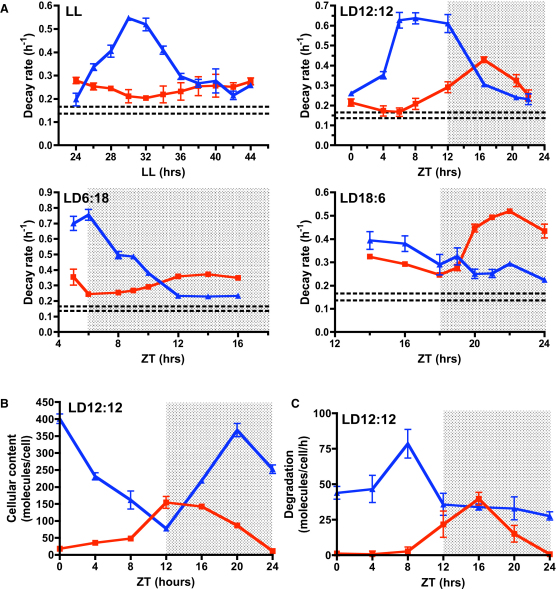
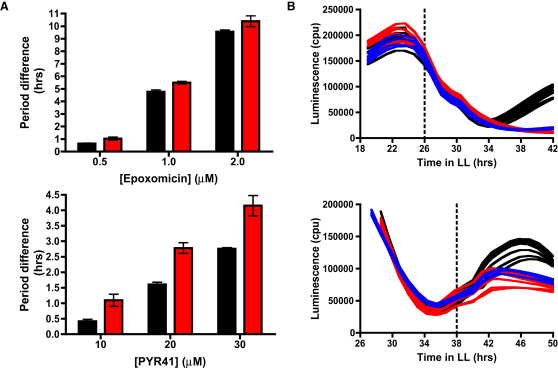
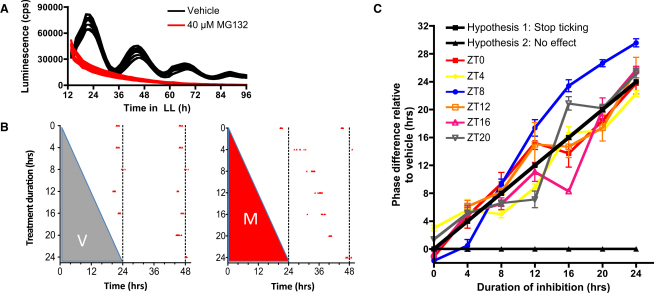
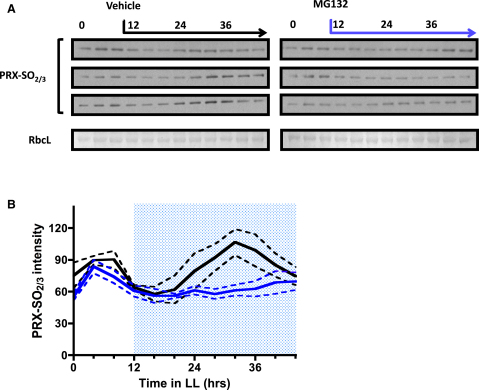
Circadian clocks were, until recently, seen as a consequence of rhythmic transcription of clock components, directed by transcriptional/translational feedback loops (TTFLs). Oscillations of protein modification were then discovered in cyanobacteria. Canonical posttranslational signaling processes have known importance for clocks across taxa. More recently, evidence from the unicellular eukaryote Ostreococcus tauri revealed a transcription-independent, rhythmic protein modification shared in anucleate human cells. In this study, the Ostreococcus system reveals a central role for targeted protein degradation in the mechanism of circadian timing. The Ostreococcus clockwork contains a TTFL involving the morning-expressed CCA1 and evening-expressed TOC1 proteins. Cellular CCA1 and TOC1 protein content and degradation rates are analyzed qualitatively and quantitatively using luciferase reporter fusion proteins. CCA1 protein degradation rates, measured in high time resolution, feature a sharp clock-regulated peak under constant conditions. TOC1 degradation peaks in response to darkness. Targeted protein degradation, unlike transcription and translation, is shown to be essential to sustain TTFL rhythmicity throughout the circadian cycle. Although proteasomal degradation is not necessary for sustained posttranslational oscillations in transcriptionally inactive cells, TTFL and posttranslational oscillators are normally coupled, and proteasome function is crucial to sustain both.
Copyright © 2011 Elsevier Ltd. All rights reserved.
Figures
Comment in
-
Circadian rhythms: lost in post-translation.Curr Biol. 2011 May 24;21(10):R400-2. doi: 10.1016/j.cub.2011.04.024. Curr Biol. 2011. PMID: 21601802
References
-
- Nakajima M., Imai K., Ito H., Nishiwaki T., Murayama Y., Iwasaki H., Oyama T., Kondo T. Reconstitution of circadian oscillation of cyanobacterial KaiC phosphorylation in vitro. Science. 2005;308:414–415. - PubMed
-
- Tomita J., Nakajima M., Kondo T., Iwasaki H. No transcription-translation feedback in circadian rhythm of KaiC phosphorylation. Science. 2005;307:251–254. - PubMed
-
- Godinho S.I., Maywood E.S., Shaw L., Tucci V., Barnard A.R., Busino L., Pagano M., Kendall R., Quwailid M.M., Romero M.R. The after-hours mutant reveals a role for Fbxl3 in determining mammalian circadian period. Science. 2007;316:897–900. - PubMed
-
- Hastings M.H., Maywood E.S., O'Neill J.S. Cellular circadian pacemaking and the role of cytosolic rhythms. Curr. Biol. 2008;18:R805–R815. - PubMed
Publication types
MeSH terms
Substances
Grants and funding
LinkOut - more resources
Full Text Sources
