Review
. 2011 Dec;1813(12):2176-90.
doi: 10.1016/j.bbamcr.2011.03.019. Epub 2011 Apr 16.

Regulation of nucleocytoplasmic trafficking of viral proteins: an integral role in pathogenesis?

Affiliations
Review

Regulation of nucleocytoplasmic trafficking of viral proteins: an integral role in pathogenesis?

Alex J Fulcher et al. Biochim Biophys Acta. 2011 Dec.

Abstract

Signal-dependent targeting of proteins into and out of the nucleus is mediated by members of the importin (IMP) family of transport receptors, which recognise targeting signals within a cargo protein and mediate passage through the nuclear envelope-embedded nuclear pore complexes. Regulation of this process is paramount to processes such as cell division and differentiation, but is also critically important for viral replication and pathogenesis; phosphorylation appears to play a major role in regulating viral protein nucleocytoplasmic trafficking, along with other posttranslational modifications. This review focuses on viral proteins that utilise the host cell IMP machinery in order to traffic into/out of the nucleus, and in particular those where trafficking is critical to viral replication and/or pathogenesis, such as simian virus SV40 large tumour antigen (T-ag), human papilloma virus E1 protein, human cytomegalovirus processivity factor ppUL44, and various gene products from RNA viruses such as Rabies. Understanding of the mechanisms regulating viral protein nucleocytoplasmic trafficking is paramount to the future development of urgently needed specific and effective anti-viral therapeutics. This article was originally intended for the special issue "Regulation of Signaling and Cellular Fate through Modulation of Nuclear Protein Import". The Publisher apologizes for any inconvenience caused.


Figures

Fig. 1
Fig. 1
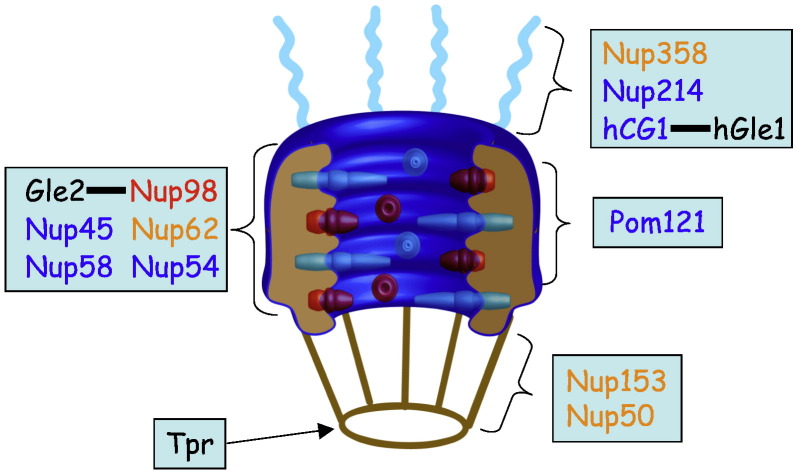
Schematic representation of the NPC highlighting vertebrate FG-Nup subcomplexes (modified from [9]). Each box denotes a biochemically or functionally defined subcomplex, where “FG-Nups” containing predominantly FG, GLFG, and FXFG repeats are highlighted in blue, red and orange texts respectively, with selected structural, non-FG-Nups in black.
Fig. 2
Fig. 2
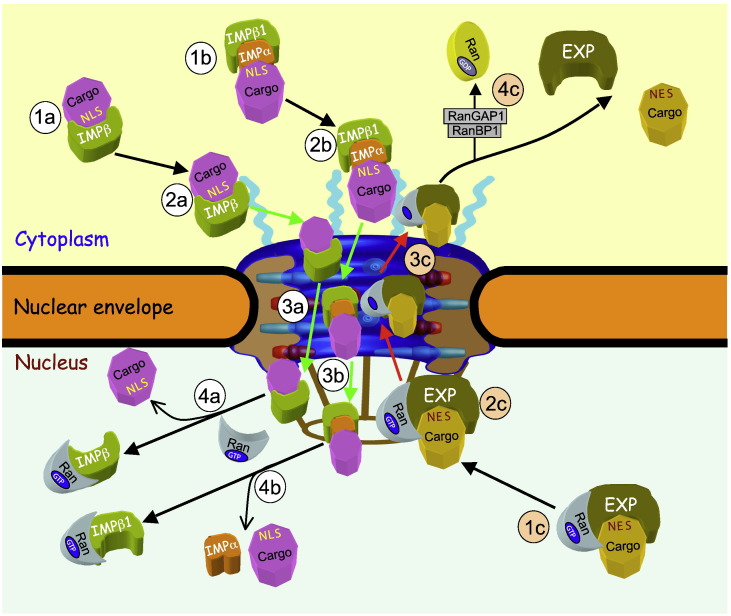
Schematic representation of IMP/EXP dependent nucleocytoplasmic transport. Transport of NLS-containing cargo proteins from the cytoplasm to the nucleus is either mediated by IMPβs alone (1a), or the IMPα/β1 heterodimer (1b), where the IMPα adaptor links the cargo protein to IMPβ1. The IMP/cargo complexes then dock onto the cytoplasmic side of the NPC (2a and 2b), followed by passage to the nuclear side of the NPC, through sequential, transient interactions of the IMPβ with the FG-Nups that make up the NPC (3a and 3b). Once within the nucleus, RanGTP binding to IMPβ disassociates the complex (4a and 4b) to release the NLS-containing cargo into the nucleus to perform its function. In analogous fashion to nuclear import, transport of NES-containing cargo proteins (1c) from the nucleus to the cytoplasm is mediated by EXPs which recognise the NES, dependent on RanGTP binding to the EXP. The EXP/RanGTP/cargo complex docks at the nuclear side of the NPC (2c), before passing to the cytoplasmic side of NPC through sequential, transient interactions of the EXP with the FG-Nups (3c). Once within the cytoplasm, RanGAP1 (RanGTPase-activating protein 1) and RanBP1 facilitate hydrolysis of GTP to GDP by Ran (4c), thereby dissociating cargo from the EXP.
Fig. 3
Fig. 3
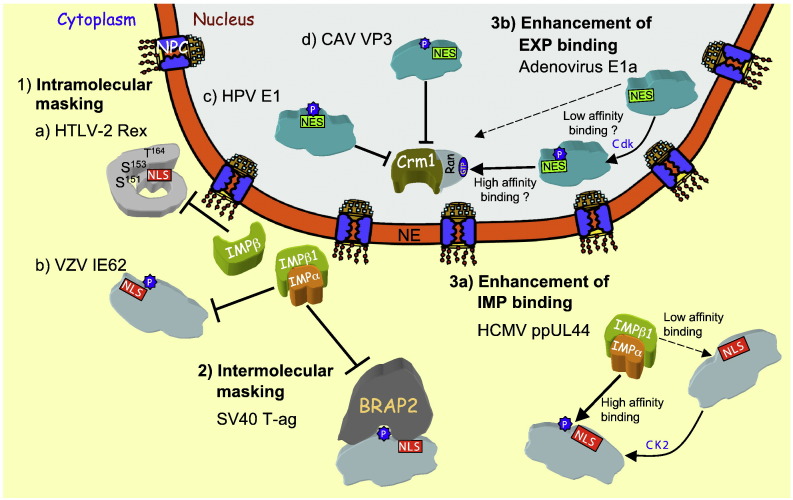
Schematic representation of the mechanisms of regulation of IMP/EXP-dependent nuclear transport, as illustrated by examples of viral proteins. In intramolecular masking (1) IMPs/EXPs are prevented from binding the NLS/NES of the cargo by masking of the NLS/NES by sequences within the same protein. This is exemplified by (a) the human T-cell leukaemia virus type 2 (HTLV-2) Rex protein in its inactive p24 form, where specific phosphorylation by CK1/GSK3 at T164 and subsequent phosphorylation at S151/153 are required for IMPβ recognition of the NLS, and (b) the VZV IE62, where phosphorylation at S686 by the VZV kinase ORF66 inhibits nuclear import by impairing recognition by IMPα/β1 . Examples of intramolecular masking in nuclear export are shown for (c) HPV E1, where Cdk mediated phosphorylation of S107 prevents Crm1 binding, resulting in nuclear retention , , and (d) CAV VP3, where phosphorylation of T108 specifically in cancer cells prevents nuclear export , . In intermolecular masking (2), NLSs/NESs are masked from IMPs/EXPs binding by a heterologous protein/molecule. An example in the case of nuclear import is the cytoplasmic protein BRAP2 which, dependent on Cdk phosphorylation of T124, prevents recognition by IMPα/β1 of the SV40 T-ag NLS, a similar mechanism dependent on protein kinase C phosphorylation of T427 applies to HCMV ppUL44 protein (not shown) . Enhanced nuclear import/export can occur through posttranslational modification enhancing NLS/NES recognition by IMP/EXP. An example (3a) is the increase in the affinity of binding of IMPα/β1 to the NLSs of HCMV ppUL44 and SV40 T-ag (not shown) by CK2 phosphorylation (of S413 and S111/112 respectively) leading to enhanced nuclear import , , . In the case of nuclear export (3b), Cdk1/Cdk2 mediated phosphorylation of S89 enhances recognition of the Adenovirus type 5 E1a NES by Crm1, leading to more efficient nuclear export .
Fig. 4
Fig. 4
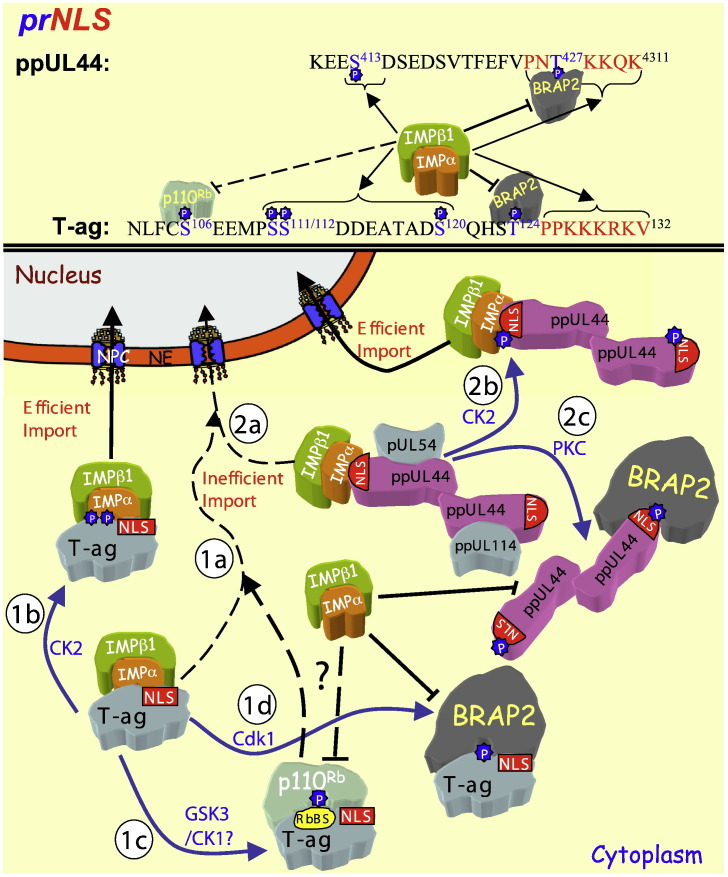
The regulation of viral protein nuclear import through phosphorylation near the NLS. The phosphorylation regulated NLSs (prNLSs) of SV40 T-ag and ppUL44 are shown (top — single letter amino acid code) with the regulatory phosphorylation sites (blue) and the NLS (red) highlighted, as well as the binding partners recognising them when phosphorylated (“P”). The T-ag NLS alone mediates IMPα/β1-mediated nuclear import, relatively inefficiently (black dotted arrow — 1a), but upon phosphorylation at serine111/112 by CK2 (blue arrow), IMPα/β1 is able to bind the T-ag NLS c. 50-fold better, to facilitate subsequent efficient nuclear import (1b). Phosphorylation at serine106 by GSK3/CK1 (blue arrow) allows p110Rb to bind T-ag at the RbBS, which leads to cytoplasmic retention and decreased nuclear import (1c). Phosphorylation at threonine124 by Cdk1 (blue arrow) allows BRAP2 to bind the T-ag NLS to prevent IMPα/β1 binding through intermolecular masking, and sequester T-ag in the cytoplasm (1d). (2a) HCMV ppUL44 IMPα/β1-mediated NLS-dependent nuclear import is inefficient (black dotted arrow) but upon phosphorylation at serine413 by CK2 (blue arrow), IMPα/β1 is able to bind the ppUL44 NLS with greater affinity to facilitate efficient nuclear import (2b). Phosphorylation at Thr427 by PK-C (blue arrow), enhances binding of ppUL44 to BRAP2 to prevent IMPα/β1 binding through intermolecular masking, and sequester ppUL44 in the cytoplasm and prevent nuclear import. Since ppUL44 may play a role in piggy-backing the HCMV proteins pUL54 and ppUL114 proteins into the nucleus early in infection, the various regulating mechanisms may apply to nuclear import of multiple HCMV proteins.
Fig. 5
Fig. 5
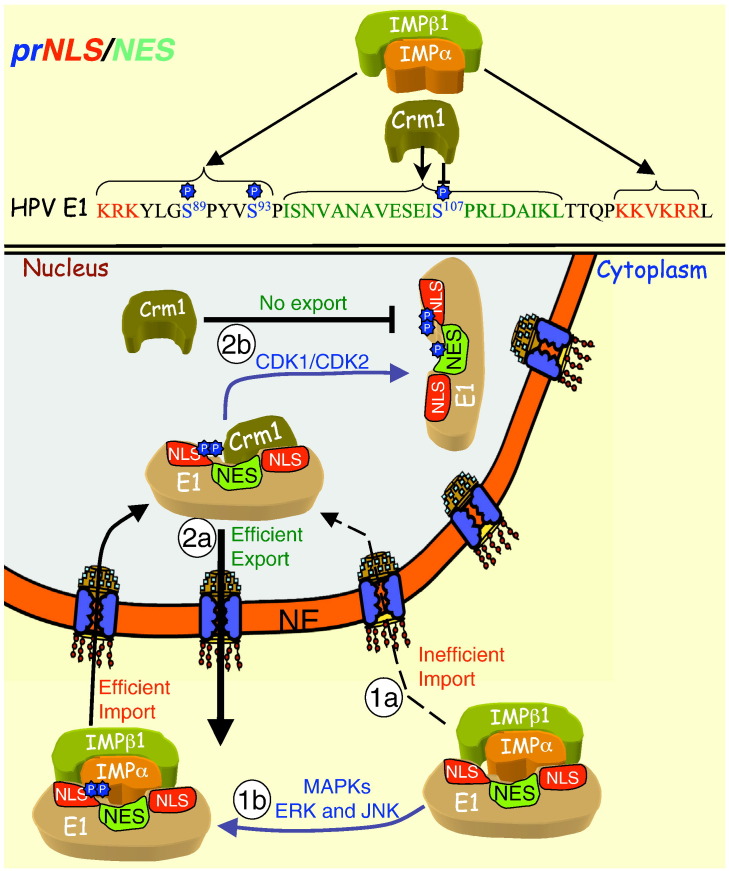
Cell cycle-dependent regulation of nuclear localisation for HPV E1 by cellular kinases. The prNLS of HPV E1 is shown (top), with the regulatory phosphorylation sites (blue), NLS (red) and NES (green), highlighted, as well as the binding partners that recognise them according to phosphorylation state (“P” indicates phosphorylation). The E1 NLS mediates IMPα/β1-mediated nuclear import inefficiently (black dotted arrow) (1a) but upon phosphorylation of S89 and S93 by ERK (and/or JNK for S89), IMPα/β1 is able to bind the NLS more strongly to facilitate efficient nuclear import (1b). Once in the nucleus E1 is quickly exported back to the cytoplasm, through Crm1 (2a). Nuclear export is prevented by the nuclear kinases Cdk1/Cdk2 (2b), present during S and G2 phases of cell cycle, which phosphorylate S107 to prevent Crm1 binding to the NES, leading to strong nuclear accumulation/nuclear retention.
Fig. 6
Fig. 6
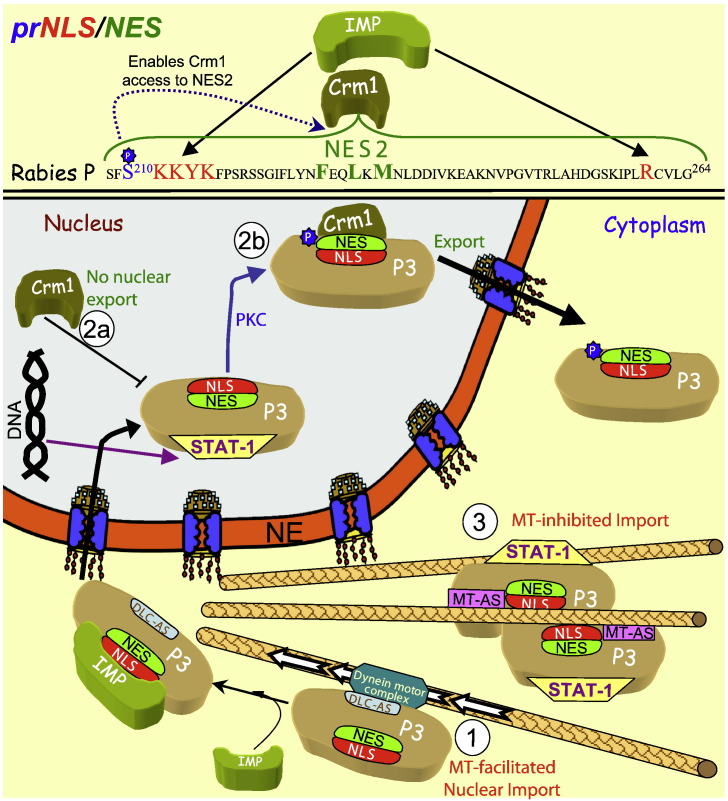
Regulation of nucleocytoplasmic shuttling of RV P3 protein to inhibit activity of the STAT-1 transcription factor in cytoplasmic and nuclear compartments. The prNLS/NES of RPP is shown (top), with the regulatory phosphorylation site (blue), NLS (red) and NES (green), highlighted, as well as the binding partners recognising them according to phosphorylation state (“P” indicating phosphorylation). In the absence of phosphorylation, P3 localises efficiently in the nucleus (1) through its NLS and the dynein light chain association sequence (DLC-AS), which confers binding to the microtubule (MT) motor dynein that acts to enhance IMP facilitated transport to the nucleus, where its role is to prevent DNA binding activity by the STAT-1 signalling molecule. P3 remains in the nucleus because NES2 is inaccessible (2a) until PKC phosphorylation of S210 induces conformation changes to render NES2 accessible to Crm1 (and mask the NLS) to permit Crm1 recognition and nuclear export (2b). Upon oligomerisation and binding to MTs through a MT-associating sequence (MT-AS) distinct from the DLC-AS, P3 remains cytoplasmic, acting to retain STAT-1 in the cytoplasm bound to MTs (3) and prevent its action in the anti-viral response.

References

    1. Mosammaparast N., Pemberton L.F. Karyopherins: from nuclear-transport mediators to nuclear-function regulators. Trends Cell Biol. 2004;14:547–556. - PubMed
    1. Suntharalingam M., Wente S.R. Peering through the pore: nuclear pore complex structure, assembly, and function. Dev. Cell. 2003;4:775–789. - PubMed
    1. Gorlich D., Kutay U. Transport between the cell nucleus and the cytoplasm. Annu. Rev. Cell Dev. Biol. 1999;15:607–660. - PubMed
    1. Jans D.A., Xiao C.Y., Lam M.H. Nuclear targeting signal recognition: a key control point in nuclear transport? Bioessays. 2000;22:532–544. - PubMed
    1. Brohawn S.G., Partridge J.R., Whittle J.R., Schwartz T.U. The nuclear pore complex has entered the atomic age. Structure. 2009;17:1156–1168. - PMC - PubMed