


Relationship of clinic-based gait speed measurement to limitations in community-based activities in older adults
- PMID: 21530734
- PMCID: PMC3086725
- DOI: 10.1016/j.apmr.2010.12.030
Relationship of clinic-based gait speed measurement to limitations in community-based activities in older adults
Abstract
Objective: To examine the ability of clinic-based assessments of gait speed to capture limitations in a broad range of home- and community-based activities.
Design: Cross-sectional study.
Setting: Community-based aging cohort study.
Participants: Community-residing subjects (N=655; 61% women; age ≥70y; mean, 80.4y).
Interventions: None.
Main outcome measures: Limitations on 3 gait-related activities of daily living (walking inside home, climbing up and down stairs) and 6 motor-based but gait-independent activities (bathing, dressing, getting up from a chair, toileting, shopping, using public transportation).
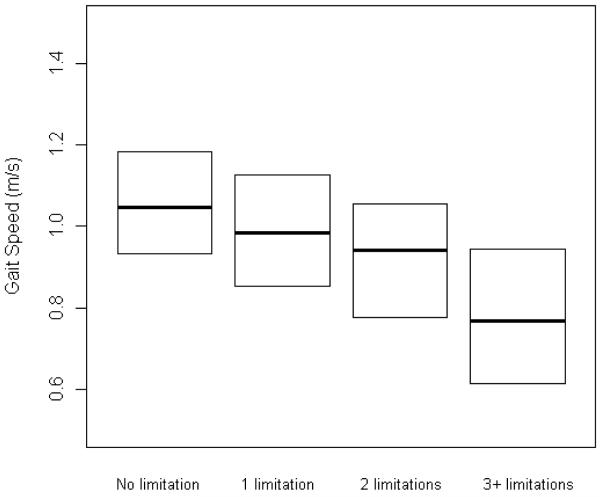
Results: Gait speed was associated with the presence of self-reported difficulty for all 3 home-based activities that were directly gait related and 5 of 6 motor-based activities. Gait speed of 1m/s or less was associated with increased risk for limitations on at least 1 of the 9 selected activities (odds ratio, 3.21; 95% confidence interval, 2.24-4.58; P<.001).
Conclusions: Gait speed measured in clinical settings has ecologic validity as a clinical marker of functional status in older adults for use in clinical and research settings.
Copyright © 2011 American Congress of Rehabilitation Medicine. Published by Elsevier Inc. All rights reserved.
Figures
References
-
- Abellan van Kan G, Rolland Y, Andrieu S, et al. An International Academy on Nutrition and Aging (IANA) Task Force Gait Speed at Usual Pace as a Predictor of Adverse Outcomes in Community-Dwelling Older People. J Nutr Health Aging. 2009;13:881–9. - PubMed
-
- Fried LP, Tangen CM, Walston J, et al. Frailty in older adults: evidence for a phenotype. J Gerontol A Biol Sci Med Sci. 2001;56:M146–56. - PubMed
-
- Gill TM, Allore HG, Holford TR, Guo Z. Hospitalization, restricted activity, and the development of disability among older persons. Jama. 2004;292:2115–24. - PubMed
Publication types
MeSH terms
Grants and funding
LinkOut - more resources
Full Text Sources
