


Recent insights into the genetics of inflammatory bowel disease
- PMID: 21530736
- PMCID: PMC4947143
- DOI: 10.1053/j.gastro.2011.02.046
Recent insights into the genetics of inflammatory bowel disease
Abstract
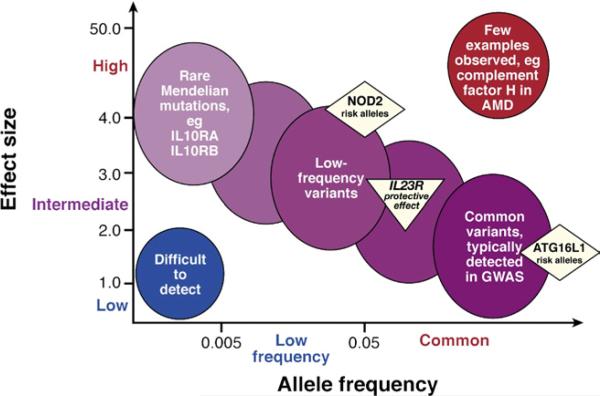
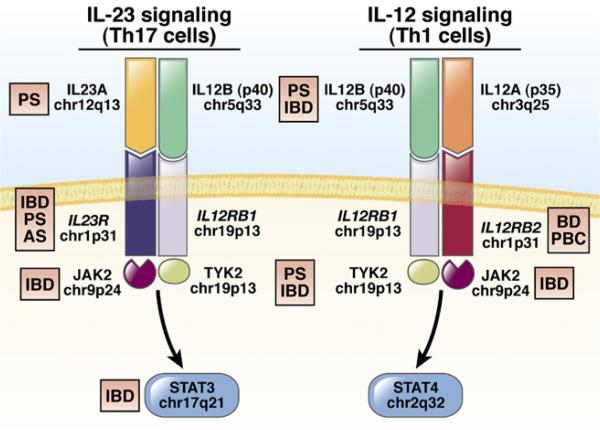
Inflammatory bowel diseases (IBDs) are complex, multifactorial disorders that comprise Crohn's disease (CD) and ulcerative colitis (UC). Genome-wide association studies have identified approximately 100 loci that are significantly associated with IBD. These loci implicate a diverse array of genes and pathophysiologic mechanisms, including microbe recognition, lymphocyte activation, cytokine signaling, and intestinal epithelial defense. Consistent with epidemiologic predictions, many IBD-associated loci demonstrate genome-wide significant associations to both CD and UC, notably, genes whose products function in the interleukin-23 pathway, and transcription factors, including NK2 transcription factor related, locus 3 (NKX2-3), SMAD3, STAT3, ZMIZ1, and c-REL. Although CD and UC are both associated with genomic regions that implicate products of genes involved in leukocyte trafficking, there is evidence for association patterns that are distinct between CD and UC. CD-predominant associations include NOD2 and genes that regulate autophagy. In UC, the predominant association signal is on chromosome 6p21, in the major histocompatibility complex region, near HLA class II genes. UC-predominant loci have also implicated genes mediating epithelial defense function. There is a striking overlap of loci between diseases, which could provide comparative insight into mechanisms of disease pathogenesis. Genes that encode factors that function in the interleukin-23 pathway have been associated with a number of chronic inflammatory diseases, notably psoriasis and ankylosing spondylitis. Distinct genetic associations indicate that the colitis associated with primary sclerosing cholangitis is pathophysiologically distinct from UC that is not associated with primary sclerosing cholangitis. As many as 14 susceptibility loci are shared between IBD and celiac disease, indicating significant overlap in pathophysiology. Future genetic studies will be directed toward identifying uncommon variations with potentially greater statistical effects, defining population differences, and more completely accounting for familial transmission of disease.
Copyright © 2011 AGA Institute. Published by Elsevier Inc. All rights reserved.
Figures
References
-
- Orholm M, Munkholm P, Langholz E, et al. Familial occurrence of inflammatory bowel disease. N Engl J Med. 1991;324:84–88. - PubMed
-
- Lowe AM, Roy PO, B-Poulin M, et al. Epidemiology of Crohn's disease in Quebec, Canada. Inflamm Bowel Dis. 2009;15:429–435. - PubMed
-
- Brant SR. Update on the heritability of inflammatory bowel disease: the importance of twin studies. Inflamm Bowel Dis. 2011;17:1–5. - PubMed
-
- Glocker EO, Frede N, Perro M, et al. Infant colitis—it's in the genes. Lancet. 376:1272. - PubMed
Supplementary References
-
- Cho JH. The genetics and immunopathogenesis of inflammatory bowel disease. Nat Rev Immunol. 2008;8:458–466. - PubMed
Publication types
MeSH terms
Substances
Grants and funding
- R01 DK083553/DK/NIDDK NIH HHS/United States
- R01 DK055731/DK/NIDDK NIH HHS/United States
- R01 DK83553/DK/NIDDK NIH HHS/United States
- KL2 RR024138/RR/NCRR NIH HHS/United States
- U01 DK062429/DK/NIDDK NIH HHS/United States
- M01 RR000055/RR/NCRR NIH HHS/United States
- RC1 DK086800/DK/NIDDK NIH HHS/United States
- P30 DK034989/DK/NIDDK NIH HHS/United States
- KL2RR024138/RR/NCRR NIH HHS/United States
- U01 DK062431/DK/NIDDK NIH HHS/United States
- U01 DK062422/DK/NIDDK NIH HHS/United States
- DK034989/DK/NIDDK NIH HHS/United States
- U19 A1082713/PHS HHS/United States
- F32 DK008943/DK/NIDDK NIH HHS/United States
- R01 DK092235/DK/NIDDK NIH HHS/United States
- R01 GM059507/GM/NIGMS NIH HHS/United States
LinkOut - more resources
Full Text Sources
Other Literature Sources
Medical
Research Materials
Miscellaneous
