Review
. 2011 May;140(6):1748-55.
doi: 10.1053/j.gastro.2011.01.056.

Hypoxia and metabolic factors that influence inflammatory bowel disease pathogenesis

Affiliations
Review

Hypoxia and metabolic factors that influence inflammatory bowel disease pathogenesis

Louise E Glover et al. Gastroenterology. 2011 May.

Abstract

The gastrointestinal epithelium is anatomically positioned to provide a selective barrier between the anaerobic lumen and lamina propria, which has a high rate of metabolism. Supported by a complex vasculature, this important barrier is affected by reduced blood flow and resultant tissue hypoxia, particularly during the severe metabolic shifts associated with active inflammation in individuals with inflammatory bowel disease. Activation of hypoxia-inducible factor (HIF) under these conditions promotes resolution of inflammation in mouse models of disease. Protective influences of HIF are attributed, in part, to the complex regulation of barrier protection with the intestinal mucosa. Reagents that activate HIF, via inhibition of the prolyl hydroxylase enzymes, might be developed to induce hypoxia-mediated resolution in patients with intestinal mucosal inflammatory disease.


Conflict of interest statement

The authors declare no financial interests in any of the work submitted here.

Figures
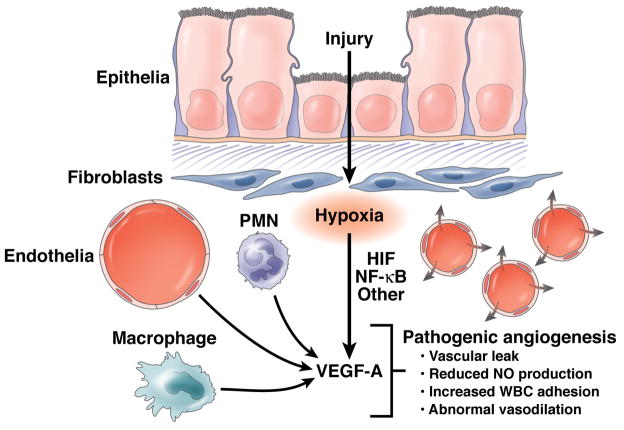
Figure 1
Figure 1. Contributions of inflammation and hypoxia to angiogenesis
Inflammation and hypoxia each contribute to angiogenesis during pathogenesis of IBD, partly by induction of VEGF-A expression in multiple cell types that include submucosal fibroblasts, macrophages, neutrophils (PMNs), and endothelial cells. VEGF-A-induced angiogenesis is likely to be pathogenic and result in abnormal vessel formation and poorly functioning vasculature.
Figure 2
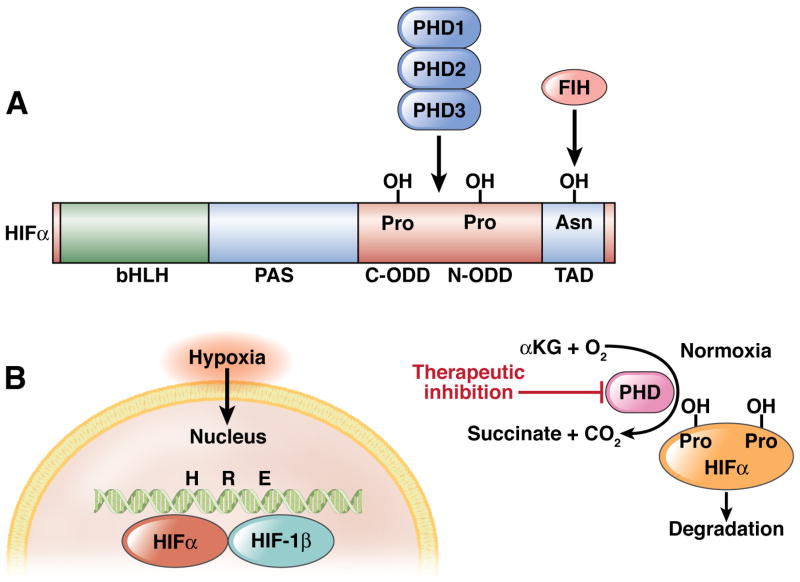
Figure 2. Functional features of hypoxia-inducible factor (HIF) and mechanism of HIF stabilization
HIF is hydroxylated by the combination of α–ketoglutarate (αKG), molecular oxygen (O2), and the PHD enzymes in normoxic conditions. When O2 becomes limiting (hypoxia), the HIF-1 α subunit is stabilized and binds to the HIF-1 β subunit in the nucleus; the complex binds to the hypoxia-response element (HRE) in target genes to regulate their transcription.

References

    1. Laukoetter MG, Nava P, Nusrat A. Role of the intestinal barrier in inflammatory bowel disease. World J Gastroenterol. 2008;14:401–7. - PMC - PubMed
    1. Turner JR. Intestinal mucosal barrier function in health and disease. Nat Rev Immunol. 2009;9:799–809. - PubMed
    1. Colgan SP, Taylor CT. Hypoxia: an alarm signal during intestinal inflammation. Nat Rev Gastroenterol Hepatol. 7:281–7. - PMC - PubMed
    1. Shepherd AP. Metabolic control of intestinal oxygenation and blood flow. Fed Proc. 1982;41:2084–9. - PubMed
    1. Furuta GT, Turner JR, Taylor CT, Hershberg RM, Comerford K, Narravula S, Podolsky DK, Colgan SP. Hypoxia-inducible factor 1-dependent induction of intestinal trefoil factor protects barrier function during hypoxia. J Exp Med. 2001;193:1027–34. - PMC - PubMed

Publication types

MeSH terms