. 2011 May 4;13(5):573-83.
doi: 10.1016/j.cmet.2011.02.019.

Knockdown of NPY expression in the dorsomedial hypothalamus promotes development of brown adipocytes and prevents diet-induced obesity

Affiliations

Knockdown of NPY expression in the dorsomedial hypothalamus promotes development of brown adipocytes and prevents diet-induced obesity

Pei-Ting Chao et al. Cell Metab. .

Abstract

Hypothalamic neuropeptide Y (NPY) has been implicated in control of energy balance, but the physiological importance of NPY in the dorsomedial hypothalamus (DMH) remains unclear. Here we report that knockdown of NPY expression in the DMH by adeno-associated virus-mediated RNAi reduced fat depots in rats fed regular chow and ameliorated high-fat diet-induced hyperphagia and obesity. DMH NPY knockdown resulted in development of brown adipocytes in inguinal white adipose tissue through the sympathetic nervous system. This knockdown increased uncoupling protein 1 expression in both inguinal fat and interscapular brown adipose tissue (BAT). Consistent with the activation of BAT, DMH NPY knockdown increased energy expenditure and enhanced the thermogenic response to a cold environment. This knockdown also increased locomotor activity, improved glucose homeostasis, and enhanced insulin sensitivity. Together, these results demonstrate critical roles of DMH NPY in body weight regulation through affecting food intake, body adiposity, thermogenesis, energy expenditure, and physical activity.


Figures

Figure 1
Figure 1
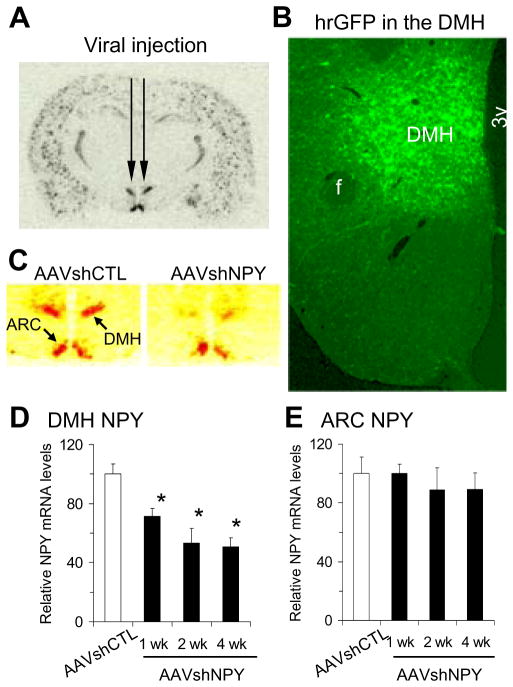
Adeno-associated virus (AAV)-mediated knockdown of NPY expression in the dorsomedial hypothalamus (DMH). (A) Bilateral injections of AAV vectors into the DMH. (B) Representative micrograph shows hrGFP (humanized Renilla green fluorescent protein) expression in the DMH post-viral DMH injection as examined under fluorescence microscopy. (C) 35S-labeled in situ hybridization histochemistry shows suppressed Npy expression in the DMH (pseudo red) in rats receiving bilateral DMH injections of AAVshNPY compared with rats receiving bilateral DMH injections of AAVshCTL. (D–E) Mean ± SEM Npy mRNA levels significantly decreased in the DMH of AAVshNPY rats at 1, 2 and 4 weeks after viral injection compared with AAVshCTL rats (D), but Npy mRNA levels in the arcuate nucleus (ARC) did not differ between AAVshCTL and AAVshNPY rats at any time points (E). n = 5 per group. *P<0.05 compared with AAVshCTL rats. f: fornix; 3v: the third ventricle.
Figure 2
Figure 2
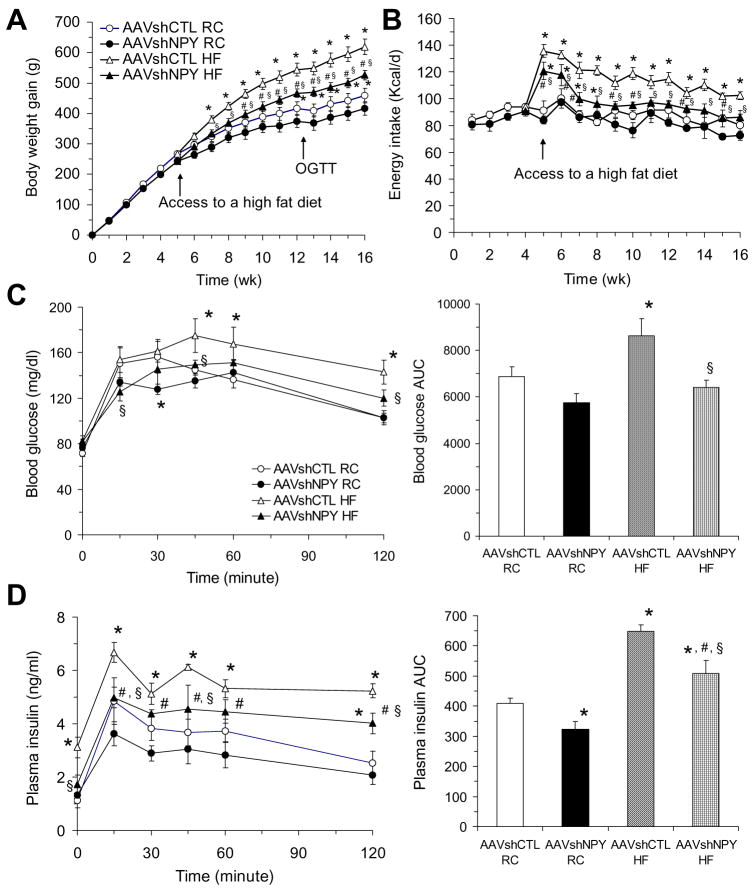
Effects of DMH NPY knockdown on food intake, body weight, and glucose tolerance. (A) Body weight gain in AAVshCTL and AAVshNPY rats with access to a regular chow (RC) or high fat (HF) diet. OGTT, time of oral glucose tolerance test. (B) Daily food intake in the four groups of rats. (C) Blood glucose response to oral glucose administration. AUC indicates the area under the curve. (D) Plasma insulin response to oral glucose administration. Values are means ± SEM. n = 6 rats per group. *P<0.05 compared with AAVshCTL RC rats, #P<0.05 compared with AAVshNPY RC rats and §P<0.05 compared with AAVshCTL HF rats.
Figure 3
Figure 3
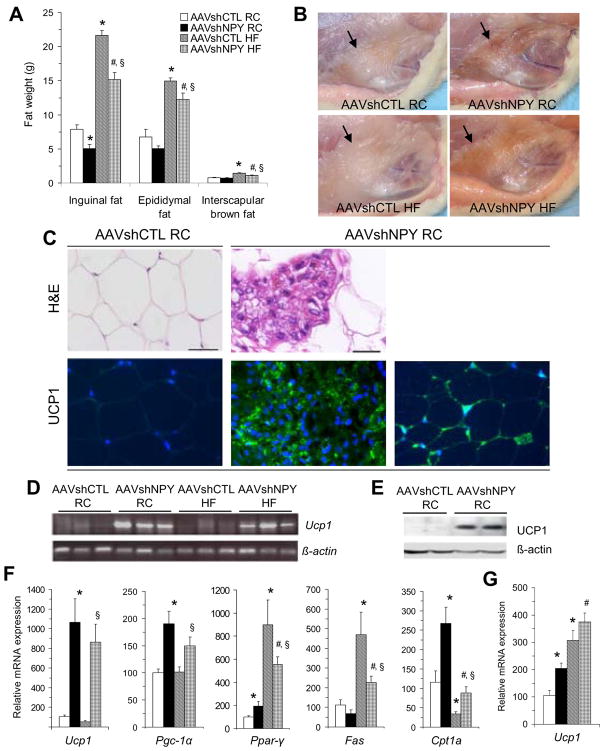
DMH NPY knockdown promotes development of brown adipocytes in inguinal white adipose tissue (WAT). (A) Fat weights at three different sites in the four groups of rats. (B) The color of inguinal WAT became dark (brownish) in AAVshNPY rats compared to that of AAVshCTL rats as indicated by black arrows. (C) Representative H&E (hematoxylin and eosin) stain shows unilocular adipocytes in inguinal WAT of AAVshCTL rats (upper left) and multilocular adipocytes (brown-like adipocytes) in inguinal WAT of AAVshNPY rats (upper middle); Mitochondrial uncoupling protein 1 (UCP1) was detected in inguinal adipocytes in AAVshNPY rats (green, lower middle) by using immunostaining with anti-UCP1 antibody and nuclei (blue) were counterstained by DAPI (4′,6-Diamidino-2-phenylindole); UCP1 immunoreactive (green) unilocular adipocytes were also detected in inguinal WAT of AAVshNPY rats (lower right), but undetectable in inguinal WAT of AAVshCTL rats (lower left). Scale bar indicates 20μm. (D) Ucp1 mRNA was expressed in the inguinal fat of AAVshNPY rats as determined by RT-PCR. (E) UCP1 protein was produced in the inguinal fat of AAVshNPY rats as determined by Western blot. (F) mRNA expression levels in the inguinal adipose tissue including Ucp1, peroxisome proliferator-activated receptor-γ (PPARγ)-coactivator-1α (Pgc-1 α), Ppar-γ, fatty acid synthesis (Fas) and carnitine palmitoyltransferase 1α (Cpt1α). (G) Ucp1 mRNA expression in the interscapular brown adipose tissue. Values are means ± SEM. n = 6 rats per group. *P<0.05 compared with AAVshCTL RC rats, #P<0.05 compared with AA VshNPY RC rats and §P<0.05 compared with AAVshCTL HF rats.
Figure 4
Figure 4
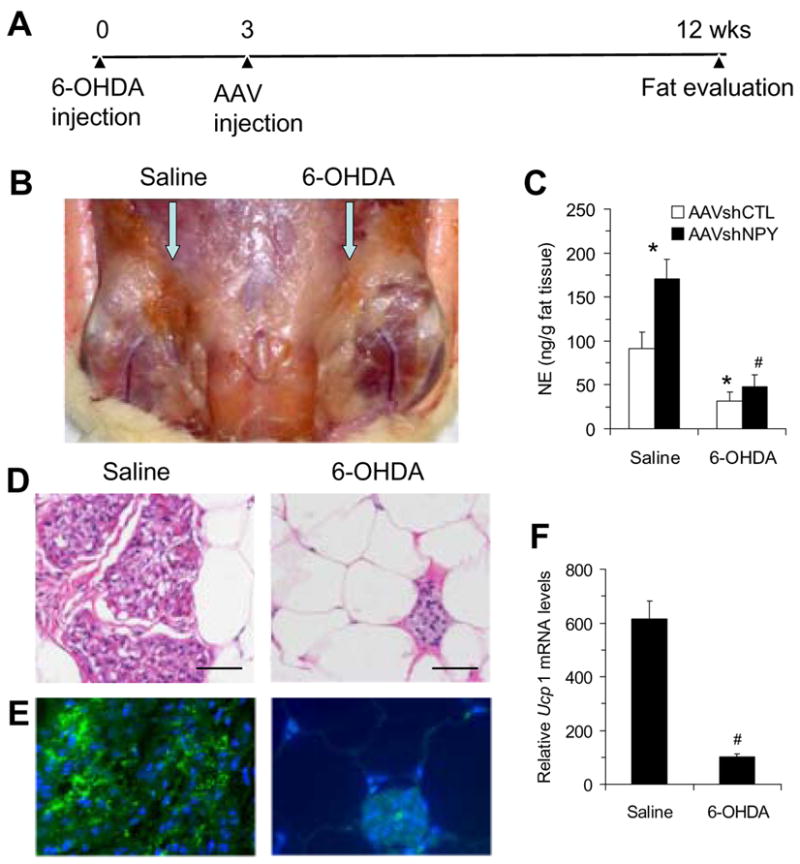
Sympathetic denervation in the inguinal adipose tissue of AAVshNPY rats. (A) Schedule of sympathetic denervation experiment. (B) Development of brown adipocytes in the inguinal WAT was prevented by the local injection of 6-hydroxydopamine (6-OHDA) compared to the contralateral injection of saline in AAVshNPY rats. (C) Norepinephrine (NE) concentration in inguinal fat pads. (D) H&E staining shows clusters of multilocular adipocytes (brown-like adipocytes) in the side of saline-treated inguinal fat pad, but barely in the 6-OHDA-treated side. Scale bar indicates 50μm. (E) UCP1 immunostaining was highly detected in the side of saline-treated inguinal fat pad, but not in the 6-OHDA-treated side. (F) 6-OHDA treatment prevented Ucp1 mRNA expression in the inguinal adipose tissue. Values are means ± SEM. n =5 rats for control group and 10 rats for NPY knockdown group. *P<0.05 compared to the saline-treated inguinal fat pad of AAVshCTL rats and #P<0.05 compared to the saline-treated inguinal fat pad of AAVshNPY rats.
Figure 5
Figure 5
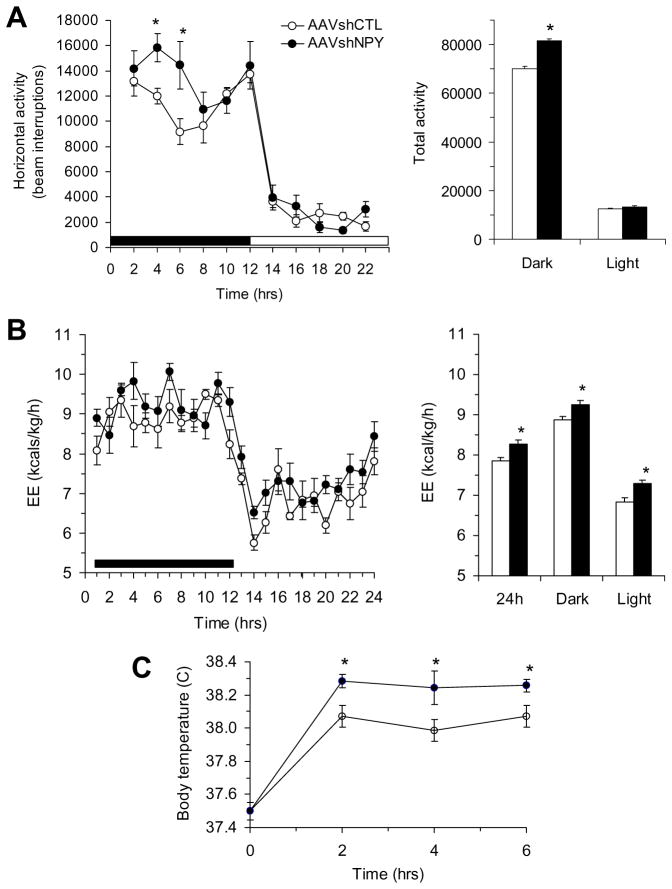
Effects of DMH NPY knockdown on locomotor activity, energy expenditure and body temperature response to cold environment. (A) Locomotor activity during the 22-h period. (B) Energy expenditure during the 24 h period. (C) Body temperature during the 6-h cold exposure (6°C). Values are means ± SEM. n = 7–8 rats per group. * P<0.05 compared to AAVshCTL rats.

Comment in

References

    1. Ailhaud G, Grimaldi P, Negrel R. Cellular and molecular aspects of adipose tissue development. Annu Rev Nutr. 1992;12:207–233. - PubMed
    1. Aja S, Bi S, Knipp SB, McFadden JM, Ronnett GV, Kuhajda FP, Moran TH. Intracerebroventricular C75 decreases meal frequency and reduces AgRP gene expression in rats. Am J Physiol Regul Integr Comp Physiol. 2006;291:R148–154. - PubMed
    1. Bamshad M, Aoki VT, Adkison MG, Warren WS, Bartness TJ. Central nervous system origins of the sympathetic nervous system outflow to white adipose tissue. Am J Physiol. 1998;275:R291–299. - PubMed
    1. Barbatelli G, Murano I, Madsen L, Hao Q, Jimenez M, Kristiansen K, Giacobino JP, De Matteis R, Cinti S. The emergence of cold-induced brown adipocytes in mouse white fat depots is determined predominantly by white to brown adipocyte transdifferentiation. Am J Physiol Endocrinol Metab. 2010;298:E1244–1253. - PubMed
    1. Bartness TJ, Bamshad M. Innervation of mammalian white adipose tissue: implications for the regulation of total body fat. Am J Physiol. 1998;275:R1399–1411. - PubMed

Publication types

MeSH terms