Quality of private and public ambulatory health care in low and middle income countries: systematic review of comparative studies
- PMID: 21532746
- PMCID: PMC3075233
- DOI: 10.1371/journal.pmed.1000433
Quality of private and public ambulatory health care in low and middle income countries: systematic review of comparative studies
Abstract
Background: In developing countries, the private sector provides a substantial proportion of primary health care to low income groups for communicable and non-communicable diseases. These providers are therefore central to improving health outcomes. We need to know how their services compare to those of the public sector to inform policy options.
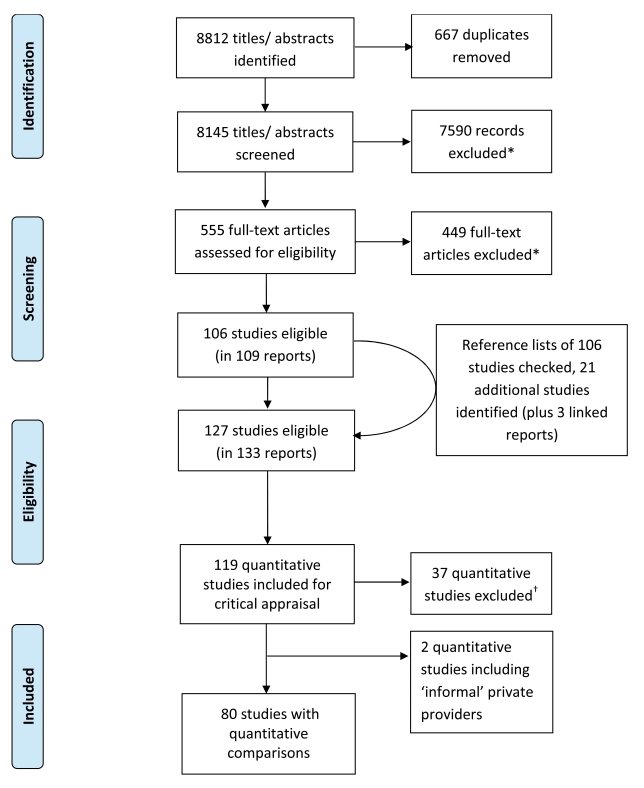
Methods and findings: We summarised reliable research comparing the quality of formal private versus public ambulatory health care in low and middle income countries. We selected studies against inclusion criteria following a comprehensive search, yielding 80 studies. We compared quality under standard categories, converted values to a linear 100% scale, calculated differences between providers within studies, and summarised median values of the differences across studies. As the results for for-profit and not-for-profit providers were similar, we combined them. Overall, median values indicated that many services, irrespective of whether public or private, scored low on infrastructure, clinical competence, and practice. Overall, the private sector performed better in relation to drug supply, responsiveness, and effort. No difference between provider groups was detected for patient satisfaction or competence. Synthesis of qualitative components indicates the private sector is more client centred.
Conclusions: Although data are limited, quality in both provider groups seems poor, with the private sector performing better in drug availability and aspects of delivery of care, including responsiveness and effort, and possibly being more client orientated. Strategies seeking to influence quality in both groups are needed to improve care delivery and outcomes for the poor, including managing the increasing burden of non-communicable diseases.
Conflict of interest statement
The authors have declared that no competing interests exist.
Figures
Comment in
-
The quality of medical care in low-income countries: from providers to markets.PLoS Med. 2011 Apr;8(4):e1000432. doi: 10.1371/journal.pmed.1000432. Epub 2011 Apr 12. PLoS Med. 2011. PMID: 21532744 Free PMC article. Review.
References
-
- World Bank. World development report: Making services work for poor people. Washington (District of Columbia): World Bank and Oxford University Press; 2004.
-
- Marek T, O'Farrell C, Yamamoto C, Zable I. Trends and opportunities in public-private partnerships to improve health service delivery in Africa. Africa Region Human Development Working Paper Series. Washington (District of Columbia): World Bank; 2005.
-
- Murray CJ, Lopez AD. Alternative projections of mortality and disability by cause 1990–2020: Global Burden of Disease Study. Lancet. 1997;349:1498–1504. - PubMed
-
- Bloom G, Standing H, Lloyd R. Markets, information asymmetry and health care: towards new social contracts. Soc Sci Med. 2008;66:2076–2087. - PubMed
-
- Gilson L, Sen PD, Mohammed S, Mujinja P. The potential of health sector non-governmental organizations: policy options. Health Policy Plan. 1994;9:14–24. - PubMed
Publication types
MeSH terms
LinkOut - more resources
Full Text Sources
Research Materials