. 2011 Feb;6(2):185-193.
doi: 10.1517/17460441.2011.547468.

Ligand-based receptor tyrosine kinase partial agonists: New paradigm for cancer drug discovery?

Affiliations

Ligand-based receptor tyrosine kinase partial agonists: New paradigm for cancer drug discovery?

David J Riese 2nd. Expert Opin Drug Discov. 2011 Feb.

Abstract

INTRODUCTION: Receptor tyrosine kinases (RTKs) are validated targets for oncology drug discovery and several RTK antagonists have been approved for the treatment of human malignancies. Nonetheless, the discovery and development of RTK antagonists has lagged behind the discovery and development of agents that target G-protein coupled receptors. In part, this is because it has been difficult to discover analogs of naturally-occurring RTK agonists that function as antagonists. AREAS COVERED: Here we describe ligands of ErbB receptors that function as partial agonists for these receptors, thereby enabling these ligands to antagonize the activity of full agonists for these receptors. We provide insights into the mechanisms by which these ligands function as antagonists. We discuss how information concerning these mechanisms can be translated into screens for novel small molecule- and antibody-based antagonists of ErbB receptors and how such antagonists hold great potential as targeted cancer chemotherapeutics. EXPERT OPINION: While there have been a number of important key findings into this field, the identification of the structural basis of ligand functional specificity is still of the greatest importance. While it is true that, with some notable exceptions, peptide hormones and growth factors have not proven to be good platforms for oncology drug discovery; addressing the fundamental issues of antagonistic partial agonists for receptor tyrosine kinases has the potential to steer oncology drug discovery in new directions. Mechanism based approaches are now emerging to enable the discovery of RTK partial agonists that may antagonize both agonist-dependent and -independent RTK signaling and may hold tremendous promise as targeted cancer chemotherapeutics.


Figures
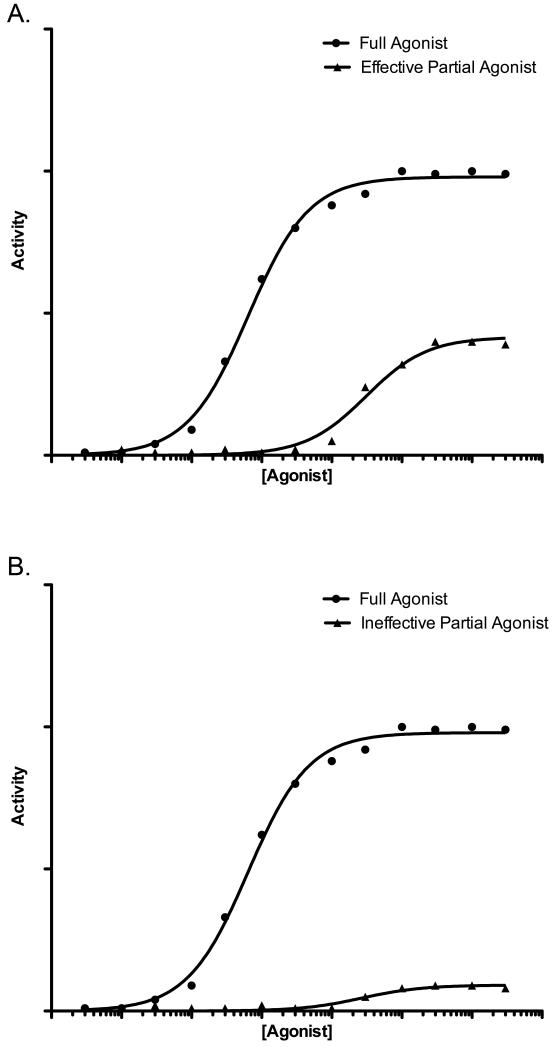
Figure 1
Figure 1. A saturating concentration of a theoretical full agonist elicits a greater response than a saturating concentration of a theoretical partial agonist
(A) A theoretical full agonist versus a relatively effective theoretical partial agonist. The activity of these ligands resembles the activity of AREG (full agonist) and EGF (partial agonist). (B) A theoretical full agonist versus a relatively ineffective theoretical partial agonist. The activity of these ligands resembles the activity of wild-type NRG2β (full agonist) and NRG2β/Q43L (partial agonist).
Figure 2
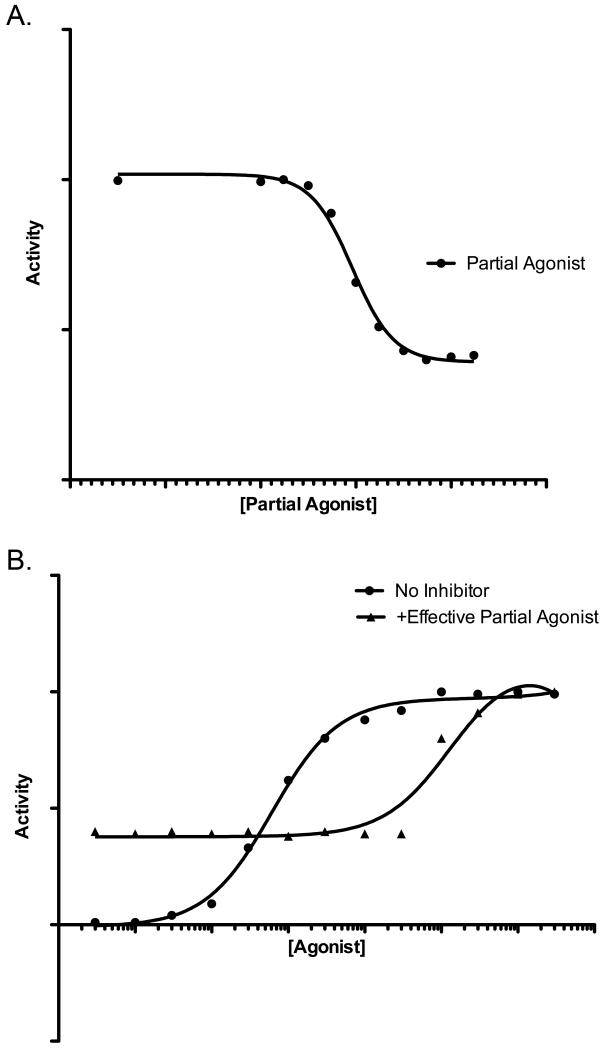
Figure 2. A theoretical partial agonist can antagonize the activity of a theoretical full agonist
The activity of these ligands resembles the activity of AREG (full agonist) and EGF (partial agonist). (A) Increasing concentrations of a relatively effective theoretical partial agonist inhibit the activity of a fixed concentration of a theoretical full agonist. (B) The antagonistic effects of a fixed concentration of a relatively effective theoretical partial agonist can be overcome by increasing concentrations of a theoretical full agonist. The resulting rightward shift in the full agonist dose response curve in the presence of the partial agonist is indicative of competitive inhibition of full agonist activity by the partial agonist.
Figure 3
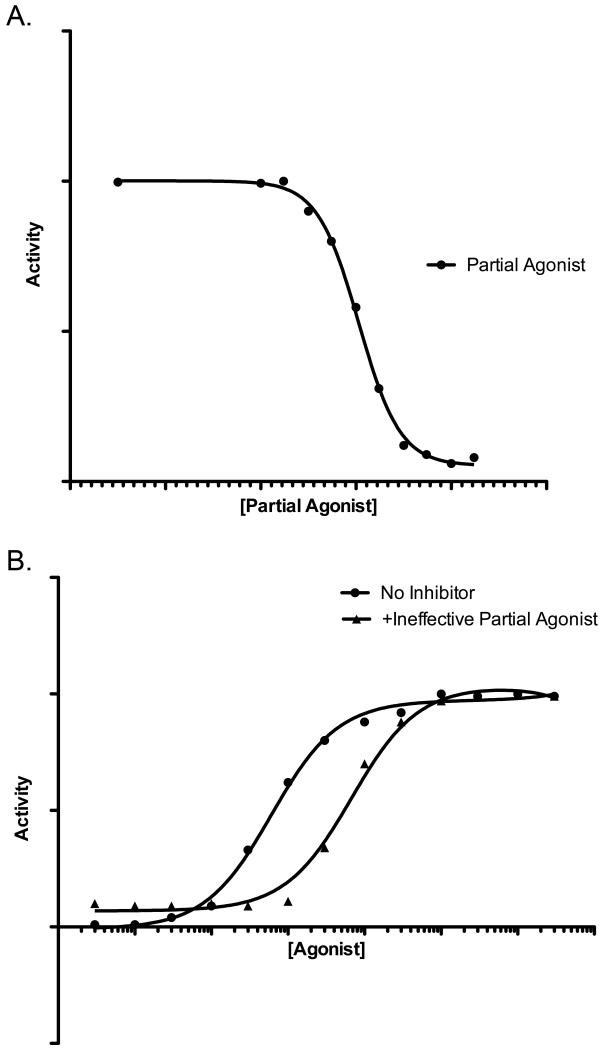
Figure 3. A relatively ineffective theoretical partial agonist can have a profound effect on the activity of a theoretical full agonist
The activity of these ligands resembles the activity of wild-type NRG2β (full agonist) and NRG2β/Q43L (partial agonist). (A) Increasing concentrations of a relatively ineffective theoretical partial agonist almost completely abrogate the activity of a fixed concentration of a theoretical full agonist. (B) The antagonistic effects of a fixed concentration of a relatively effective theoretical partial agonist can be overcome by increasing concentrations of a theoretical full agonist. The resulting rightward shift in the full agonist dose response curve in the presence of the partial agonist is indicative of competitive inhibition of full agonist activity by the partial agonist.

References

    1. Lemmon MA, Schlessinger J. Cell signaling by receptor tyrosine kinases. Cell. 2010 Jun 25;141(7):1117–34. - PMC - PubMed
    1. Lemmon MA. Ligand-induced ErbB receptor dimerization. Exp Cell Res. 2009 Feb 15;315(4):638–48. - PMC - PubMed
    1. Jura N, Endres NF, Engel K, Deindl S, Das R, Lamers MH, et al. Mechanism for activation of the EGF receptor catalytic domain by the juxtamembrane segment. Cell. 2009 Jun 26;137(7):1293–307. - PMC - PubMed
    1. Zhang X, Gureasko J, Shen K, Cole PA, Kuriyan J. An allosteric mechanism for activation of the kinase domain of epidermal growth factor receptor. Cell. 2006 Jun 16;125(6):1137–49. - PubMed
    1. Hubbard SR. EGF receptor activation: push comes to shove. Cell. 2006 Jun 16;125(6):1029–31. - PubMed