


Excellent adherence to antiretrovirals in HIV+ Zambian children is compromised by disrupted routine, HIV nondisclosure, and paradoxical income effects
- PMID: 21533031
- PMCID: PMC3080873
- DOI: 10.1371/journal.pone.0018505
Excellent adherence to antiretrovirals in HIV+ Zambian children is compromised by disrupted routine, HIV nondisclosure, and paradoxical income effects
Abstract
Introduction: A better understanding of pediatric antiretroviral therapy (ART) adherence in sub-Saharan Africa is necessary to develop interventions to sustain high levels of adherence.
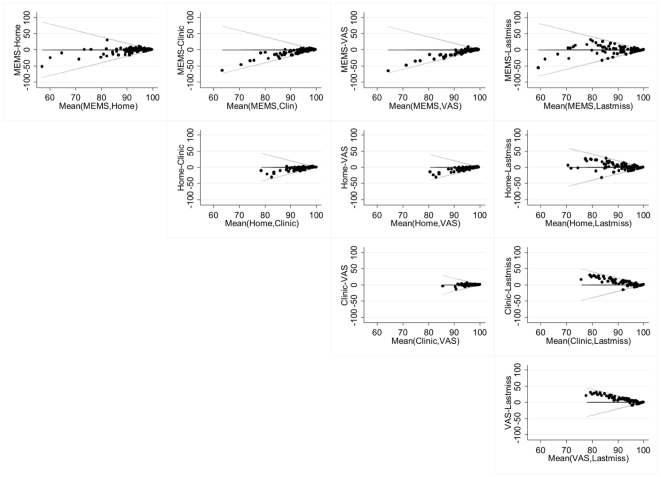
Methodology/principal findings: Adherence among 96 HIV-infected Zambian children (median age 6, interquartile range [IQR] 2,9) initiating fixed-dose combination ART was measured prospectively (median 23 months; IQR 20,26) with caregiver report, clinic and unannounced home-based pill counts, and medication event monitoring systems (MEMS). HIV-1 RNA was determined at 48 weeks. Child and caregiver characteristics, socio-demographic status, and treatment-related factors were assessed as predictors of adherence. Median adherence was 97.4% (IQR 96.1,98.4%) by visual analog scale, 94.8% (IQR 86,100%) by caregiver-reported last missed dose, 96.9% (IQR 94.5,98.2%) by clinic pill count, 93.4% (IQR 90.2,96.7%) by unannounced home-based pill count, and 94.8% (IQR 87.8,97.7%) by MEMS. At 48 weeks, 72.6% of children had HIV-1 RNA <50 copies/ml. Agreement among adherence measures was poor; only MEMS was significantly associated with viral suppression (p = 0.013). Predictors of poor adherence included changing residence, school attendance, lack of HIV disclosure to children aged nine to 15 years, and increasing household income.
Conclusions/significance: Adherence among children taking fixed-dose combination ART in sub-Saharan Africa is high and sustained over two years. However, certain groups are at risk for treatment failure, including children with disrupted routines, no knowledge of their HIV diagnosis among older children, and relatively high household income, possibly reflecting greater social support in the setting of greater poverty.
Conflict of interest statement
Figures
References
-
- Report on the Global AIDS Epidemic. Joint United Nations Programme on AIDS. 2009. Available at: http://www.unaids.org/en/KnowledgeCentre/ HIVData/GlobalReport/2008/2008_global_report.asp.
-
- Children and AIDS Fourth Stocktaking Report. UNICEF. 2009. Available at: http://www.unicef.org/colombia/pdf/Children_and_AIDS_A_FSR_LoRes_PDF_EN_....
-
- Burns DN, Mofenson L. Paediatric HIV-1 infection. Lancet. 1999;354:1–6. - PubMed
-
- de Martino M, Tovo PA, Balducci M, Galli L, Gabiano C, et al. Reduction in mortality with availability of antiretroviral therapy for children with perinatal HIV-1 infection. Italian Register for HIV Infection in Children and the Italian National AIDS Registry. JAMA. 2000;284:190–197. - PubMed
-
- Flynn PM, Rudy BJ, Douglas SD, Lathey J, Spector SA, et al. Virologic and immunologic outcomes after 24 weeks in HIV type 1-infected adolescents receiving highly active antiretroviral therapy. J Infect Dis. 2004;190:271–279. - PubMed
Publication types
MeSH terms
Substances
Grants and funding
LinkOut - more resources
Full Text Sources
Medical
