


Quantifying relative diver effects in underwater visual censuses
- PMID: 21533039
- PMCID: PMC3080881
- DOI: 10.1371/journal.pone.0018965
Quantifying relative diver effects in underwater visual censuses
Abstract
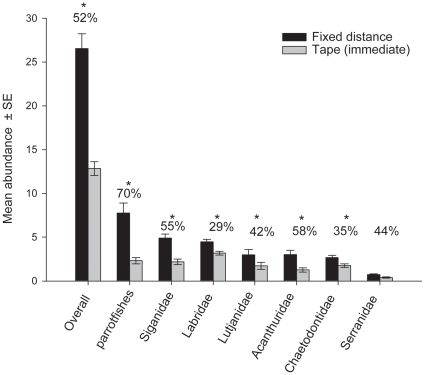
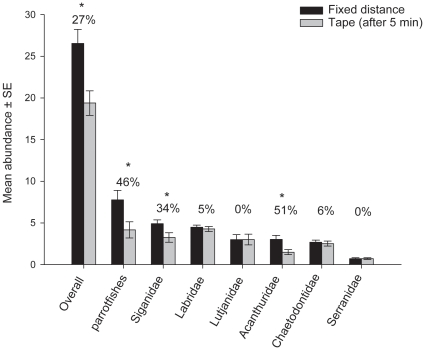
Diver-based Underwater Visual Censuses (UVCs), particularly transect-based surveys, are key tools in the study of coral reef fish ecology. These techniques, however, have inherent problems that make it difficult to collect accurate numerical data. One of these problems is the diver effect (defined as the reaction of fish to a diver). Although widely recognised, its effects have yet to be quantified and the extent of taxonomic variation remains to be determined. We therefore examined relative diver effects on a reef fish assemblage on the Great Barrier Reef. Using common UVC methods, the recorded abundance of seven reef fish groups were significantly affected by the ongoing presence of SCUBA divers. Overall, the diver effect resulted in a 52% decrease in the mean number of individuals recorded, with declines of up to 70% in individual families. Although the diver effect appears to be a significant problem, UVCs remain a useful approach for quantifying spatial and temporal variation in relative fish abundances, especially if using methods that minimise the exposure of fishes to divers. Fixed distance transects using tapes or lines deployed by a second diver (or GPS-calibrated timed swims) would appear to maximise fish counts and minimise diver effects.
Conflict of interest statement
Figures
References
-
- Sale PF, Sharp BJ. Correction for bias in visal transect censuses of coral reef fishes. Coral Reefs. 1983;2:37–42.
-
- Kulbicki M. How the acquired behaviour of commercial reef fishes may influence the results obtained from visual censuses. J Exp Mar Biol Ecol. 1998;222:11–30.
-
- Samoilys MA, Carlos G. Determining methods of underwater visual census for estimating the abundance of coral reef fishes. Env Biol Fish. 2000;57:289–304.
-
- Edgar GJ, Barrett NS, Morton AJ. Biases associated with the use of underwater visual census techniques to quantify the density and size-structure of fish populations. J Exp Mar Biol Ecol. 2004;308:269–290.
-
- MacNeil MA, Graham NAJ, Conroy MJ, Fonnesbeck CJ, Polunin NVC, et al. Detection heterogeneity in underwater visual-census data. J Fish Biol. 2008;73:1748–1763.
Publication types
MeSH terms
LinkOut - more resources
Full Text Sources
