Metabolic depression: a chronic depressive subtype? Findings from the InCHIANTI study of older persons
- PMID: 21535996
- PMCID: PMC6232848
- DOI: 10.4088/JCP.10m06559
Metabolic depression: a chronic depressive subtype? Findings from the InCHIANTI study of older persons
Abstract
Objective: Several studies report a cross-sectional association between metabolic syndrome and depression. Possibly, metabolic syndrome promotes onset or chronicity of depression. However, such a longitudinal link has not yet been confirmed. This study examines whether metabolic syndrome or its components are associated with onset and chronicity of depression.
Method: Secondary analyses were performed on data from 823 participants (≥ 65 years of age) in the InCHIANTI study, a prospective, population-based cohort study of older persons. From 1998 to 2000, the study sample was randomly selected from the population registry of 2 sites in Italy using a multistage stratified sampling method. Baseline data collection consisted of a home interview and a medical evaluation at the study clinic. Follow-up for each participant occurred after 3 years and 6 years. Metabolic syndrome at baseline was defined as ≥ 3 of the following: abdominal obesity, high triglycerides, low high-density lipoprotein cholesterol, high blood pressure, and high fasting glucose. Depressive symptoms were assessed using the Center for Epidemiologic Studies Depression scale (CES-D) at baseline and after 3 and 6 years. Sample characteristics were compared between persons with and without depression at baseline using χ² and t statistics. Logistic regression analyses were conducted separately in persons with and without depression at baseline to test whether metabolic syndrome at baseline could predict onset and chronicity of depression at follow-up.
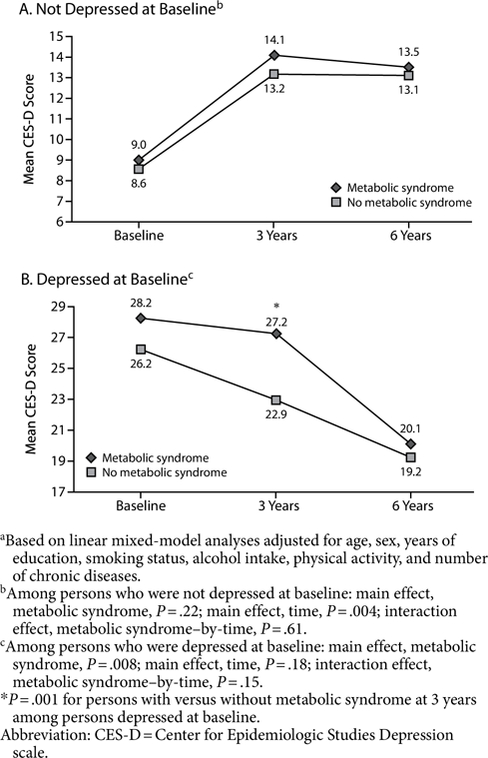
Results: At baseline, 235 persons had metabolic syndrome, and 168 were depressed (CES-D score ≥ 20). Among persons not depressed at baseline, 26.0% developed depression. Higher waist circumference increased the odds of depression onset (adjusted OR per SD increase = 1.28; 95% CI, 1.05-1.56), but there was no association between other metabolic syndrome components and onset of depression. Among persons depressed at baseline, depression had a chronic character in 69.0% of persons without and 88.5% of persons with metabolic syndrome. Metabolic syndrome was associated with an almost 3-fold increase in the odds of chronicity of depression (adjusted OR = 2.66; 95% CI, 1.01-7.00), with almost every metabolic syndrome component contributing to this association.
Conclusion: In late life, waist circumference, but not metabolic syndrome, predicted onset of depression. Depressed persons with metabolic syndrome were more likely to have persistent or recurrent depression. The latter may suggest that depression with metabolic abnormalities, which could be labeled metabolic depression, identifies a chronic subtype of depression.
© Copyright 2011 Physicians Postgraduate Press, Inc.
Conflict of interest statement
Figures
References
-
- Nicholson A, Kuper H, Hemingway H. Depression as an aetiologic and prognostic factor in coronary heart disease: a meta-analysis of 6362 events among 146 538 participants in 54 observational studies. Eur Heart J 2006; 27(23):2763–2774. - PubMed
-
- Van der Kooy K, van Hout H, Marwijk H, et al. Depression and the risk for cardiovascular diseases: systematic review and meta analysis. Int J Geriatr Psychiatry 2007;22(7):613–626. - PubMed
-
- National Cholesterol Education Program (NCEP) Expert Panel on Detection, Evaluation, and Treatment of High Blood Cholesterol in Adults (Adult Treatment Panel III). Third Report of the National Cholesterol Education Program (NCEP) Expert Panel on Detection, Evaluation, and Treatment of High Blood Cholesterol in Adults (Adult Treatment Panel III) final report. Circulation 2002;106(25):3143–3421. - PubMed
-
- Vitaliano PP, Scanlan JM, Zhang J, et al. A path model of chronic stress, the metabolic syndrome, and coronary heart disease. Psychosom Med 2002; 64(3):418–435. - PubMed
Publication types
MeSH terms
Grants and funding
LinkOut - more resources
Full Text Sources
Medical