doi: 10.1101/pdb.prot5611.
Affinity purification of protein complexes
- PMID: 21536765
- PMCID: PMC6666412
- DOI: 10.1101/pdb.prot5611
Item in Clipboard
Affinity purification of protein complexes
Cold Spring Harb Protoc.
.
Abstract
Knowledge of the composition of protein complexes provides key insights into their functions. Immunoaffinity purification provides an effective means for isolating protein complexes and elucidating their composition. Immunoisolation is achieved with antibodies directed either specifically against the proteins of interest or against tags that are coupled to the proteins of interest. This approach uses immunoaffinity purification on magnetic beads coated with antibodies for the rapid and efficient purification of protein complexes from cells or tissues. This protocol describes affinity purification of protein complexes using conjugated magnetic beads.
Figures
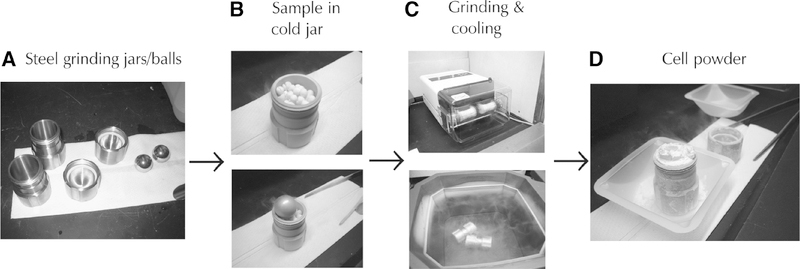
Experimental flow chart for preparing cell extracts by cryogenic grinding of cells or tissues. (A) Stainless steel jars, lids, and balls for cryogenically disrupting frozen cells. The stainless steel jars and balls are used to cryogenically grind frozen cells into a powder for making whole cell protein extracts. Before use, the jars and balls are precooled in liquid nitrogen. (B) Frozen cell pellets added to a frozen steel jar. The pellets are made by dropping a cell slurry into liquid nitrogen and recovering the frozen cell pellets. The precooled steel ball is added to the jar with the cell pellets. The stainless steel cap is then screwed on to seal the chamber. (C) Steel jars inserted into the grinding mill (Retsch MM 301 Mixer Mill). For yeast, the cells are ground into a powder using 10× 3-min cycles at 25 Hz. Between each grinding cycle, the jars are removed from the holders and plunged into liquid nitrogen to keep the cells frozen. (D) Cryogenically disrupted cells. A fine powder is created from the frozen cell pellets and grinding process. The powder is kept frozen and quickly transferred to a 50-mL tube kept cool in liquid nitrogen using a cold spatula. The disrupted cells are stored at −80°C until ready to use.
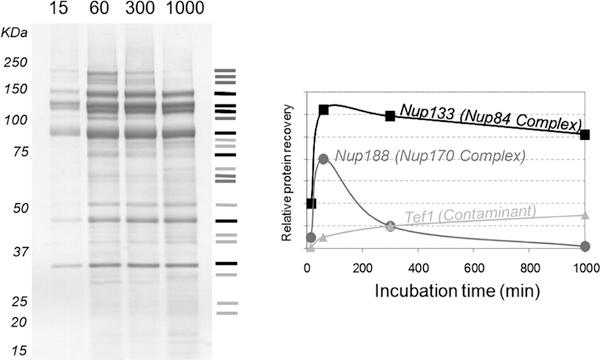
Effects of incubation times on protein recovery and nonspecific interactions. Coomassie-stained SDS-PAGE showing isolation of GFP-tagged Nup84 and its associated proteins using various incubation times (left). Recoveries of the indicated proteins as a function of time. Proteins were identified by mass spectrometry (right). (Reprinted, with permission, from the American Society for Biochemistry and Molecular Biology, Inc.)
References
-
- Cristea IM, Williams R, Chait BT, Rout MP. 2005. Fluorescent proteins as proteomic probes. Mol Cell Proteomics 4: 19331941. - PubMed
-
- Cristea IM, Carroll JW, Rout MP, Rice CM, Chait BT, MacDonald MR. 2006. Tracking and elucidating alphavirus-host protein interactions. J Biol Chem 281: 30269–30278. - PubMed
MeSH terms
Substances
Grants and funding
LinkOut - more resources
Full Text Sources