. 2011 Jul;301(1):H221-9.
doi: 10.1152/ajpheart.00119.2011. Epub 2011 May 2.

Decreased aortic diameter and compliance precedes blood pressure increases in postnatal development of elastin-insufficient mice

Affiliations

Decreased aortic diameter and compliance precedes blood pressure increases in postnatal development of elastin-insufficient mice

Victoria P Le et al. Am J Physiol Heart Circ Physiol. 2011 Jul.

Abstract

Increased arterial stiffness and blood pressure are characteristic of humans and adult mice with reduced elastin levels caused by aging or genetic disease. Direct associations have been shown between increased arterial stiffness and hypertension in humans, but it is not known whether changes in mechanical properties or increased blood pressure occur first. Using genetically modified mice with elastin haploinsufficiency (Eln(+/-)), we investigated the temporal relationship between arterial mechanical properties and blood pressure throughout postnatal development. Our results show that some mechanical properties are maintained constant regardless of elastin amounts. The peak diameter compliance for both genotypes occurs near the physiologic pressure at each age, which acts to provide maximum pulse dampening. The stress-strain relationships are similar between genotypes and become nonlinear near the systolic pressure for each age, which serves to limit distension under high pressure. Our results also show that some mechanical properties are affected by reduced elastin levels and that these changes occur before measurable changes in blood pressure. Eln(+/-) mice have decreased aortic diameter and compliance in ex vivo tests that are significant by postnatal day 7 and increased blood pressure that is not significant until postnatal day 14. This temporal relationship suggests that targeting large arteries to increase diameter or compliance may be an effective treatment for human hypertension.


Figures
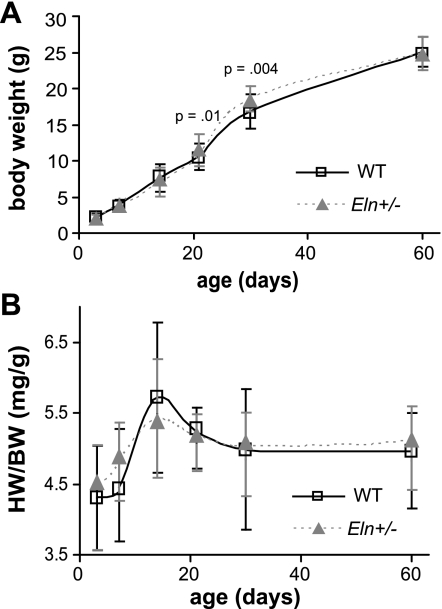
Fig. 1.
Fig. 1.
Body weight (BW) is significantly different between genotypes at postnatal days (P) P21 and P30 (A). Normalized total heart weight (HW) is not significantly different between genotypes at any age (B). WT, wild-type; n = 14–29/group.
Fig. 2.
Fig. 2.
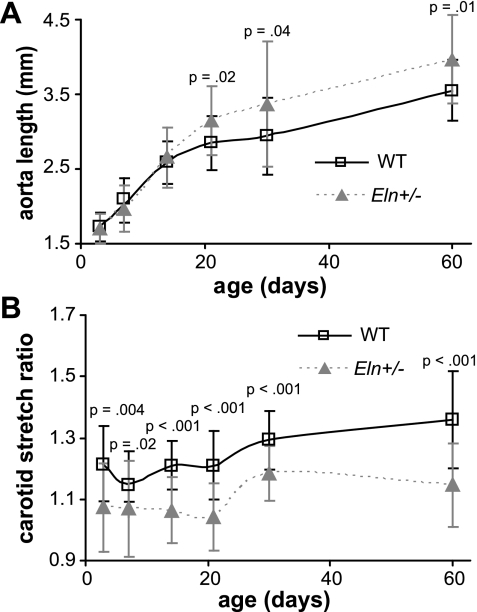
In vivo length of the ascending aorta is significantly longer in Eln+/− mice by P21 (A). In vivo carotid stretch ratio is significantly smaller in Eln+/− mice at all ages (B). n = 10–23/group.
Fig. 3.
Fig. 3.
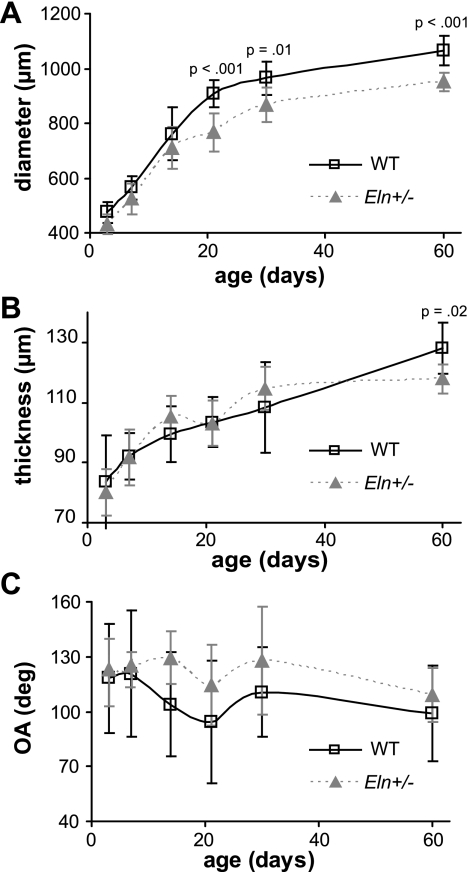
Unloaded outer diameter of the ascending aorta is significantly smaller in Eln+/− mice by P21 (A) and the thickness is significantly smaller at P60 (B). There are no significant differences in the opening angle (OA) between genotypes at each age (C). n = 6–11/group.
Fig. 4.
Fig. 4.
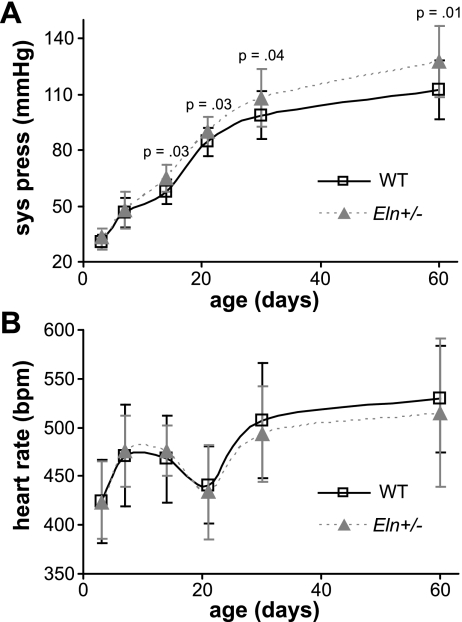
Systolic pressure (sys press) is significantly higher in Eln+/− mice by P14 (A). There are no significant differences in heart rate between genotypes (B). bpm, Beats/min; n = 12–25/group.
Fig. 5.
Fig. 5.
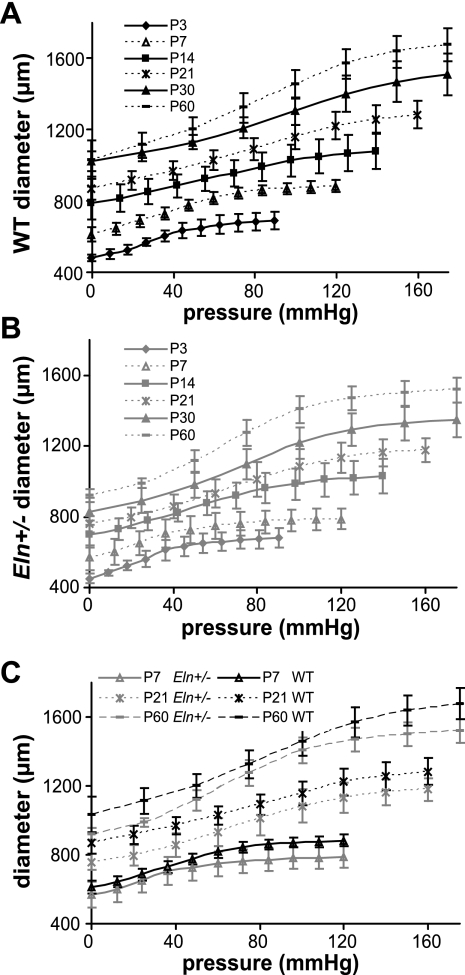
Aortic pressure-outer diameter curves for WT (A), Eln+/− (B), and representative ages for both genotypes (C). Diameter differences between the genotypes are significant for at least 4 pressure steps at P7–60 (Supplemental Table S1); n = 5–10/group.
Fig. 6.
Fig. 6.
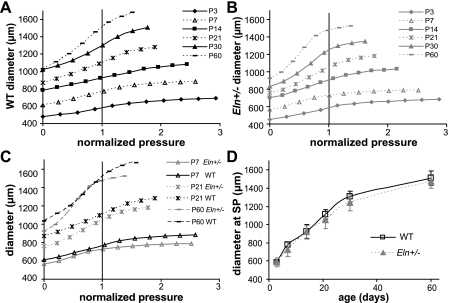
Aortic normalized pressure-outer diameter curves for WT (A), Eln+/− (B), and representative ages for both genotypes (C). A normalized pressure of 1 indicates the systolic value and the maximum normal physiologic pressure. There are no significant differences between WT and Eln+/− aorta for the calculated outer diameter at the systolic pressure (SP) for each age and genotype (D). Error bars same as Fig. 6 but removed for clarity; n = 5–10/group.
Fig. 7.
Fig. 7.
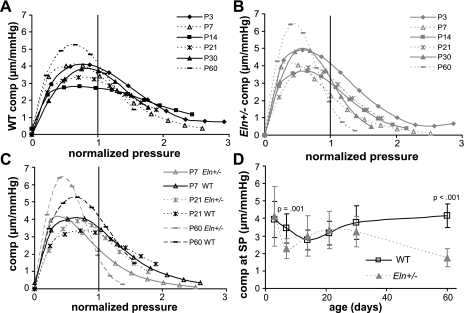
Aortic normalized pressure-compliance (comp) curves for WT (A), Eln+/− (B), and representative ages for both genotypes (C). At the systolic pressure for each age and genotype, the compliance of Eln+/− aorta is significantly lower than WT for P7 and 60 (D). n = 5–10/group.
Fig. 8.
Fig. 8.
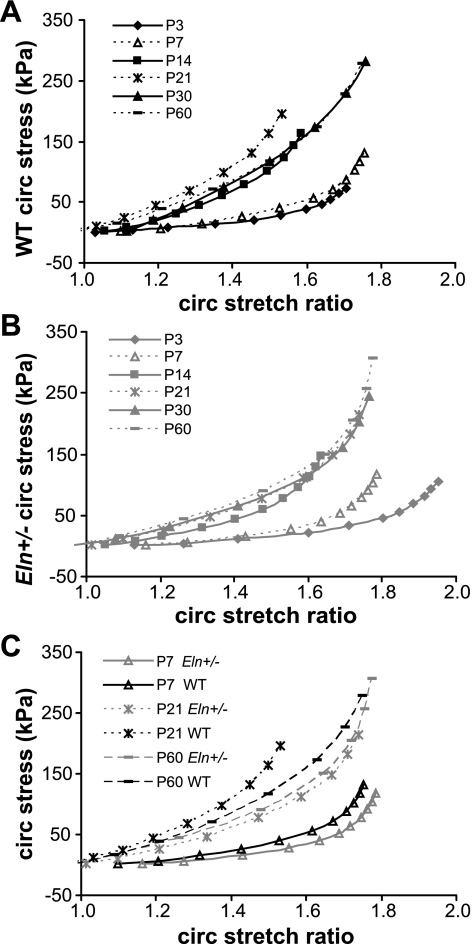
Aortic circumferential (circ) stretch ratio-stress curves for WT (A), Eln+/− (B), and representative ages for both genotypes (C). Curves segregate into 2 groups by age but are similar between genotypes for most ages; n = 5–10/group.
Fig. 9.
Fig. 9.
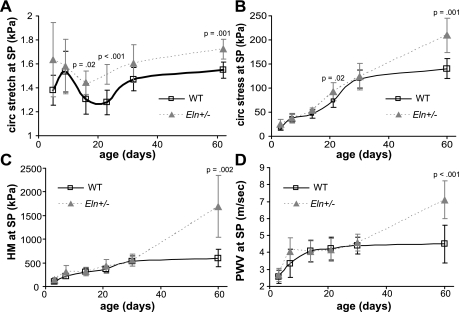
Aortic circumferential stretch ratio (A), circumferential stress (B), Hudetz elastic modulus (HM; C), and pulse wave velocity (PWV, D) at the systolic pressure for each age and genotype. There are significant differences between genotypes for all parameters by P60; n = 5–10/group.

References

    1. Bramwell J, Hill A. The velocity of the pulse wave in man. Proc Roy Soc London Ser B 93: 298–306, 1922
    1. Carta L, Wagenseil JE, Knutsen RH, Mariko B, Faury G, Davis EC, Starcher B, Mecham RP, Ramirez F. Discrete contributions of elastic fiber components to arterial development and mechanical compliance. Arterioscler Thromb Vasc Biol 29: 2083–2089, 2009 - PMC - PubMed
    1. Chuong CJ, Fung YC. On residual stresses in arteries. J Biomech Eng 108: 189–192, 1986 - PubMed
    1. Davis EC. Elastic lamina growth in the developing mouse aorta. J Histochem Cytochem 43: 1115–1123, 1995 - PubMed
    1. Dobrin PB. Physiology and pathophysiology of blood vessels. In: The Basic Science of Vascular Disease, edited by SidawyAN SB, DePalma RG.New York: Futura, 1997, chapt. 3, p. 69–105

Publication types

MeSH terms

LinkOut - more resources