


Pomalidomide augments fetal hemoglobin production without the myelosuppressive effects of hydroxyurea in transgenic sickle cell mice
- PMID: 21536862
- PMCID: PMC3148160
- DOI: 10.1182/blood-2010-11-319137
Pomalidomide augments fetal hemoglobin production without the myelosuppressive effects of hydroxyurea in transgenic sickle cell mice
Abstract
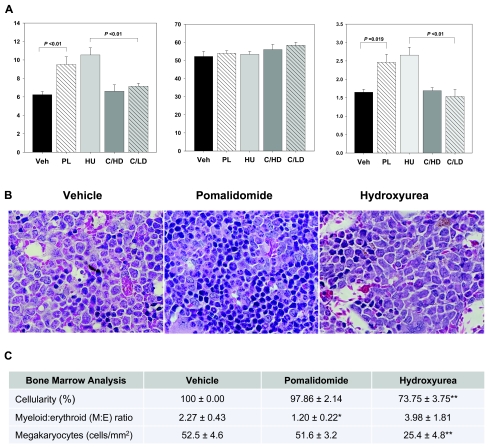
Pharmacologic induction of fetal hemoglobin (HbF) expression is an effective treatment strategy for sickle cell disease (SCD) and β-thalassemia. Pomalidomide is a potent structural analog of thalidomide and member of a new class of immunomodulatory drugs. Recent reports demonstrated that pomalidomide reduced or eliminated transfusion requirements in certain hematologic malignancies and induced HbF ex vivo in CD34(+) progenitor cells from healthy and SCD donors. We investigated the effects of pomalidomide on erythropoiesis and hemoglobin synthesis in a transgenic mouse model of SCD. We found that 8 weeks of treatment with pomalidomide induced modest increases of HbF with similar efficacy as hydroxyurea. However, in stark contrast to hydroxyurea's myelosuppressive effects, pomalidomide augmented erythropoiesis and preserved bone marrow function. Surprisingly, combinatory therapy with both drugs failed to mitigate hydroxyurea's myelotoxic effects and caused loss of HbF induction. These findings support further evaluation of pomalidomide as a novel therapy for SCD.
Figures
Comment in
-
Switching globin, raising red cells.Blood. 2011 Jul 28;118(4):834-6. doi: 10.1182/blood-2011-06-354373. Blood. 2011. PMID: 21799098 No abstract available.
References
-
- Nagel RL, Erlingsson S, Fabry ME, et al. The Senegal DNA haplotype is associated with the amelioration of anemia in African-American sickle cell anemia patients. Blood. 1991;77(6):1371–1375. - PubMed
-
- Pace BS, Zein S. Understanding mechanisms of gamma-globin gene regulation to develop strategies for pharmacological fetal hemoglobin induction. Dev Dyn. 2006;235(7):1727–1737. - PubMed
-
- Perrine SP. Fetal globin stimulant therapies in the beta-hemoglobinopathies: principles and current potential. Pediatr Ann. 2008;37(5):339–346. - PubMed
-
- Stamatoyannopoulos G, Wood WG, Papayannopoulou T, Nute PE. A new form of hereditary persistence of fetal hemoglobin in blacks and its association with sickle cell trait. Blood. 1975;46(5):683–692. - PubMed
Publication types
MeSH terms
Substances
Grants and funding
LinkOut - more resources
Full Text Sources
Other Literature Sources
Medical
Molecular Biology Databases
