. 2011 May 25;133(20):7882-91.
doi: 10.1021/ja200840p. Epub 2011 May 3.

Photosensitizer drug delivery via an optical fiber

Affiliations

Photosensitizer drug delivery via an optical fiber

Matibur Zamadar et al. J Am Chem Soc. .

Abstract

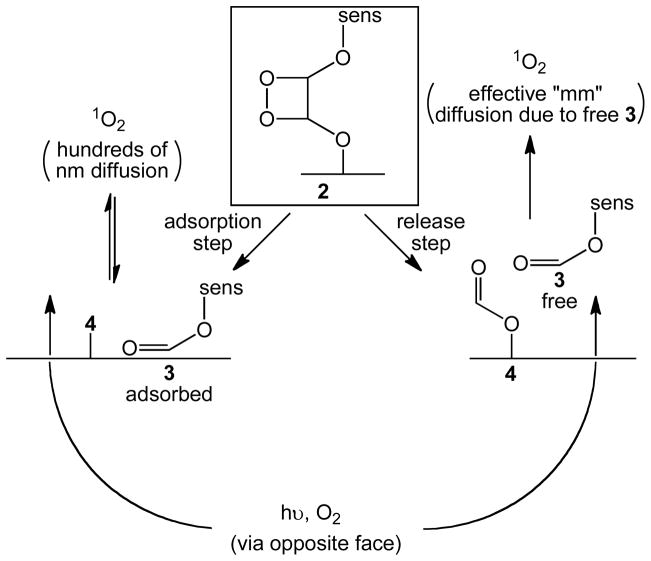
An optical fiber has been developed with a maneuverable mini-probe tip that sparges O(2) gas and photodetaches pheophorbide (sensitizer) molecules. Singlet oxygen is produced at the probe tip surface which reacts with an alkene spacer group releasing sensitizer upon fragmentation of a dioxetane intermediate. Optimal sensitizer photorelease occurred when the probe tip was loaded with 60 nmol sensitizer, where crowding of the pheophorbide molecules and self-quenching were kept to a minimum. The fiber optic tip delivered pheophorbide molecules and singlet oxygen to discrete locations. The 60 nmol sensitizer was delivered into petrolatum; however, sensitizer release was less efficient in toluene-d(8) (3.6 nmol) where most had remained adsorbed on the probe tip, even after the covalent alkene spacer bond had been broken. The results open the door to a new area of fiber optic-guided sensitizer delivery for the potential photodynamic therapy of hypoxic structures requiring cytotoxic control.


Figures
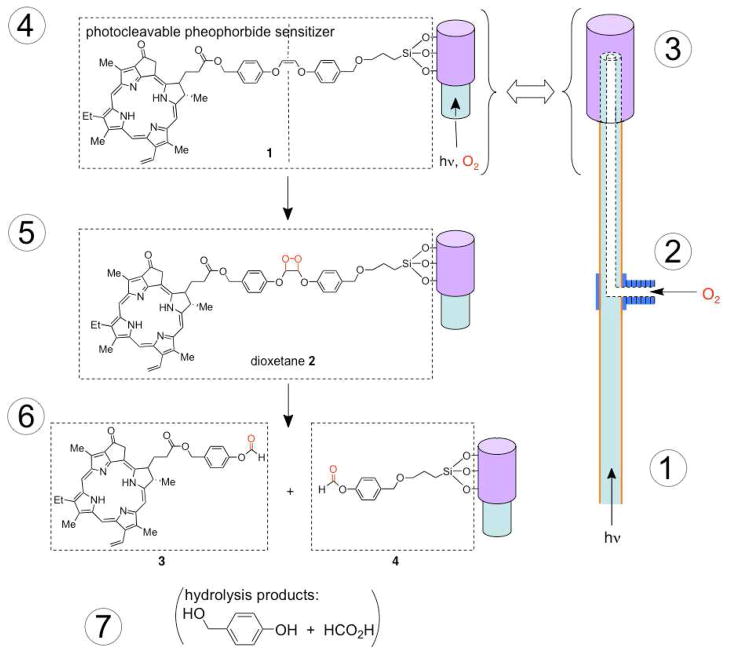
Figure 1
Figure 1
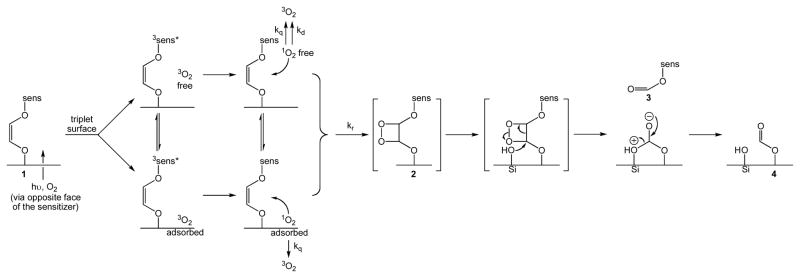
Concept of the singlet oxygen fiber optic: (1) illuminator-to-fiber coupling, (2) compressed oxygen-to-fiber coupling via a flare T valve to a borosilicate fiber optic consisting of a Teflon gas flow tube, (3) porous Vycor glass (PVG) cap-to-fiber coupling, (4) photocleavable sensitizer solid, (5) internally flowing light and oxygen, externally produced 1O2, [2 + 2] cycloaddition at the alkene site, (6) cleavage of sensitizer 3 free from the probe tip via the scission of dioxetane 2, and (7) production of co-fragment 4 and hydrolysis by-products.
Figure 2
Figure 2
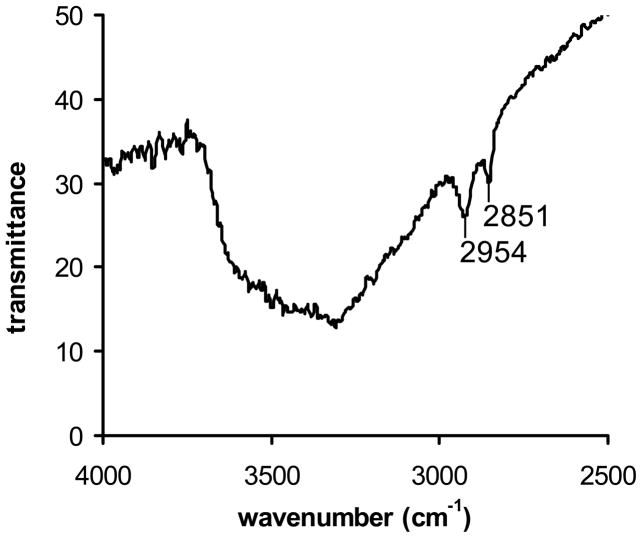
The FTIR spectrum of functionalized porous glass 1, in which the C-Hx stretching modes observed at 2851 and 2954 cm−1 were assigned to saturated carbons of the spacer methylene groups indicating that 12 and (CH3O)3SiCH2CH2CH2I (1:3 ratio) were anchored to the PVG surface. The FTIR spectrum of a clean piece of PVG was not identical, no C-Hx stretching modes were observed.
Figure 3
Figure 3
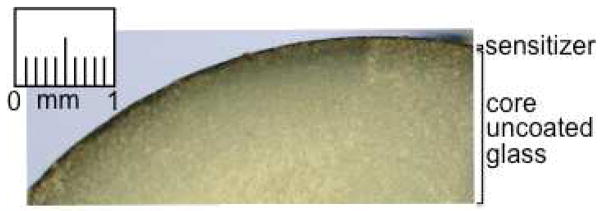
A low-magnification (10×) cross-sectional optical image. The dark green thin coating shows the depth of 1 accessed into PVG. The image shows ~0.08 mm penetration depth on the outer face of the cylinder-shaped PVG cap 1 (diameter 5.0 mm × length 8.0 mm).
Figure 4
Figure 4
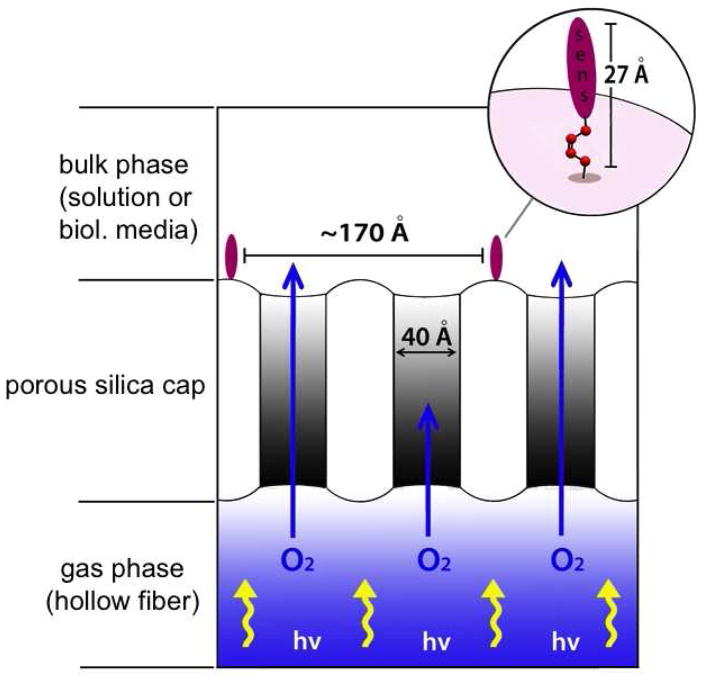
Schematic of the sensitizer functionalized porous cap 1 where oxygen and light come internally from the hollow optical fiber. Typically 0.3 μmol or 0.33% silane 12 was loaded per g PVG. The sensitizer may adopt various conformations on the isotropic PVG material.
Figure 5
Figure 5
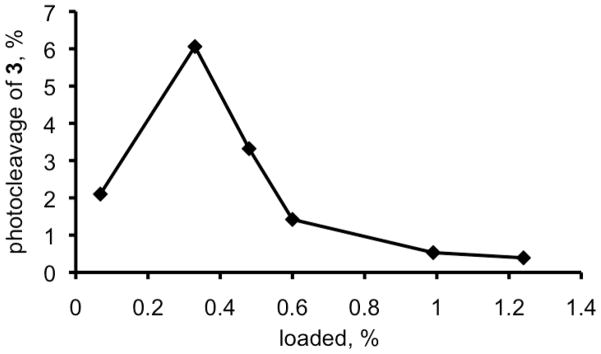
Percent of 3 photoreleased into toluene-d8 solution from the porous cap 1. Silane 12 was loaded in 0.06 to 1.1 μmol amounts (0.068 to 1.24%) onto porous Vycor glass per gram and was exposed to white light.
Figure 6
Figure 6
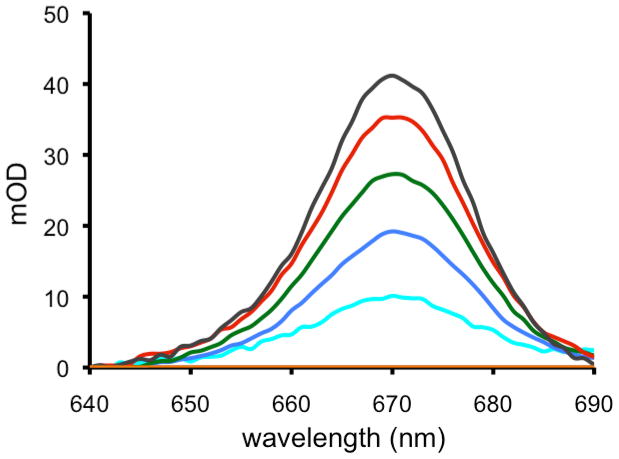
Time course of photorelease of 3 into toluene-d8 solution arising from photooxidative cleavage and departure from the fiber optic device tip. The absorption spectra show the fourth Q-band of 3 and were normalized at 640 nm: (a) orange 0.0 h, (b) turquoise 0.5 h, (c) blue 1.0 h, (d) green 1.5 h, (e) red 2.0 h, and (f) black 4.0 h.
Figure 7
Figure 7
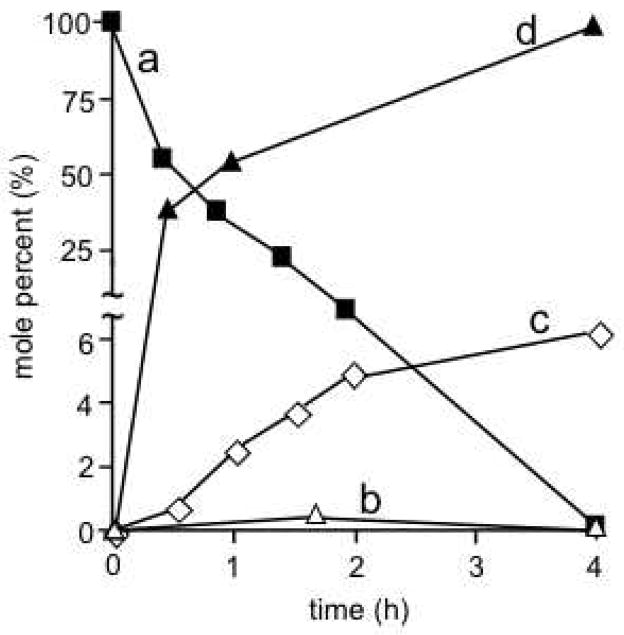
Reaction profile of fiber optic delivering light and oxygen to the probe tip (a) percent sensitizer bioconjugate 1, (b) percent surface-bound dioxetane 2, (c) percent 3 photoreleased into toluene-d8 at room temperature, and (d) percent 3 photoreleased into petrolatum at 65 °C.
Figure 8
Figure 8
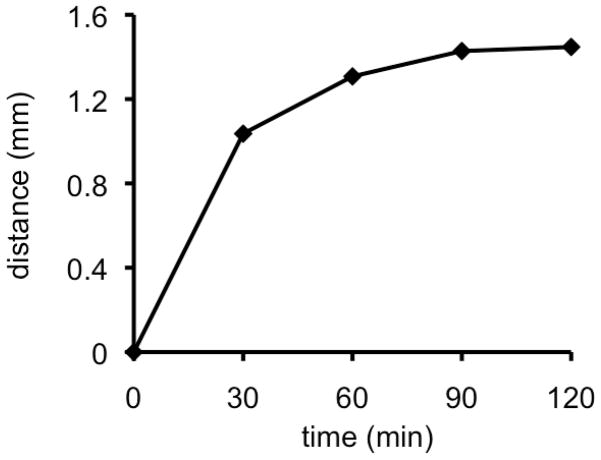
Time course of the diffusion of 3 away from the probe tip into petrolatum at 65 °C.
Figure 9
Figure 9
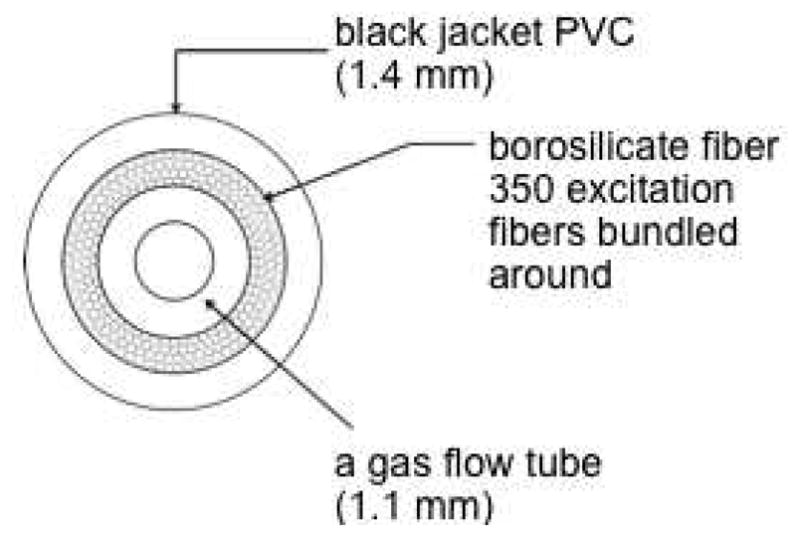
A schematic cross-section picture of the hollow-core fiber optic, in which ~350 excitation fibers surround the Teflon inner flow tube coaxially.
Scheme 1<sup>a</sup>
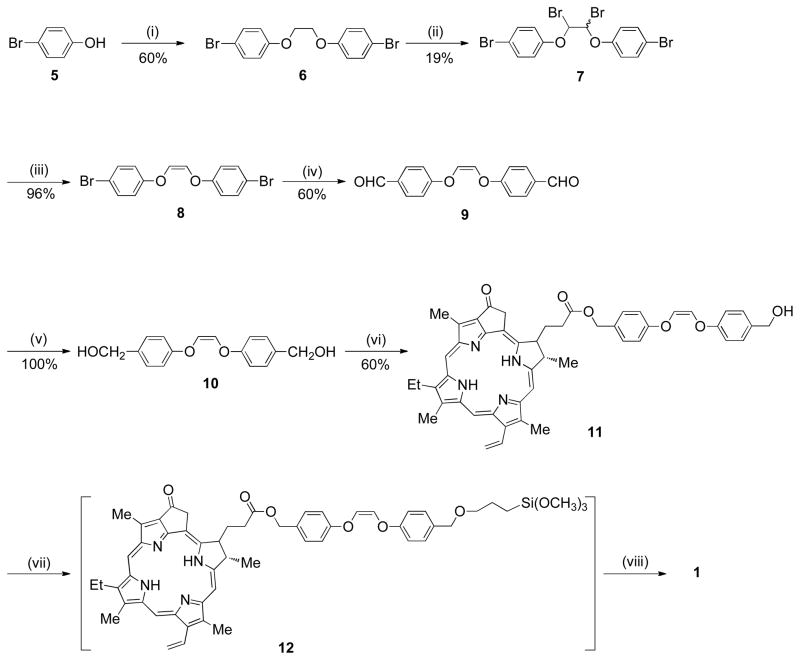
Scheme 1a. Synthesis of Sensitizer Functionalized Cap 1
aReagents and conditions: (i) BrCH2CH2Br, NaOH, 100 °C, 6 h; (ii) NBS, benzoyl peroxide, CCl4, 80 °C, 6 h (meso-7 was carried on to step iii); (iii) NaI, acetone, 25 °C, 2 h; (iv) n-BuLi, DMF, THF, −78 °C, 3.5 h; (v) NaBH4, CH3OH, 25 °C, 14 h; (vi) pyropheophorbide-a, EDC, DMAP, CH2Cl2, 25 °C, 24 h; (vii) (CH3O)3SiCH2CH2CH2I, NaH, THF, under N2, 70 °C, 24 h; (viii) porous Vycor glass (pre-dried at 500 °C), toluene, reflux 110 °C, 24 h.
Scheme 2
Scheme 2
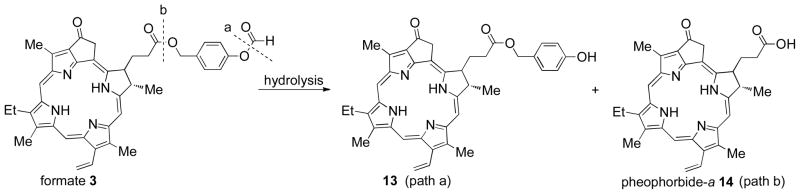
Stability of Photosensitizer 3 in Acid and Base Solution
Scheme 3
Scheme 3
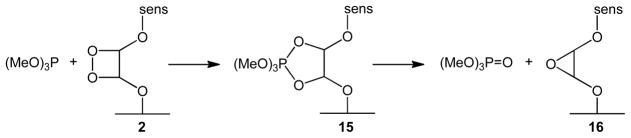
Scheme 4
Scheme 4
Scheme 5
Scheme 5

References

    1. Kessel D, Foster TH, editors. Symposium-In-Print: Photodynamic therapy. Photochem Photobiol. 2007;83:995–1282.
    1. Recommendations for occupational safety and health: Compendium of policy documents and statements. Cincinnati, OH: U.S. Department of Health and Human Services, Public Health Service, Centers for Disease Control, National Institute for Occupational Safety and Health; DHHS (NIOSH) Publication No. 92-100.
    1. Flickinger ST, Patel M, Binkowski BF, Lowe AM, Li MH, Kim C, Cerrina F, Belshaw PJ. Org Lett. 2006;8:2357–2360. - PubMed
    2. Cano M, Ladlow M, Balasubramanian S. J Org Chem. 2002;67:129–135. - PubMed
    3. Pirrung MC, Fallon L, Lever DC, Shuey SW. J Org Chem. 1996;61:2129–2136.
    1. Kammari L, Solomek T, Ngoy BP, Heger D, Klán P. J Am Chem Soc. 2010;132:11431–11433. - PubMed
    2. Xie Z, Hu X, Chen X, Sun J, Shi Q, Jing X. Biomacromolecules. 2008;9:376–380. - PubMed
    3. Kessler M, Glatthar R, Giese B, Bochet CG. Org Lett. 2003;5:1179–1181. - PubMed
    4. Singh AK, Khade PK. Bioconjugate Chem. 2002;13:1286–1291. - PubMed
    5. Hu J, Zhang J, Liu F, Kittredge K, Whitesell JK, Fox MA. J Am Chem Soc. 2001;123:1464–1470.
    6. Smet M, Liao LX, Dehaen W, McGrath DV. Org Lett. 2000;2:511–513. - PubMed
    1. Givens RS, Weber JFW, Conrad PG, Orosz G, Donahue SL, Thayer SA. J Am Chem Soc. 2000;122:2687–2697.
    2. Givens R. In: CRC Handbook of Organic Photochemistry and Photobiology. 2. Horspool WM, Lenci F, editors. CRC Press; Boca Raton, FL: 2003. pp. 1–46.

Publication types

MeSH terms

Substances