


Socioeconomic status and weight gain in early infancy
- PMID: 21540830
- PMCID: PMC3145137
- DOI: 10.1038/ijo.2011.88
Socioeconomic status and weight gain in early infancy
Abstract
Context: The association between low socioeconomic status (SES) and childhood obesity foreshadows lifelong inequalities in health. Insight into the causal mechanisms linking childhood adversity to long-term health could be provided by discovering when the negative SES gradient in weight emerges and what early life experiences are associated with it.
Objective: SES differences in infant weight gain in the first 3 months of life were examined, and contributions of parental body mass index, maternal smoking and feeding method to this association were assessed.
Design: Observational study using longitudinal weight data from 2402 families taking part in the Gemini Study; a twin birth cohort recruited from all twin births between March and December 2007 in England and Wales.
Outcome measures: Infant weights at birth and 3 months converted to standard deviation scores (SDS), change in weight SDS and rapid growth. SES was indexed by occupation and maternal education.
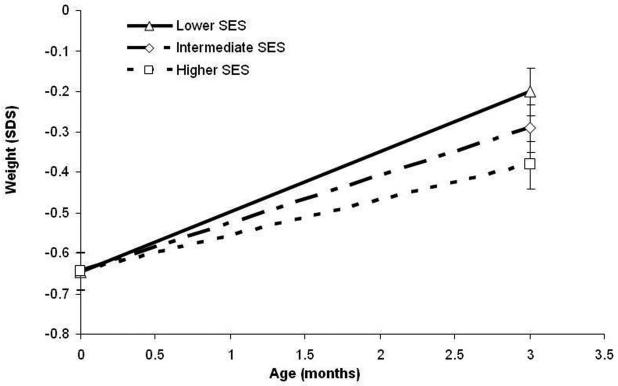
Results: There were no SES differences in birth weight, but lower SES was associated with higher 3-month weight, greater change in weight and a higher prevalence of rapid growth (all P < 0.01), with graded associations across levels of SES. Including parental overweight or smoking in pregnancy in the regression model did not affect the association between SES and weight gain, but including feeding method attenuated the SES effect on weight gain by at least 62% and rendered it nonsignificant.
Conclusion: The foundations for lifelong socioeconomic inequalities in obesity risk may be laid in early infancy, with infant-feeding practices having a part in the diverging weight trajectories.
Figures
References
-
- Dennison BA, Edmunds LS, Stratton HH, Pruzek RM. Rapid infant weight gain predicts childhood overweight. Obesity (Silver Spring) 2006;14:491–499. - PubMed
-
- Ong KK, Loos RJ. Rapid infancy weight gain and subsequent obesity: systematic reviews and hopeful suggestions. Acta Paediatr. 2006;95:904–908. - PubMed
-
- Herman KM, Craig CL, Gauvin L, Katzmarzyk PT. Tracking of obesity and physical activity from childhood to adulthood: the Physical Activity Longitudinal Study. Int J Pediatr Obes. 2009;4:281–288. - PubMed
-
- Sorof JM, Lai D, Turner J, Poffenbarger T, Portman RJ. Overweight, ethnicity, and the prevalence of hypertension in school-aged children. Pediatrics. 2004;113:475–482. - PubMed
Publication types
MeSH terms
Grants and funding
LinkOut - more resources
Full Text Sources
