


Vascular phenotypes in primary non-small cell lung carcinomas and matched brain metastases
- PMID: 21540863
- PMCID: PMC3111192
- DOI: 10.1038/bjc.2011.147
Vascular phenotypes in primary non-small cell lung carcinomas and matched brain metastases
Abstract
Background: Anti-angiogenic therapy with bevacizumab (an anti-vascular endothelial growth factor (VEGF) antibody) predominantly targets immature blood vessels. Bevacizumab has shown a survival benefit in non-small cell lung carcinoma (NSCLC) and has recently been demonstrated to be safe in patients with brain metastases. However, it is not known whether bevacizumab is effective against brain metastases or whether metastases are representative of their primary in terms of VEGF expression, hypoxia, proliferation and vascular phenotype. The aim of this study was to evaluate these factors in a series of matched primary NSCLCs and brain metastases.
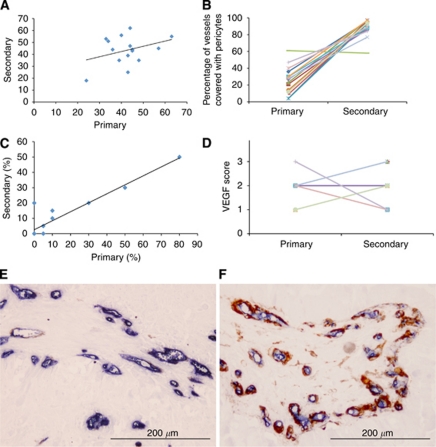
Methods and results: Immunohistochemistry showed strong correlation of carbonic anhydrase 9 expression (a marker of hypoxia) in primary and secondary cancers (P=0.0002). However, the proliferation index, VEGF expression, microvessel density and the proportion of mature vessels were discordant between primary and secondary cancers. The mean proportion of mature vessels was 63.2% higher in the brain metastases than the primary tumours (P=0.004). Moreover, the vascular pattern of the primary tumour was not representative of the metastasis.
Conclusions: Brain metastases have a significantly higher proportion of mature vasculature, suggesting that they may be refractory to anti-VEGF therapy. These findings may have implications for clinical trials and biomarker studies evaluating anti-angiogenic agents in brain metastases.
Conflict of interest statement
Dr Adrian M Jubb received a speaker's honorarium in 2010 from Genentech Inc., which is developing anti-angiogenic therapies.
Figures
References
-
- Besse B, Lasserre SF, Compton P, Huang J, Augustus S, Rohr UP (2010) Bevacizumab safety in patients with central nervous system metastases. Clin Cancer Res 16: 269–278 - PubMed
-
- Fox SB, Leek RD, Weekes MP, Whitehouse RM, Gatter KC, Harris AL (1995) Quantitation and prognostic value of breast cancer angiogenesis: comparison of microvessel density, Chalkley count, and computer image analysis. J Pathol 177: 275–283 - PubMed
-
- Gerstner ER, Frosch MP, Batchelor TT (2010) Diffusion magnetic resonance imaging detects pathologically confirmed, nonenhancing tumor progression in a patient with recurrent glioblastoma receiving bevacizumab. J Clin Oncol 28: e91–e93 - PubMed
-
- Giatromanolaki A, Koukourakis MI, Sivridis E, Pastorek J, Wykoff CC, Gatter KC, Harris AL (2001) Expression of hypoxia-inducible carbonic anhydrase-9 relates to angiogenic pathways and independently to poor outcome in non-small cell lung cancer. Cancer Res 61: 7992–7998 - PubMed
-
- Grothey A, Hedrick EE, Mass RD, Sarkar S, Suzuki S, Ramanathan RK, Hurwitz HI, Goldberg RM, Sargent DJ (2008) Response-independent survival benefit in metastatic colorectal cancer: a comparative analysis of N9741 and AVF2107. J Clin Oncol 26: 183–189 - PubMed
Publication types
MeSH terms
Substances
Grants and funding
LinkOut - more resources
Full Text Sources
Medical
