. 2010 Winter;43(4):569-89.
doi: 10.1901/jaba.2010.43-569.

An investigation of differential reinforcement of alternative behavior without extinction

Affiliations

An investigation of differential reinforcement of alternative behavior without extinction

Elizabeth S Athens et al. J Appl Behav Anal. 2010 Winter.

Abstract

We manipulated relative reinforcement for problem behavior and appropriate behavior using differential reinforcement of alternative behavior (DRA) without an extinction component. Seven children with developmental disabilities participated. We manipulated duration (Experiment 1), quality (Experiment 2), delay (Experiment 3), or a combination of each (Experiment 4), such that reinforcement favored appropriate behavior rather than problem behavior even though problem behavior still produced reinforcement. Results of Experiments 1 to 3 showed that behavior was often sensitive to manipulations of duration, quality, and delay in isolation, but the largest and most consistent behavior change was observed when several dimensions of reinforcement were combined to favor appropriate behavior (Experiment 4). Results suggest strategies for reducing problem behavior and increasing appropriate behavior without extinction.

Keywords: attention deficit hyperactivity disorder; autism; concurrent schedules; differential reinforcement; extinction; problem behavior.


Figures
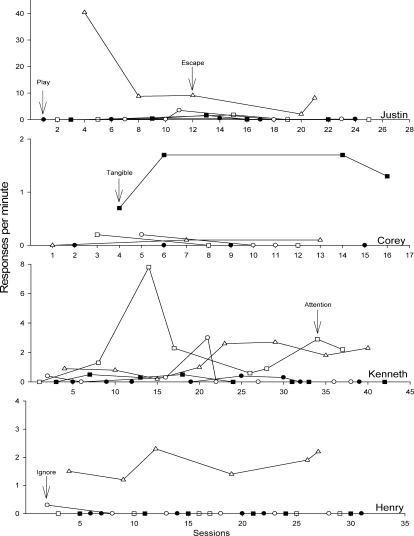
Figure 1
Figure 1
Response rates during the functional analysis for Justin, Corey, Kenneth, and Henry.
Figure 2
Figure 2
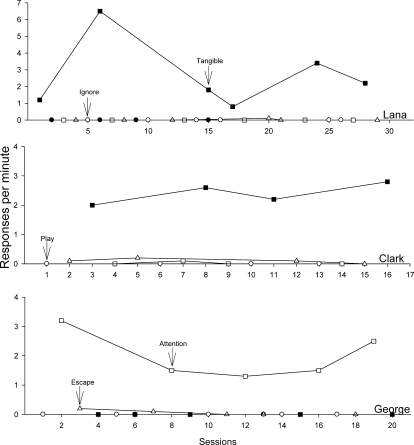
Response rates during the functional analysis for Lana, Clark, and George.
Figure 3
Figure 3
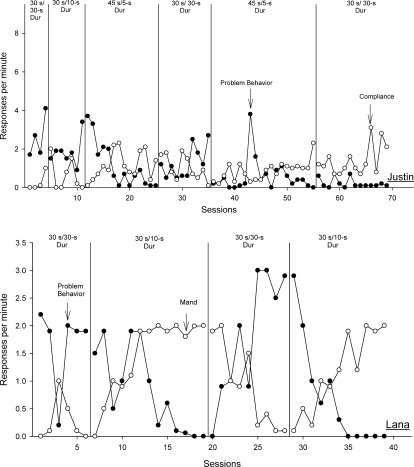
Justin's and Lana's response rates during the duration analysis for problem behavior and appropriate behavior.
Figure 4
Figure 4
Response rates for Justin and Kenneth during the quality analysis for problem behavior and appropriate behavior.
Figure 5
Figure 5
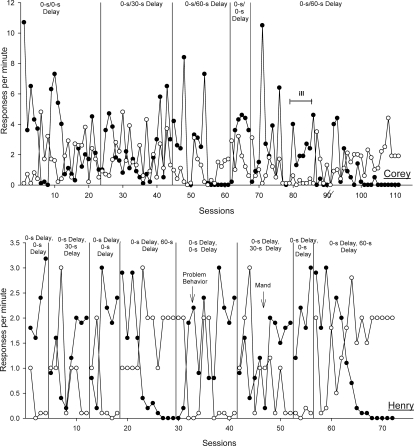
Corey's and Henry's response rates during the delay analysis for problem behavior and appropriate behavior.
Figure 6
Figure 6
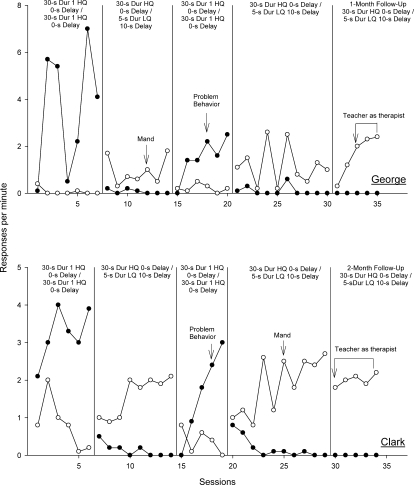
George's and Clark's response rates for problem behavior and appropriate behavior.

References

    1. Baum W.M. Choice in free-ranging wild pigeons. Science. 1974;185:78–79. - PubMed
    1. Bijou S.W, Peterson R.F, Ault M.H. A method to integrate descriptive and experimental field studies at the level of data and empirical concepts. Journal of Applied Behavior Analysis. 1968;1:175–191. - PMC - PubMed
    1. Borrero C.S.W, Vollmer T.R, Borrero J.C, Bourret J. A method for evaluating the dimensions of reinforcement in parent-child interactions. Research in Developmental Disabilities. 2005;26:577–592. - PubMed
    1. Bostow D.E, Bailey J.B. Modification of severe disruptive and aggressive behavior using brief timeout and reinforcement procedures. Journal of Applied Behavior Analysis. 1969;2:31–37. - PMC - PubMed
    1. Catania A.C. Concurrent performances: A baseline for the study of reinforcement magnitude. Journal of the Experimental Analysis of Behavior. 1963;6:299–300. - PMC - PubMed