. 2010 Nov;94(3):267-82.
doi: 10.1901/jeab.2010.94-267.

Reflexivity in pigeons

Affiliations

Reflexivity in pigeons

Mary M Sweeney et al. J Exp Anal Behav. 2010 Nov.

Abstract

A recent theory of pigeons' equivalence-class formation (Urcuioli, 2008) predicts that reflexivity, an untrained ability to match a stimulus to itself, should be observed after training on two "mirror-image" symbolic successive matching tasks plus identity successive matching using some of the symbolic matching stimuli. One group of pigeons was trained in this fashion; a second group was trained similarly but with successive oddity (rather than identity). Subsequently, comparison-response rates on novel matching versus mismatching sequences with the remaining symbolic matching stimuli were measured on nonreinforced probe trials. Higher rates were observed on matching than on mismatching probes in the former group. The opposite effect--higher rates on mismatching than matching probes--was mostly absent in the latter group, despite being predicted by the theory. Nevertheless, the ostensible reflexivity effect observed in former group may be the first time this phenomenon has been demonstrated in any animal.

Keywords: emergent oddity; key peck; pigeons; reflexivity; stimulus classes; stimulus equivalence; successive matching.


Figures
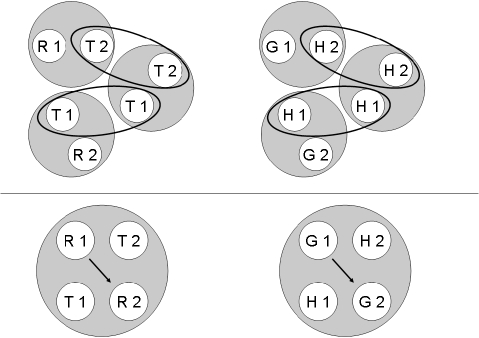
Fig 1
Fig 1
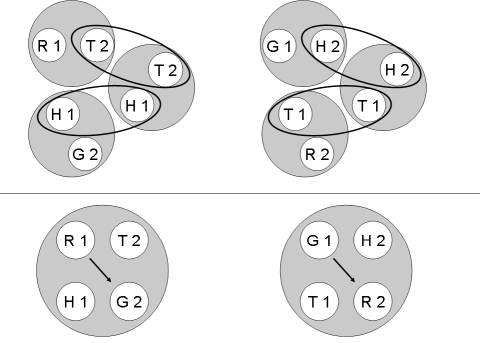
Top panel: The six stimulus classes hypothesized to develop from the reinforced sample-comparison sequences for the two symbolic and form-identity baseline matching tasks for Group Identity. Ellipses highlight common class members. Bottom panel: Two 4-member stimulus classes hypothesized to arise from the merger of the stimulus classes shown in the top panel via their common elements. Arrows indicate sample-comparison sequences to which the Group Identity pigeons should preferentially respond in a reflexivity test. R  =  red, G  =  green, T  =  triangle, H  =  horizontal, 1  =  first ordinal position within a matching trial, 2  =  second ordinal position within a matching trial.
Fig 2
Fig 2
Top panel: The six stimulus classes hypothesized to develop from the reinforced sample-comparison combinations for the two symbolic and form-oddity baseline matching tasks for Group Oddity. Ellipses highlight common class members. Bottom panel: Two 4-member stimulus classes hypothesized to arise from the merger of the stimulus classes shown in the top panel via their common elements. Arrows indicate sample-comparison sequences to which the Group Oddity pigeons should preferentially respond in a reflexivity test. R  =  red, G  =  green, T  =  triangle, H  =  horizontal, 1  =  first ordinal position within a matching trial, 2  =  second ordinal position within a matching trial.
Fig 3
Fig 3
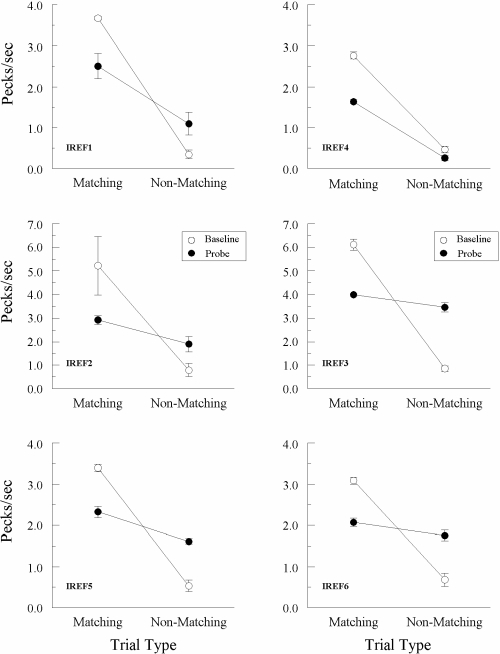
Comparison pecks/sec (± 1 SEM) on form-identity baseline trials (open circles) and nonreinforced reflexivity probe trials (filled circles) averaged over the eight initial test sessions for each Group Identity pigeon. Matching  =  trials on which the comparison physically matched the preceding sample. Non-matching  =  trials on which the comparison did not physically match the preceding sample. Note that the ordinate for 2 of the pigeons (IREF2 and IREF3) differs from the other 4 pigeons.
Fig 4
Fig 4
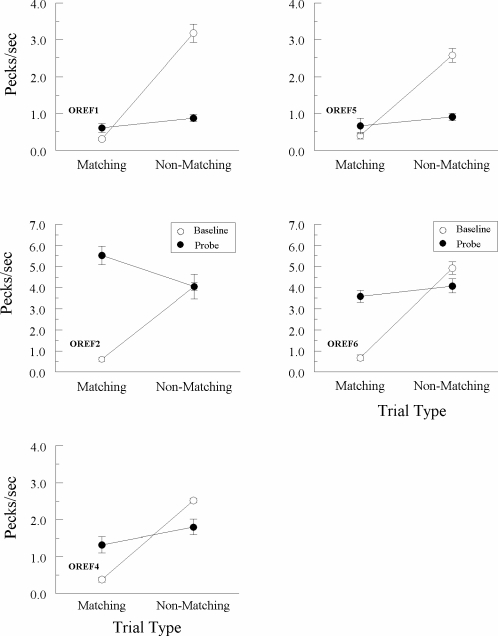
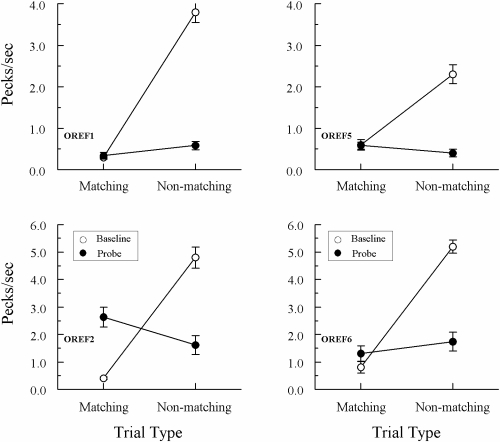
Comparison pecks/sec (± 1 SEM) on form-oddity baseline trials (open circles) and nonreinforced reflexivity probe trials (filled circles) averaged over the eight initial test sessions for each Group Oddity pigeon. Matching  =  trials on which the comparison physically matched the preceding sample. Non-matching  =  trials on which the comparison did not physically match the preceding sample. Note that the ordinate for 2 of the pigeons (OREF2 and OREF6) differs from the other 3 pigeons.
Fig 5
Fig 5
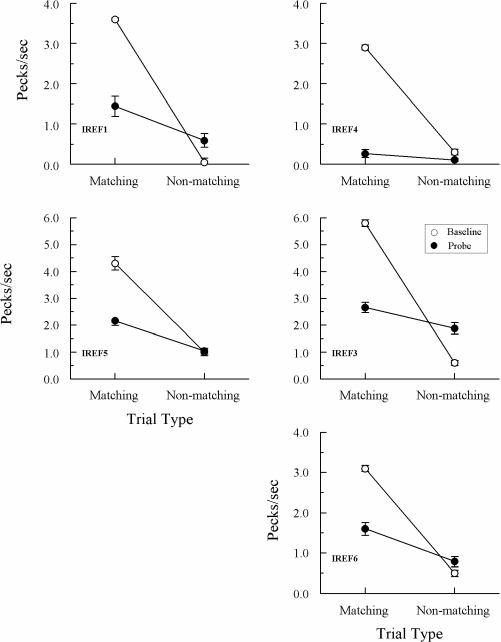
Comparison pecks/sec (± 1 SEM) on form-identity baseline trials (open circles) and nonreinforced reflexivity probe trials (filled circles) averaged over the subsequent 10 consecutive test sessions for each Group Identity pigeon. Matching  =  trials on which the comparison physically matched the preceding sample. Non-matching  =  trials on which the comparison did not physically match the preceding sample. Note that the ordinate for IREF3 and IREF5 differs from that for the other 3 pigeons.
Fig 6
Fig 6
Comparison pecks/sec (± 1 SEM) on form-oddity baseline trials (open circles) and non-reinforced reflexivity probe trials (filled circles) averaged over the subsequent 10 consecutive test sessions for each Group Oddity pigeon. Matching  =  trials on which the comparison physically matched the preceding sample. Non-matching  =  trials on which the comparison did not physically match the preceding sample. Note that the ordinate for pigeons OREF1 and OREF5 differs from that for pigeons OREF2 and OREF6.

Comment in

References

    1. Astley S.L, Wasserman E.A. Superordinate category formation in pigeons: Association with a common delay or probability of reinforcement makes perceptually dissimilar stimuli functionally equivalent. Journal of Experimental Psychology: Animal Behavior Processes. 1999;25:415–432. - PubMed
    1. Berryman R, Cumming W.W, Cohen L.R, Johnson D.F. Acquisition and transfer of simultaneous oddity. Psychological Reports. 1965;17:767–775. - PubMed
    1. Bovet D, Vauclair J. Functional categorization of objects and of their pictures in baboons (Papio anubis) Learning and Motivation. 1998;29:309–322.
    1. Carter D.E, Werner T.J. Complex learning and information processing by pigeons: A critical analysis. Journal of the Experimental Analysis of Behavior. 1978;29:565–601. - PMC - PubMed
    1. Cook R.G, Kelly D.M, Katz J.S. Successive two-item same–different discriminations and concept learning by pigeons. Behavioural Processes. 2003;62:125–144. - PubMed

Publication types

LinkOut - more resources