


Relation between methylmercury exposure and plasma paraoxonase activity in inuit adults from Nunavik
- PMID: 21543280
- PMCID: PMC3237359
- DOI: 10.1289/ehp.1003296
Relation between methylmercury exposure and plasma paraoxonase activity in inuit adults from Nunavik
Abstract
Background: Methylmercury (MeHg) exposure has been linked to an increased risk of coronary heart disease (CHD). Paraoxonase 1 (PON1), an enzyme located in the high-density-lipoprotein (HDL) fraction of blood lipids, may protect against CHD by metabolizing toxic oxidized lipids associated with low-density liproprotein and HDL. MeHg has been shown to inhibit PON1 activity in vitro, but this effect has not been studied in human populations.
Objectives: This study was conducted to determine whether blood mercury levels are linked to decreased plasma PON1 activities in Inuit people who are highly exposed to MeHg through their seafood-based diet.
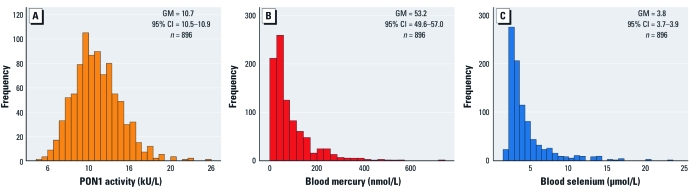
Methods: We measured plasma PON1 activity using a fluorogenic substrate and blood concentrations of mercury and selenium by inductively coupled plasma mass spectrometry in 896 Inuit adults. Sociodemographic, anthropometric, clinical, dietary, and lifestyle variables as well as PON1 gene variants (rs705379, rs662, rs854560) were considered as possible confounders or modifiers of the mercury-PON1 relation in multivariate analyses.
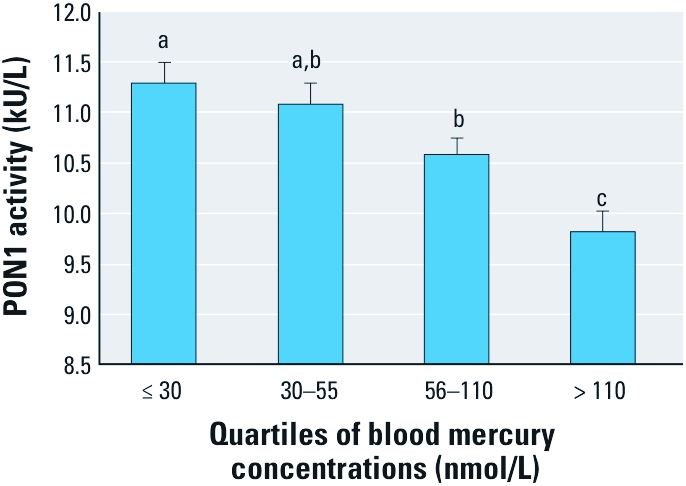
Results: In a multiple regression model adjusted for age, HDL cholesterol levels, omega-3 fatty acid content of erythrocyte membranes, and PON1 variants, blood mercury concentrations were inversely associated with PON1 activities [β-coefficient = -0.063; 95% confidence interval (CI), -0.091 to -0.035; p < 0.001], whereas blood selenium concentrations were positively associated with PON1 activities (β-coefficient = 0.067; 95% CI, 0.045-0.088; p < 0.001). We found no interaction between blood mercury levels and PON1 genotypes.
Conclusions: Our results suggest that MeHg exposure exerts an inhibitory effect on PON1 activity, which seems to be offset by selenium intake.
Conflict of interest statement
The authors declare they have no actual or potential competing financial interests.
Figures
Comment in
-
Precarious balance: methylmercury, selenium, and cardiovascular health.Environ Health Perspect. 2011 Aug;119(8):A354. doi: 10.1289/ehp.119-a354a. Environ Health Perspect. 2011. PMID: 21807590 Free PMC article. No abstract available.
References
-
- Aviram M. Review of human studies on oxidative damage and antioxidant protection related to cardiovascular diseases. Free Radic Res. 2000;33(suppl):S85–S97. - PubMed
-
- Bang HO, Dyerberg J, Nielsen AB. Plasma lipid and lipoprotein pattern in Greenlandic West-coast Eskimos. Lancet. 1971;1:1143–1145. - PubMed
-
- Boesch-Saadatmandi C, Rimbach G, Schrader C, Kofler BM, Armah CK, Minihane AM. Determinants of paraoxonase activity in healthy adults. Mol Nutr Food Res. 2010;54:1842–1850. - PubMed
-
- Carvalho CM, Chew EH, Hashemy SI, Lu J, Holmgren A. Inhibition of the human thioredoxin system. A molecular mechanism of mercury toxicity. J Biol Chem. 2008;283:11913–11923. - PubMed
Publication types
MeSH terms
Substances
LinkOut - more resources
Full Text Sources
Miscellaneous