. 2011 Jul 1;286(26):22777-84.
doi: 10.1074/jbc.M111.239988. Epub 2011 May 4.

Inactivation kinetics of a new target of beta-lactam antibiotics

Affiliations

Inactivation kinetics of a new target of beta-lactam antibiotics

Sébastien Triboulet et al. J Biol Chem. .

Abstract

Peptidoglycan is predominantly cross-linked by serine DD-transpeptidases in most bacterial species. The enzymes are the essential targets of β-lactam antibiotics. However, unrelated cysteine LD-transpeptidases have been recently recognized as a predominant mode of peptidoglycan cross-linking in Mycobacterium tuberculosis and as a bypass mechanism conferring resistance to all β-lactams, except carbapenems such as imipenem, in Enterococcus faecium. Investigation of the mechanism of inhibition of this new β-lactam target showed that acylation of the E. faecium enzyme (Ldt(fm)) by imipenem is irreversible. Using fluorescence kinetics, an original approach was developed to independently determine the catalytic constants for imipenem binding (k(1) = 0.061 μM(-1) min(-1)) and acylation (k(inact) = 4.5 min(-1)). The binding step was limiting at the minimal drug concentration required for bacterial growth inhibition. The Michaelis complex was committed to acylation because its dissociation was negligible. The emergence of imipenem resistance involved substitutions in Ldt(fm) that reduced the rate of formation of the non-covalent complex but only marginally affected the efficiency of the acylation step. The methods described in this study will facilitate development of new carbapenems active on extensively resistant M. tuberculosis.


Figures
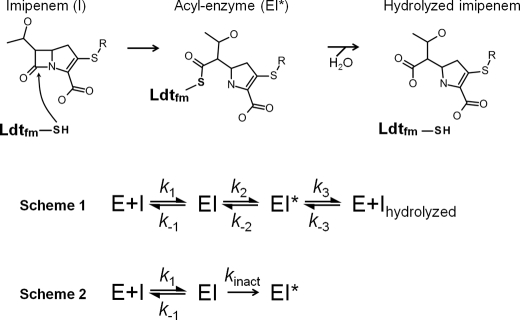
FIGURE 1.
FIGURE 1.
Acylation of Ldtfm by imipenem. Imipenem is a suicide substrate of the ld-transpeptidase. Nucleophilic attack of the carbonyl of the β-lactam ring by the sulfur of the catalytic cysteine results in the formation of a thioester bond. The resulting acylenzyme is potentially hydrolyzed, thereby generating free enzyme and hydrolyzed imipenem. Reaction scheme 1 (Scheme 1) describes a full catalytic cycle comprising three reversible steps. Reaction scheme 2 (Scheme 2) describes irreversible enzyme acylation.
FIGURE 2.
FIGURE 2.
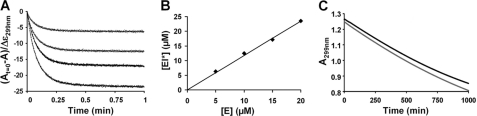
Irreversible acylation of Ldtfm by imipenem. A, kinetics of acylation of Ldtfm (5, 10, 15, and 20 μm) by imipenem (100 μm) were followed by absorbance at 299 nm. In order to estimate the concentration of imipenem with a ruptured β-lactam ring, the reduction in absorbance (At = A0A) was divided by the difference in the molar extinction coefficients of imipenem and hydrolyzed imipenem × 10−6 (Δϵ = −7,100 m−1 cm−1). B, the concentration of imipenem with a ruptured β-lactam ring was plotted as a function of enzyme concentration. C, imipenem (100 μm) was incubated in the absence (lower gray curve) or in the presence (upper black curve) of Ldtfm (2.5 μm).
FIGURE 3.
FIGURE 3.
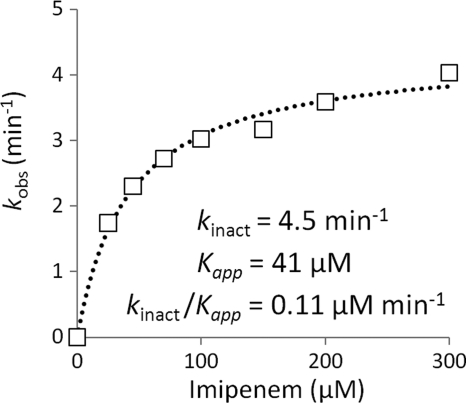
Kinetic analyses of Ldtfm inactivation by spectrophotometry. Ldtfm (10 μm) was incubated with imipenem (25, 45, 70, 100, 150, 200, and 300 μm), and regression analyses of the kinetics of formation of the acylenzyme (EI*) were performed with the equation, [EI*] = [Etotal](1 − ekobst), in which [Etotal] represents the total enzyme concentration, kobs is a constant, and t is time. For determination of the catalytic constants kinact and Kapp, the values of kobs were plotted as a function of imipenem concentration [I], and regression analysis was performed using the equation, kobs = kinact[I]/Kapp + [I], in which kinact is the first-order constant for acylenzyme formation, and Kapp is a constant.
FIGURE 4.
FIGURE 4.
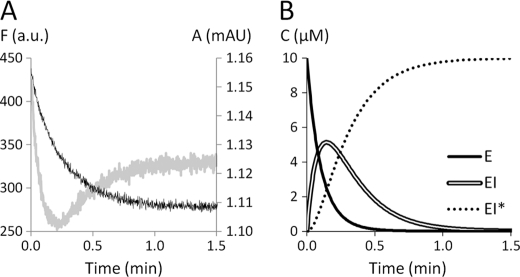
Detection of the non-covalent complex by spectrofluorimetry. A, Ldtfm (10 μm) was incubated with imipenem (150 μm), and enzyme inactivation was monitored by spectrofluorimetry (gray curve). Fluorescence intensity (arbitrary units (a.u.); left axis) was determined at λex = 225 nm and λem = 335 nm. Absorbance (milliabsorbance units (mAU); right axis) was determined at 299 nm (black curve). B, simulation of the variations in the concentrations of the three forms of the enzyme. The initial concentrations of enzyme (E = Etotal at time 0) and inhibitor (I = Itotal at time 0) were 10 and 150 μm, respectively. The values 0.065 μm−1 min−1, 0.1 min−1, and 4.5 min−1 were attributed to the catalytic constants k1, k−1, and kinact, respectively.
FIGURE 5.
FIGURE 5.
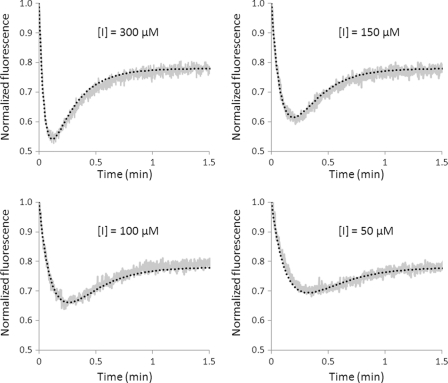
Analyses of Ldtfm inactivation at various concentrations of imipenem by spectrofluorimetry. Ldtfm (10 μm) was incubated with imipenem (300, 150, 100, and 50 μm), and enzyme inactivation was monitored by spectrofluorimetry. The gray and dotted black curves correspond to normalized fluorescence for experimental data points and a simulation, respectively. The simulation was performed with values of 0.065 μm−1 min−1, 0.1 min−1, and 4.5 min−1 for the catalytic constants k1, k−1, and kinact, respectively. The relative fluorescence intensities used for the simulation were 750, 250, and 585 arbitrary units for E, EI, and EI*, respectively.
FIGURE 6.
FIGURE 6.
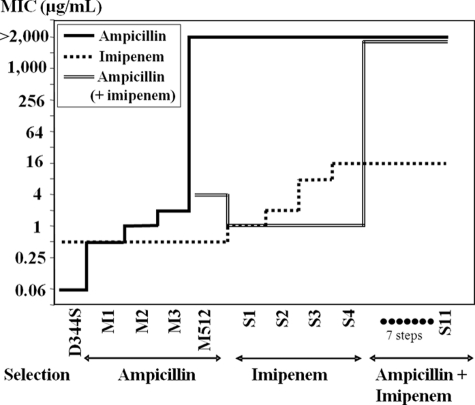
MICs of β-lactams for E. faecium mutants. Mutants M1, M2, M3, and M512 were obtained by four consecutive selections steps on increasing concentrations of ampicillin. Four additional selection steps with imipenem led to mutant S4, which was resistant to imipenem (MIC = 16 μg/ml) but remained susceptible to ampicillin (4 μg/ml) in the presence of imipenem (2 μg/ml). MICs of ampicillin were determined in the presence of 0.5, 1, and 2 μg/ml imipenem for mutants S1, S2, and S3. Mutant S11 was obtained from mutant S4 by seven selection steps in broth containing 4 μg/ml of imipenem and increasing concentrations of ampicillin. This mutant was resistant to the combination of imipenem (4 μg/ml) and ampicillin (>2,000 μg/ml).
FIGURE 7.
FIGURE 7.
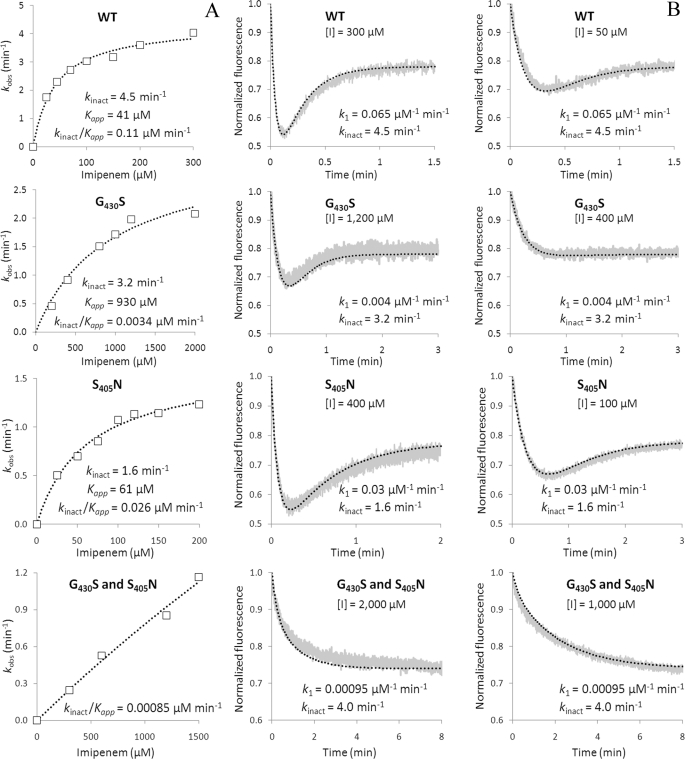
Impact of amino acid substitutions S405N and G430S on the kinetics of Ldtfm inactivation by imipenem. A, determination of the catalytic constants kinact and Kapp by spectrophotometry. The values of kobs were plotted as a function of imipenem concentration [I], and regression analysis was performed using the equation, kobs = kinact[I]/Kapp + [I], in which kinact is the first-order constant for acylenzyme formation and Kapp is a constant. B, determination of the catalytic constants k1 by spectrofluorimetry. The charts present examples of kinetics at two different concentrations of imipenem. The gray and black curves correspond to normalized fluorescence for experimental data points and the simulations, respectively. The simulations were performed with the indicated values of k1 and kinact. A value of 0.1 min−1 was used for k−1 for all kinetics. WT, wild-type enzyme.

References

    1. Sauvage E., Kerff F., Terrak M., Ayala J. A., Charlier P. (2008) FEMS Microbiol. Rev. 32, 234–258 - PubMed
    1. Mainardi J. L., Villet R., Bugg T. D., Mayer C., Arthur M. (2008) FEMS Microbiol. Rev. 32, 386–408 - PubMed
    1. Mainardi J. L., Fourgeaud M., Hugonnet J. E., Dubost L., Brouard J. P., Ouazzani J., Rice L. B., Gutmann L., Arthur M. (2005) J. Biol. Chem. 280, 38146–38152 - PubMed
    1. Mainardi J. L., Hugonnet J. E., Rusconi F., Fourgeaud M., Dubost L., Moumi A. N., Delfosse V., Mayer C., Gutmann L., Rice L. B., Arthur M. (2007) J. Biol. Chem. 282, 30414–30422 - PubMed
    1. Mainardi J. L., Legrand R., Arthur M., Schoot B., van Heijenoort J., Gutmann L. (2000) J. Biol. Chem. 275, 16490–16496 - PubMed

Publication types

MeSH terms