


Postglacial migration supplements climate in determining plant species ranges in Europe
- PMID: 21543356
- PMCID: PMC3203492
- DOI: 10.1098/rspb.2010.2769
Postglacial migration supplements climate in determining plant species ranges in Europe
Abstract
The influence of dispersal limitation on species ranges remains controversial. Considering the dramatic impacts of the last glaciation in Europe, species might not have tracked climate changes through time and, as a consequence, their present-day ranges might be in disequilibrium with current climate. For 1016 European plant species, we assessed the relative importance of current climate and limited postglacial migration in determining species ranges using regression modelling and explanatory variables representing climate, and a novel species-specific hind-casting-based measure of accessibility to postglacial colonization. Climate was important for all species, while postglacial colonization also constrained the ranges of more than 50 per cent of the species. On average, climate explained five times more variation in species ranges than accessibility, but accessibility was the strongest determinant for one-sixth of the species. Accessibility was particularly important for species with limited long-distance dispersal ability, with southern glacial ranges, seed plants compared with ferns, and small-range species in southern Europe. In addition, accessibility explained one-third of the variation in species' disequilibrium with climate as measured by the realized/potential range size ratio computed with niche modelling. In conclusion, we show that although climate is the dominant broad-scale determinant of European plant species ranges, constrained dispersal plays an important supplementary role.
Figures
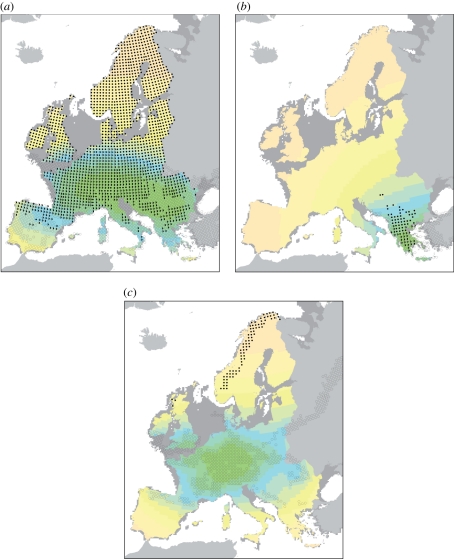
 or climate
  for selected species: (a) Filipendula ulmaria;
  64%,
64%,  0%; (b) Ranunculus psilostachys;
  14%,
14%,  45%; (c) Koenigia islandica;
  73%,
73%,  0%. Current distribution (black dots), hind-casting-based estimate of LGM distribution (empty circles), overlap between the two (half-filled circles) and accessibility to postglacial colonization from the estimated LGM range (green to orange: high to low). Maps are in the ETRS 1989 Lambert Azimuthal Equal Area projection.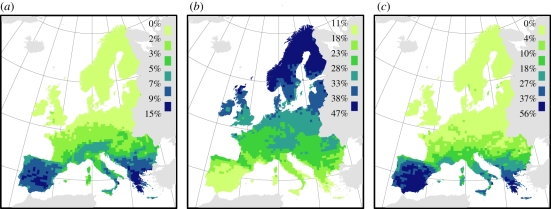
 , or (b) climate
  . (c) Percentage of species with
  >
>  . All values were calculated across species with a positive model-averaged accessibility coefficient (n = 655) in each ca 50 × 50 km AFE cell. Maps are in the ETRS 1989 Lambert Azimuthal Equal Area projection.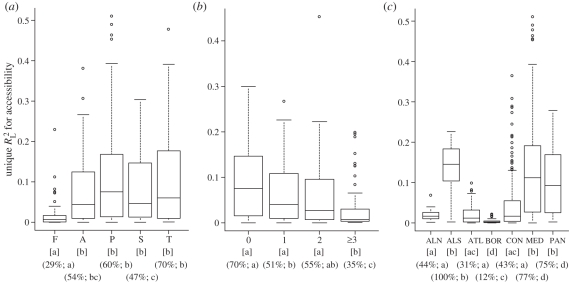
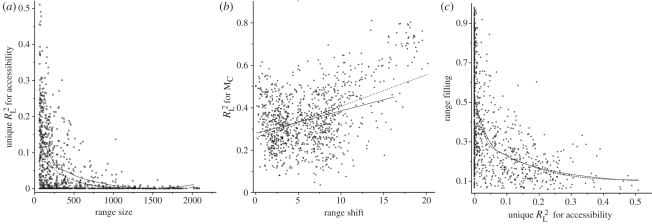
 for accessibility represent the variation in species occurrences uniquely explained by accessibility after controlling for the effect of climate (shown for all species, n = 1016). Linear and Gaussian local (loess, fitted with span = 0.75 and a quadratic term) regressions were fitted either for all species or only for species with a positive model-averaged accessibility coefficient (n = 655). (a) Dashed line with circles, all (loess: R2 0.23); solid line, βMA(A) > 0 (loess: R2 0.29); (b) dashed line with circles, all (linear: R2 0.20); solid line, βMA(A) > 0 (linear: R2 0.07); (c) dashed line with circles, all (loess: R2 0.35); solid line, βMA(A) > 0 (loess: R2 0.37).
References
-
- Pearson R. G., Dawson T. P. 2003. Predicting the impacts of climate change on the distribution of species: are bioclimate envelope models useful? Global Ecol. Biogeogr. 12, 361–371 10.1046/j.1466-822X.2003.00042.x (doi:10.1046/j.1466-822X.2003.00042.x) - DOI
-
- Gaston K. J. 2009. Geographic range limits: achieving synthesis. Proc. R. Soc. B 276, 1395–1406 10.1098/rspb.2008.1480 (doi:10.1098/rspb.2008.1480) - DOI - PMC - PubMed
-
- Prentice I. C., Bartlein P. J., Webb T. 1991. Vegetation and climate change in eastern North America since the Last Glacial Maximum. Ecology 72, 2038–2056 10.2307/1941558 (doi:10.2307/1941558) - DOI
-
- Lang G. 1994. Quartäre Vegetationsgeschichte Europas: Methoden und Ergebnisse Jena, Germany: Gustav Fischer Verlag
-
- Davis M. B. 1986. Climatic instability, time lags, and community disequilibrium. In Community Ecology (eds Diamond J., Case T. J.), pp. 269–284 New York, NY: Harper & Row
Publication types
MeSH terms
LinkOut - more resources
Full Text Sources
