


doi: 10.1128/JCM.00399-11.
Epub 2011 May 4.
Reevaluation of the taxonomic status of recently described species of Enterococcus: evidence that E. thailandicus is a senior subjective synonym of "E. sanguinicola" and confirmation of E. caccae as a species distinct from E. silesiacus
Affiliations
- PMID: 21543565
- PMCID: PMC3147853
- DOI: 10.1128/JCM.00399-11
Item in Clipboard
Reevaluation of the taxonomic status of recently described species of Enterococcus: evidence that E. thailandicus is a senior subjective synonym of "E. sanguinicola" and confirmation of E. caccae as a species distinct from E. silesiacus
J Clin Microbiol.
2011 Jul.
Erratum in
-
Correction for Shewmaker et al., Reevaluation of the Taxonomic Status of Recently Described Species of Enterococcus: Evidence that E. thailandicus Is a Senior Subjective Synonym of "E. sanguinicola" and Confirmation of E. caccae as a Species Distinct from E. silesiacus.J Clin Microbiol. 2016 Dec 28;55(1):344. doi: 10.1128/JCM.01953-16. Print 2017 Jan. J Clin Microbiol. 2016. PMID: 28031448 Free PMC article. No abstract available.
Abstract
Several of the more recently proposed new species of Enterococcus are nearly identical based on 16S rRNA gene sequence analysis and phenotypic traits. In the present study, DNA-DNA reassociation experiments, in conjunction with sequencing of the 16S rRNA and rpoB genes, provided evidence that "Enterococcus sanguinicola" and Enterococcus thailandicus actually represent the same species. In contrast, Enterococcus caccae and Enterococcus silesiacus, two other species with nearly identical 16S rRNA gene sequences, were confirmed to be separate species.
Figures
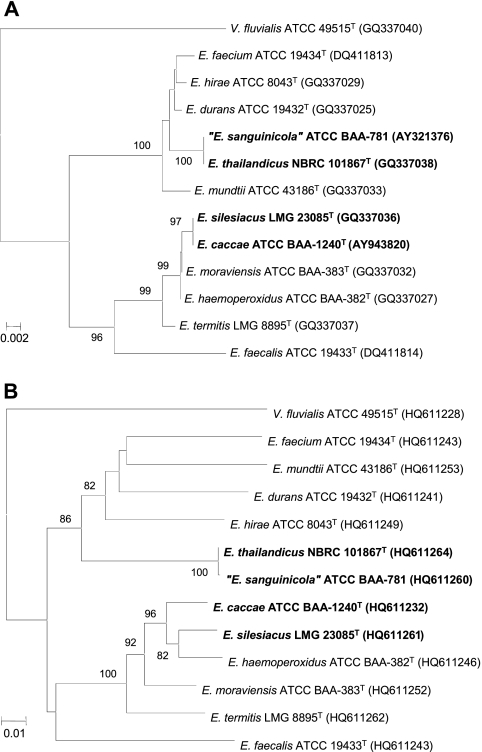
Phylogenetic trees based on comparative analysis of the 16S rRNA (A) or rpoB (B) gene sequences, showing the relationships among the type strains of Enterococcus sanguinicola, Enterococcus thailandicus, Enterococcus caccae, Enterococcus silesiacus, and other selected species of Enterococcus. GenBank accession numbers are given in parentheses. The neighbor-joining method was used to create the dendrograms, and 1,000 resamplings at the nodes are displayed as percentages. Scale bars indicate numbers of substitutions per nucleotide position. V. fluvialis, Vagococcus fluvialis.
References
-
- Carvalho M. G., et al. 2008. Designation of the provisional new Enterococcus species CDC PNS-E2 as Enterococcus sanguinicola sp. nov., isolated from human blood, and identification of a strain previously named Enterococcus CDC PNS-E1 as Enterococcus italicus Fortina, Ricci, Mora, and Manachini 2004. J. Clin. Microbiol. 46:3473–3476 - PMC - PubMed
-
- Carvalho M. G., et al. 2006. Enterococcus caccae sp. nov., isolated from human stools. Int. J. Syst. Evol. Microbiol. 56:1505–1508 - PubMed
Publication types
MeSH terms
Substances
LinkOut - more resources
Full Text Sources
Other Literature Sources
Molecular Biology Databases
