


Patterns of anxiety in critically ill patients receiving mechanical ventilatory support
- PMID: 21543962
- PMCID: PMC3124305
- DOI: 10.1097/NNR.0b013e318216009c
Patterns of anxiety in critically ill patients receiving mechanical ventilatory support
Abstract
Background: Mechanical ventilation is one of the most frequently used technological treatments in critical care units and induces great anxiety in patients.
Objectives: Although mechanical ventilation and critical illness induce great anxiety and distress in hospitalized patients, little is known about anxiety ratings over the course of ventilatory support. Knowledge of anxiety ratings over time is needed to implement effective symptom management interventions. The purposes of this study were to describe anxiety ratings for a subgroup of mechanically ventilated patients over the duration of enrollment in a multisite clinical trial, to discern any pattern of change in anxiety ratings, to determine if anxiety decreases over time, and to explore the influence of sedative exposure on anxiety ratings.
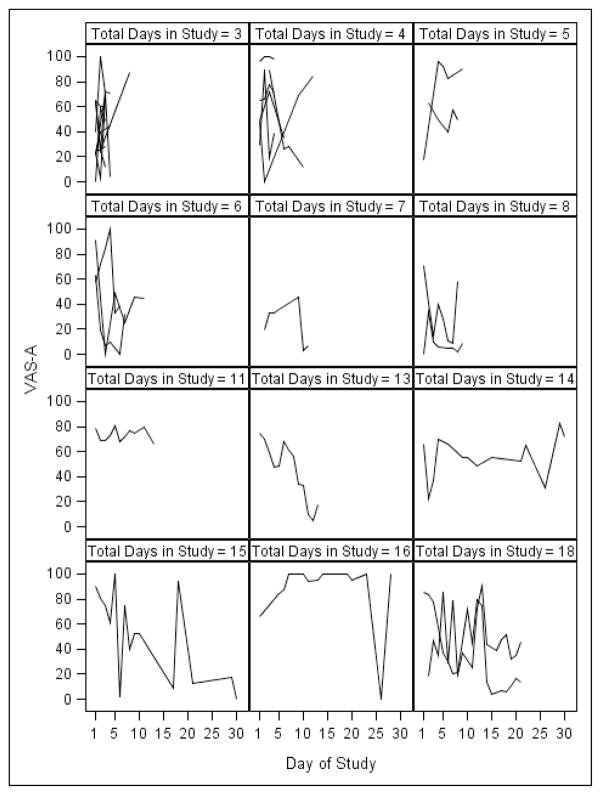
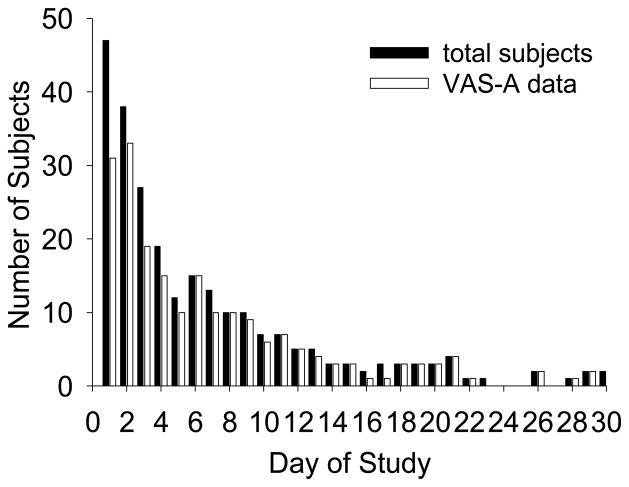
Methods: Participants were 57 mechanically ventilated patients who were randomly assigned to the usual care group of a randomized controlled trial designed to assess the efficacy of music interventions on anxiety of mechanically ventilated patients in intensive care units. Anxiety ratings were obtained at study entry and daily for up to 30 days. A 100-mm visual analog scale was used to measure anxiety. Visual Analog Scale-Anxiety scores were plotted as a function of study time in days for each participant to discern possible patterns of change. A mixed-models analysis was performed to assess the nature and magnitude of change over time (slope) using 251 observations on 57 patients.
Results: Results of the unconditional means model indicated that further modeling was appropriate. An autoregressive covariance structure with a random component for participant was chosen as the most appropriate covariance structure for modeling. An unconditional growth model indicated that the Visual Analog Scale-Anxiety ratings declined slowly over time: -.53 points per day (p = .09).
Discussion: Anxiety is an individual patient experience that requires ongoing management with appropriate assessment and intervention over the duration of mechanical ventilatory support.
Figures
References
-
- Chlan L. Effectiveness of a music therapy intervention on relaxation and anxiety for patients receiving ventilatory assistance. Heart and Lung. 1998;27:169–176. - PubMed
-
- Chlan L. Description of anxiety levels by individual differences and clinical factors in patients receiving mechanical ventilatory support. Heart and Lung: The Journal of Acute and Critical Care. 2003;32:275–282. - PubMed
-
- Chlan L. Relationship between two anxiety instruments in patients receiving mechanical ventilatory support. Journal of Advanced Nursing. 2004;48:493–499. - PubMed
-
- Chlan L, Savik K, Weinert C. Development of a shortened state anxiety scale from the Spielberger State-Trait Anxiety Inventory (STAI) for patients receiving mechanical ventilatory support. Journal of Nursing Measurement. 2003;11:283–293. - PubMed
-
- Cline ME, Herman J, Shaw ER, Morton RD. Standardization of the visual analogue scale. Nursing Research. 1992;4:378–380. - PubMed
