. 2011 Aug;36(9):1912-20.
doi: 10.1038/npp.2011.77. Epub 2011 May 4.

Inhibition of β-adrenergic receptors induces a persistent deficit in retrieval of a cocaine-associated memory providing protection against reinstatement

Affiliations

Inhibition of β-adrenergic receptors induces a persistent deficit in retrieval of a cocaine-associated memory providing protection against reinstatement

James M Otis et al. Neuropsychopharmacology. 2011 Aug.

Abstract

Drug-seeking behavior is maintained by encounters with drug-associated cues. Preventing retrieval of drug-associated memories that these cues provoke would therefore limit relapse susceptibility; however, little is known regarding the mechanisms of retrieval. Here, we show that β-adrenergic receptor activation is necessary for the retrieval of a cocaine-associated memory. Using a conditioned place preference (CPP) procedure, rats were conditioned to associate one chamber, but not another, with cocaine. When administered before a CPP trial, propranolol, but not saline, prevented retrieval of a cocaine-associated CPP. In subsequent drug-free trials, rats previously treated with propranolol continued to show a retrieval deficit, as no CPP was evident. This retrieval deficit was long lasting and robust, as the CPP did not re-emerge during a test for spontaneous recovery 14 days later or reinstate following a priming injection of cocaine. Moreover, the peripheral β-adrenergic receptor antagonist sotalol did not affect retrieval. Thus, retrieval of cocaine-associated memories is mediated by norepinephrine acting at central β-adrenergic receptors. Our findings support the use of propranolol, a commonly prescribed β-blocker, as an adjunct to exposure therapy for the treatment of addiction by preventing retrieval of drug-associated memories during and long after treatment, and by providing protection against relapse.


Figures
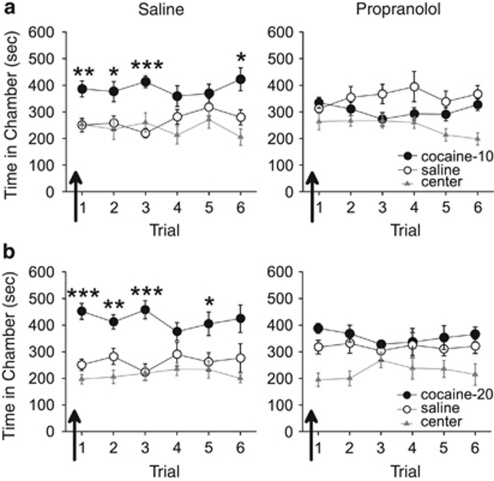
Figure 1
Figure 1
Propranolol disrupts retrieval of a cocaine-associated conditioned place preference (CPP). Following conditioning with (a) 10 mg/kg or (b) 20 mg/kg doses of cocaine, propranolol but not saline injections (arrows) prevented rats from expressing a CPP for the previously cocaine-paired chamber over the previously saline-paired chamber during the first CPP trial. Propranolol- but not saline-treated rats continued to show no CPP during subsequent propranolol-free trials. ***p<0.001, **p<0.01, and *p<0.05.
Figure 2
Figure 2
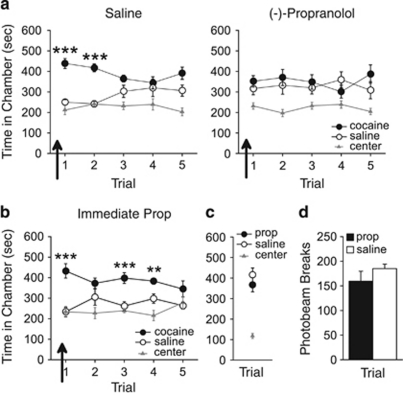
Propranolol-induced conditioned place preference (CPP) retrieval disruption is not due to nonspecific effects of propranolol or reconsolidation blockade. (a) Following conditioning, the more active enantiomer of propranolol, (−)-propranolol but not saline injections (arrows) prevented rats from expressing a CPP for the previously cocaine-paired chamber over the previously saline-paired chamber during the first and subsequent CPP trials. (b) Propranolol injection immediately before the first CPP trial did not prevent CPP expression during this trial or subsequent trials. (c) Following conditioning with propranolol or saline, rats spent an equivalent amount of time in the previously propranolol-paired and saline-paired chambers. (d) Propranolol had no effect on locomotor activity, as measured by photobeam breaks, when injected before an initial CPP trial. Prop, propranolol. ***p<0.001, **p<0.01, and *p<0.05.
Figure 3
Figure 3
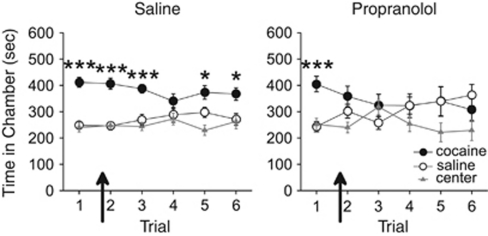
Propranolol disrupts retrieval of an established conditioned place preference (CPP). All rats expressed a CPP for the previously cocaine-paired chamber over the previously saline-paired chamber during the first CPP trial. Propranolol but not saline injections (arrows) prevented rats from expressing a CPP during the second CPP trial. Propranolol- but not saline-treated rats continued to show no CPP during subsequent propranolol-free trials. ***p<0.001 and *p<0.05.
Figure 4
Figure 4
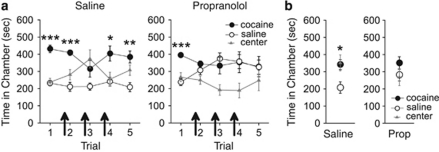
Repeated propranolol treatment causes a long-lasting disruption in the retrieval of a conditioned place preference (CPP). (a) All rats expressed a CPP for the previously cocaine-paired chamber over the previously saline-paired chamber during the first CPP trial. Propranolol but not saline injections (arrows) before the second, third, and fourth CPP trials prevented the rats from expressing a CPP during those trials and a subsequent propranolol-free CPP trial. (b) Propranolol but not saline treatment resulted in a lack of expression of a CPP during a CPP trial 14 days later. Prop, propranolol. ***p<0.001, **p<0.01, and *p<0.05.
Figure 5
Figure 5
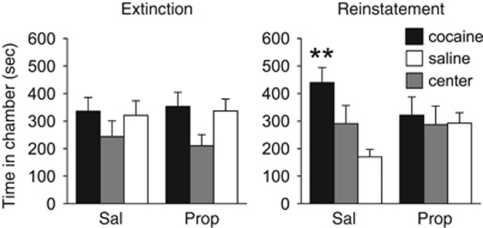
Propranolol treatment prevents subsequent cocaine-induced reinstatement of a conditioned place preference (CPP). Saline- and propranolol-treated rats showed no CPP for the previously cocaine-paired chamber over the previously saline-paired chamber on the final extinction trials. The following day, saline- but not propranolol-treated rats expressed a cocaine-induced reinstatement of the CPP. Sal, saline; prop, propranolol. **p<0.01.
Figure 6
Figure 6
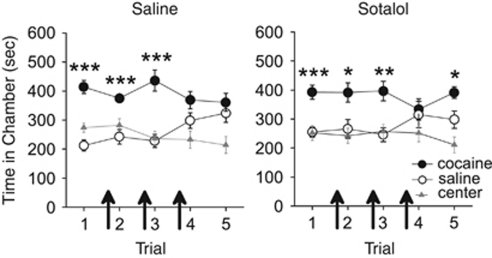
Peripheral β-adrenergic receptor antagonist sotalol does not impair retrieval of a conditioned place preference (CPP). All rats expressed a CPP for the previously cocaine-paired chamber over the previously saline-paired chamber during the first CPP trial. Peripheral β-adrenergic receptor antagonist sotalol and saline injections (arrows) before the second, third, and fourth CPP trials did not alter expression of a CPP across trials. ***p<0.001, **p<0.01, and *p<0.05.

References

    1. Alexander BS, Wood MD. Stereoselective blockade of central [3H]5-hydroxytryptamine binding to multiple sites (5-HT1A, 5-HT1B and 5-HT1C) by mianserin and propranolol. J Pharm Pharmacol. 1987;39:664–666. - PubMed
    1. Aston-Jones G, Rajkowski J, Kubiak P. Conditioned responses of monkey locus coeruleus neurons anticipate acquisition of discriminative behavior in a vigilance task. Neuroscience. 1997;80:697–715. - PubMed
    1. Banna KM, Back SE, Do P, See RE. Yohimbine stress potentiates conditioned cue-induced reinstatement of heroin-seeking in rats. Behav Brain Res. 2010;208:144–148. - PMC - PubMed
    1. Bernardi RE, Lattal KM, Berger SP. Postretrieval propranolol disrupts a cocaine conditioned place preference. Neuroreport. 2006;17:1443–1447. - PubMed
    1. Bouret S, Sara SJ. Reward expectation, orientation of attention and locus coeruleus-medial frontal cortex interplay during learning. Eur J Neurosci. 2004;20:791–802. - PubMed

Publication types

MeSH terms