. 2011 Nov;18(11):1098-102.
doi: 10.1038/gt.2011.61. Epub 2011 May 5.

Increased oncolytic efficacy for high-grade gliomas by optimal integration of ionizing radiation into the replicative cycle of HSV-1

Affiliations

Increased oncolytic efficacy for high-grade gliomas by optimal integration of ionizing radiation into the replicative cycle of HSV-1

S J Advani et al. Gene Ther. 2011 Nov.

Abstract

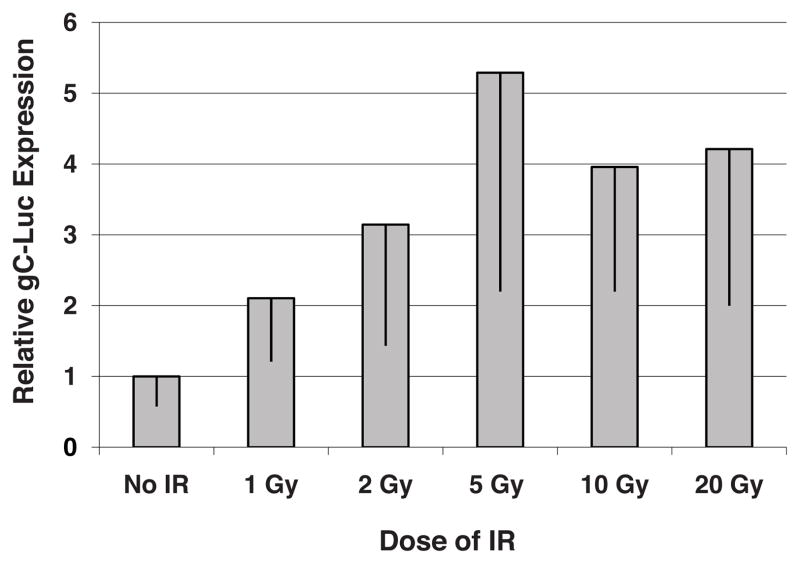
Oncolytic viruses have been combined with standard cancer therapies to increase therapeutic efficacy. Given the sequential activation of herpes viral genes (herpes simplex virus-1, HSV-1) and the temporal cellular changes induced by ionizing radiation, we hypothesized an optimal temporal sequence existed in combining oncolytic HSV-1 with ionizing radiation. Murine U-87 glioma xenografts were injected with luciferase encoding HSV-1, and ionizing radiation (IR) was given at times before or after viral injection. HSV-1 replication and tumor-volume response were followed. Radiation given 6-9 h after HSV-1 injection resulted in maximal viral luciferase expression and infectious viral production in tumor xenografts. The greatest xenograft regression was also seen with radiation given 6 h after viral injection. We then tested if HSV-1 replication had a dose response to ionizing radiation. HSV-1 luciferase expression exhibited a dose response as xenografts were irradiated from 0 to 5 Gy. There was no difference in viral luciferase expression as IR dose increased from 5 Gy up to 20 Gy. These results suggest that the interaction of IR with the HSV-1 lytic cycle can be manipulated for therapeutic gain by delivering IR at a specific time within viral replicative cycle.


Conflict of interest statement

Conflict of Interest:

The authors declare no conflict of interest

Figures

Figure 1
Figure 1
Optimal Timing of Radiation in Glioma Xenografts Injected with Oncolytic HSV-1 for Viral Gene Expression and Tumor Regression. HSV-1 R2636 was injected at time 0, and 20 Gy of IR was delivered before or after viral injection. 1A: Luciferase expression was quantified on days 1, 2, 3, 4, 5, and 7 after viral injection in non-irradiated and irradiated mice by measuring photon flux. The mean bioluminescence of 5 xenografts per group are shown, and normalized to values obtained in non-irradiated R2636 injected xenografts on day 1. 1B: Fractional tumor volumes of glioma xenografts imaged in Figure 1A Tumors volume measurements were normalized to tumor volumes on day 0.
Figure 2
Figure 2
Influence of Timing Sequence of Oncolytic HSV-1 and Radiation on HSV-1 Progeny Production. Infectious viral particles were quantified from xenografts harvested 3 days after injection with R3616 and irradiated with 20 Gy before or after viral injection. Viral particle production was normalized to non-irradiated R3616 infected glioma xenografts.
Figure 3
Figure 3
Irradiation Dose Response of Viral gC-luciferase Expression. U87 xenografts were injected with R2636 and irradiated 6 hrs later, bioluminescence imaging was done 4 days after viral injection. Photon fluxes were normalized to non-irradiated R2636 injected xenografts.
Figure 4
Figure 4
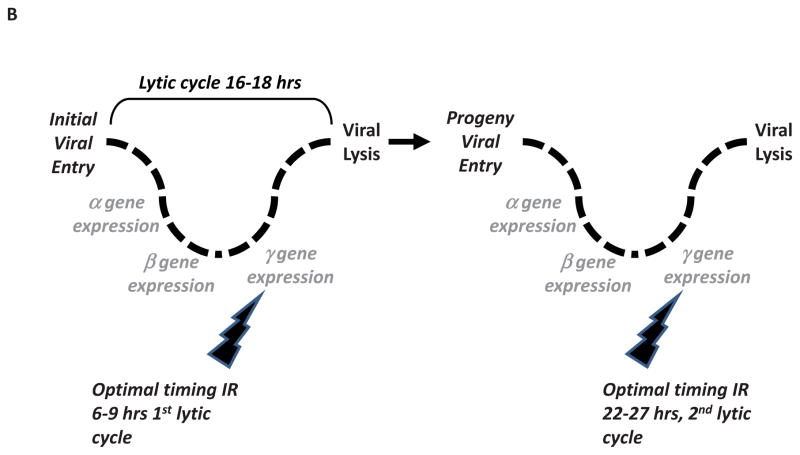
Mechanistic Model of the Interaction of Radiation and Oncolytic HSV-1. 4A: The interaction of IR during a single HSV-1 replicative cycle. Following receptor mediated internalization of HSV-1, a temporal cascade of HSV-1 gene expression occurs. Initial α gene expression is followed by β genes (function to replicate viral DNA), and finally γ genes (involved in assembly of progeny virus). Ionizing radiation has been shown to enhance replication of HSV-1 by multiple mechanisms. As depicted, IR delivered at different times in relation to the viral replicative cycle can enhance the oncolytic ability of viruses. 4B: Clinically incorporating radiotherapy with oncolytic HSV-1. As oncolytic viruses replicate and spread within tumor, radiotherapy could be optimally delivered so as to coincide with late viral gene expression (i.e. 6–9 hrs after viral entry) in later viral replicative life cycles. This interaction may be clinically incorporated into hypofractionated radiotherapy.
Figure 4
Figure 4
Mechanistic Model of the Interaction of Radiation and Oncolytic HSV-1. 4A: The interaction of IR during a single HSV-1 replicative cycle. Following receptor mediated internalization of HSV-1, a temporal cascade of HSV-1 gene expression occurs. Initial α gene expression is followed by β genes (function to replicate viral DNA), and finally γ genes (involved in assembly of progeny virus). Ionizing radiation has been shown to enhance replication of HSV-1 by multiple mechanisms. As depicted, IR delivered at different times in relation to the viral replicative cycle can enhance the oncolytic ability of viruses. 4B: Clinically incorporating radiotherapy with oncolytic HSV-1. As oncolytic viruses replicate and spread within tumor, radiotherapy could be optimally delivered so as to coincide with late viral gene expression (i.e. 6–9 hrs after viral entry) in later viral replicative life cycles. This interaction may be clinically incorporated into hypofractionated radiotherapy.

References

    1. Stupp R, Hegi ME, Mason WP, van den Bent MJ, Taphoorn MJ, Janzer RC, et al. Effects of radiotherapy with concomitant and adjuvant temozolomide versus radiotherapy alone on survival in glioblastoma in a randomised phase III study: 5-year analysis of the EORTC-NCIC trial. Lancet Oncol. 2009;10:459–466. - PubMed
    1. Wallner KE, Galicich JH, Krol G, Arbit E, Malkin MG. Patterns of failure following treatment for glioblastoma multiforme and anaplastic astrocytoma. Int J Radiat Oncol Biol Phys. 1989;16:1405–1409. - PubMed
    1. Martuza RL, Malick A, Markert JM, Ruffner KL, Coen DM. Experimental therapy of human glioma by means of a genetically engineered virus mutant. Science. 1991;252:854–856. - PubMed
    1. Markert JM, Medlock MD, Rabkin SD, Gillespie GY, Todo T, Hunter WD, et al. Conditionally replicating herpes simplex virus mutant, G207 for the treatment of malignant glioma: results of a phase I trial. Gene Ther. 2000;7:867–874. - PubMed
    1. Rampling R, Cruickshank G, Papanastassiou V, Nicoll J, Hadley D, Brennan D, et al. Toxicity evaluation of replication-competent herpes simplex virus (ICP 34. 5 null mutant 1716) in patients with recurrent malignant glioma. Gene Ther. 2000;7:859–866. - PubMed

Publication types

MeSH terms