


Novel, divergent simian hemorrhagic fever viruses in a wild Ugandan red colobus monkey discovered using direct pyrosequencing
- PMID: 21544192
- PMCID: PMC3081318
- DOI: 10.1371/journal.pone.0019056
Novel, divergent simian hemorrhagic fever viruses in a wild Ugandan red colobus monkey discovered using direct pyrosequencing
Abstract
Background: Simian hemorrhagic fever virus (SHFV) has caused lethal outbreaks of hemorrhagic disease in captive primates, but its distribution in wild primates has remained obscure. Here, we describe the discovery and genetic characterization by direct pyrosequencing of two novel, divergent SHFV variants co-infecting a single male red colobus monkey from Kibale National Park, Uganda.
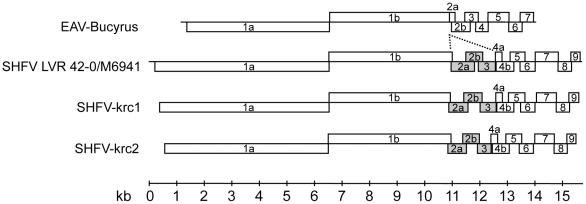
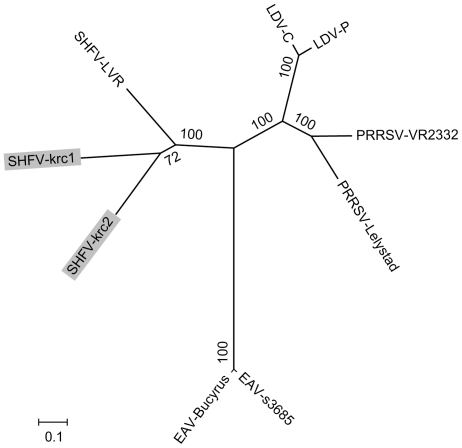
Methodology/principal findings: The viruses were detected directly from blood plasma using pyrosequencing, without prior virus isolation and with minimal PCR amplification. The two new SHFV variants, SHFV-krc1 and SHFV-krc2 are highly divergent from each other (51.9% nucleotide sequence identity) and from the SHFV type strain LVR 42-0/M6941 (52.0% and 51.8% nucleotide sequence identity, respectively) and demonstrate greater phylogenetic diversity within SHFV than has been documented within any other arterivirus. Both new variants nevertheless have the same 3' genomic architecture as the type strain, containing three open reading frames not present in the other arteriviruses.
Conclusions/significance: These results represent the first documentation of SHFV in a wild primate and confirm the unusual 3' genetic architecture of SHFV relative to the other arteriviruses. They also demonstrate a degree of evolutionary divergence within SHFV that is roughly equivalent to the degree of divergence between other arterivirus species. The presence of two such highly divergent SHFV variants co-infecting a single individual represents a degree of within-host viral diversity that exceeds what has previously been reported for any arterivirus. These results expand our knowledge of the natural history and diversity of the arteriviruses and underscore the importance of wild primates as reservoirs for novel pathogens.
Conflict of interest statement
Figures
References
-
- Palmer AE, Allen AM, Tauraso NM, Shelokov A. Simian hemorrhagic fever. I. Clinical and epizootiologic aspects of an outbreak among quarantined monkeys. American Journal of Tropical Medicine and Hygiene. 1968;17:404–412. - PubMed
-
- London WT. Epizootiology, transmission and approach to prevention of fatal simian haemorrhagic fever in rhesus monkeys. Nature. 1977;268:344–345. - PubMed
-
- Gravell M, London WT, Leon ME, Palmer AE, Hamilton RS. Differences among isolates of simian hemorrhagic fever (SHF) virus. Proceedings of the Society for Experimental Biology and Medicine. 1986;181:112–119. - PubMed
-
- Dalgard DW, Hardy RJ, Pearson SL, Pucak GJ, Quander RV, et al. Combined simian hemorrhagic fever and Ebola virus infection in cynomolgus monkeys. Laboratory Animal Science. 1992;42:152–157. - PubMed
-
- Borio L, Inglesby T, Peters CJ, Schmaljohn AL, Hughes JM, et al. Hemorrhagic fever viruses as biological weapons: medical and public health management. Journal of the American Medical Association. 2002;287:2391–2405. - PubMed
Publication types
MeSH terms
Grants and funding
LinkOut - more resources
Full Text Sources
Other Literature Sources
