


Influence of body weight and type of chow on the sensitivity of rats to the behavioral effects of the direct-acting dopamine-receptor agonist quinpirole
- PMID: 21544521
- PMCID: PMC3875398
- DOI: 10.1007/s00213-011-2320-6
Influence of body weight and type of chow on the sensitivity of rats to the behavioral effects of the direct-acting dopamine-receptor agonist quinpirole
Abstract
Rationale: Amount and type of food can alter dopamine systems and sensitivity to drugs acting on those systems.
Objectives: This study examined whether changes in body weight, food type, or both body weight and food type contribute to these effects.
Methods: Rats had free or restricted access (increasing, decreasing, or maintaining body weight) to standard (5.7% fat) or high-fat (34.3%) chow.
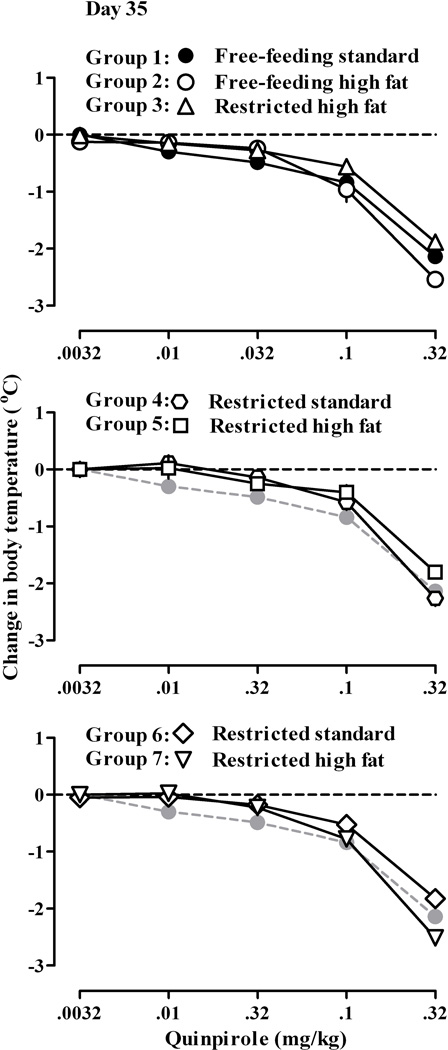
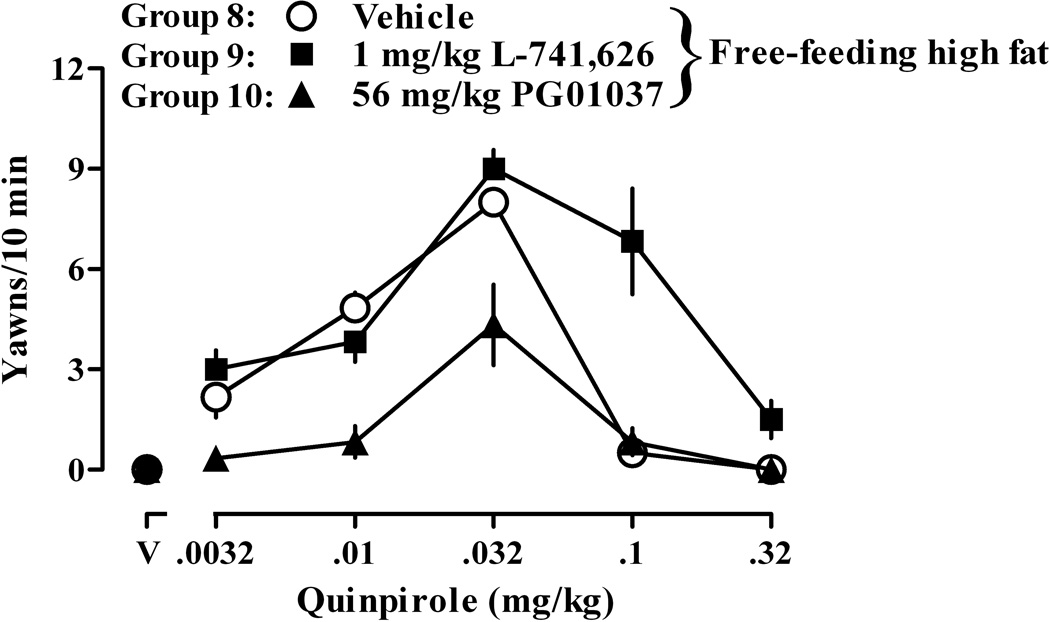
Results: In rats gaining weight with restricted or free access to high-fat chow, both limbs of the quinpirole yawning dose-response curve (0.0032-0.32 mg/kg) shifted leftward compared with rats eating standard chow. Restricting access to standard or high-fat chow (maintaining or decreasing body weight) decreased or eliminated quinpirole-induced yawning; within 1 week of resuming free feeding, sensitivity to quinpirole was restored, although the descending limb of the dose-response curve was shifted leftward in rats eating high-fat chow. These are not likely pharmacokinetic differences because quinpirole-induced hypothermia was not different among groups. PG01037 and L-741,626 antagonized the ascending and descending limbs of the quinpirole dose-response curve in rats eating high-fat chow, indicating D3 and D2 receptor mediation, respectively. Rats eating high-fat chow also developed insulin resistance.
Conclusions: These results show that amount and type of chow alter sensitivity to a direct-acting dopamine-receptor agonist with the impact of each factor depending on whether body weight increases, decreases, or is maintained. These data demonstrate that feeding conditions, perhaps related to insulin and insulin sensitivity, profoundly impact the actions of drugs acting on dopamine systems.
Conflict of interest statement
The authors have no conflict of interest.
Figures



References
-
- Abi-Dargham A, Laruelle M. Mechanisms of action of second generation antipsychotic drugs in schizophrenia: insights from brain imaging studies. Eur Psychiatry. 2005;20:15–27. - PubMed
-
- Acri JB, Carter SR, Alling K, Geter-Douglass B, Dijkstra D, Wikström H, Katz JL, Witkin JM. Assessment of cocaine-like discriminative stimulus effects of dopamine D3 receptor ligands. Eur J Pharmacol. 1995;281:R7–R9. - PubMed
-
- Argiolas A, Melis MR. The neuropharmacology of yawning. Eur J Pharmacol. 1998;343:1–16. - PubMed
-
- Bailer UF, Frank GK, Henry SE, Price JC, Meltzer CC, Weissfeld L, Mathis CA, Drevets WC, Wagner A, Hoge J, Ziolko SK, McConaha CW, Kaye WH. Altered brain serotonin 5-HT1A receptor binding after recovery from anorexia nervosa measured by positron emission tomography and [carbonyl11C]WAY-100635. Arch Gen Psychiatry. 2005;62:1032–1041. - PubMed
Publication types
MeSH terms
Substances
Grants and funding
LinkOut - more resources
Full Text Sources
Medical
