. 2011 Jul;37(7):1182-91.
doi: 10.1007/s00134-011-2232-2. Epub 2011 May 5.

Acute effects of intracranial hypertension and ARDS on pulmonary and neuronal damage: a randomized experimental study in pigs

Affiliations

Acute effects of intracranial hypertension and ARDS on pulmonary and neuronal damage: a randomized experimental study in pigs

Jan Florian Heuer et al. Intensive Care Med. 2011 Jul.

Abstract

Purpose: To determine reciprocal and synergistic effects of acute intracranial hypertension and ARDS on neuronal and pulmonary damage and to define possible mechanisms.

Methods: Twenty-eight mechanically ventilated pigs were randomized to four groups of seven each: control; acute intracranial hypertension (AICH); acute respiratory distress syndrome (ARDS); acute respiratory distress syndrome in combination with acute intracranial hypertension (ARDS + AICH). AICH was induced with an intracranial balloon catheter and the inflation volume was adjusted to keep intracranial pressure (ICP) at 30-40 cmH2O. ARDS was induced by oleic acid infusion. Respiratory function, hemodynamics, extravascular lung water index (ELWI), lung and brain computed tomography (CT) scans, as well as inflammatory mediators, S100B, and neuronal serum enolase (NSE) were measured over a 4-h period. Lung and brain tissue were collected and examined at the end of the experiment.

Results: In both healthy and injured lungs, AICH caused increases in NSE and TNF-alpha plasma concentrations, extravascular lung water, and lung density in CT, the extent of poorly aerated (dystelectatic) and atelectatic lung regions, and an increase in the brain tissue water content. ARDS and AICH in combination induced damage in the hippocampus and decreased density in brain CT.

Conclusions: AICH induces lung injury and also exacerbates pre-existing damage. Increased extravascular lung water is an early marker. ARDS has a detrimental effect on the brain and acts synergistically with intracranial hypertension to cause histological hippocampal damage.


Figures
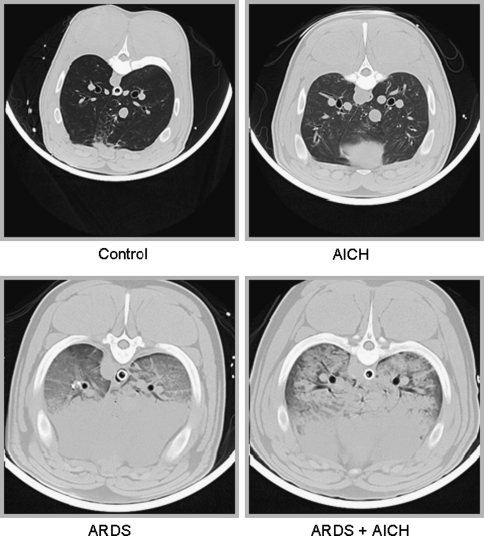
Fig. 1
Fig. 1
CT scans of representative animals from each group taken at end-expiration at 240 min. Control control; AICH acute intracranial hypertension; ARDS acute respiratory distress syndrome; ARDS + AICH acute respiratory distress syndrome and acute intracranial hypertension
Fig. 2
Fig. 2
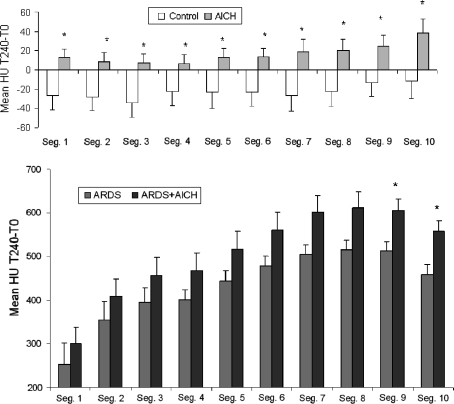
Mean changes in lung density [delta Hounsfield units from T 240 to T 0 (mean + SE)] in control and AICH (upper panel) and in ARDS and ARDS + AICH (lower panel) from segment 1 (non-dependent) to segment 10 (dependent). Control control; AICH acute intracranial hypertension; ARDS acute respiratory distress syndrome; ARDS + AICH acute respiratory distress syndrome and acute intracranial hypertension. Significant (p < 0.05) difference between control and AICH in segments 1–8 and 10; significant (p < 0.05) difference between ARDS and ARDS + AICH in segments 9 and 10
Fig. 3
Fig. 3
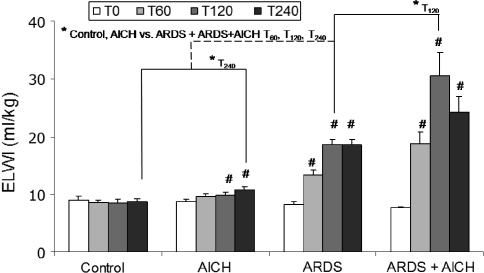
Extravascular lung water index (ELWI) (mean + SE). Control control; AICH acute intracranial hypertension; ARDS acute respiratory distress syndrome; ARDS + AICH acute respiratory distress syndrome and acute intracranial hypertension. #Significant (p < 0.05) effect of time in AICH, ARDS, and ARDS + AICH; *significant difference between control versus AICH after 240 min (p < 0.05). *Significant difference between ARDS versus ARDS + AICH at T 120 (p < 0.05)
Fig. 4
Fig. 4
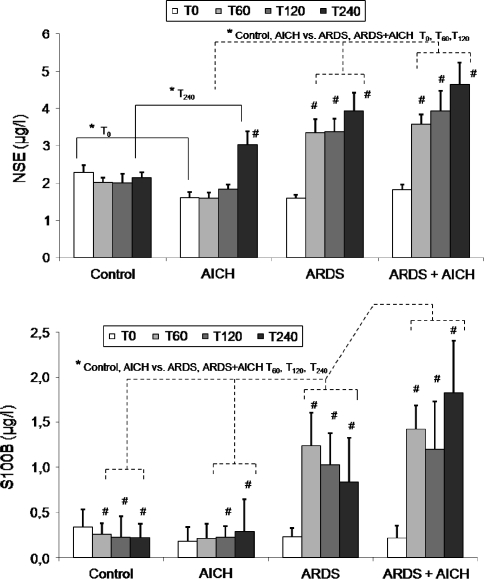
Plasma concentration of neuron-specific enolase (NSE) and S100B (mean + SE) in control, AICH, ARDS, ARDS + AICH from T 0 to T 240. Control control; AICH acute intracranial hypertension; ARDS acute respiratory distress syndrome; ARDS + AICH acute respiratory distress syndrome and acute intracranial hypertension. NSE: #significant (p < 0.05) effect of time in AICH, ARDS and ARDS + AICH; *significant (p < 0.05) difference between control and AICH at T 0 and T 240. Significant (p < 0.05) difference between control, AICH and ARDS, ARDS + AICH at T60, T120, and T240. S100B: #significant (p < 0.05) effect of time in all groups; significant (p < 0.05) difference between control and AICH at T 240. Significant difference between control, AICH and ARDS, ARDS + AICH at T 60, T 120, and T 240

Comment in

  • The brain-lung-brain axis.
    Stevens RD, Puybasset L. Stevens RD, et al. Intensive Care Med. 2011 Jul;37(7):1054-6. doi: 10.1007/s00134-011-2233-1. Epub 2011 May 5. Intensive Care Med. 2011. PMID: 21544691 No abstract available.

References

    1. Stocchetti N, Zanaboni C, Colombo A, Citerio G, Beretta L, Ghisoni L, Zanier ER, Canavesi K. Refractory intracranial hypertension and “second-tier” therapies in traumatic brain injury. Intensive Care Med. 2008;34:461–467. doi: 10.1007/s00134-007-0948-9. - DOI - PubMed
    1. Bratton SL, Davis RL. Acute lung injury in isolated traumatic brain injury. Neurosurgery. 1997;40:707–712. doi: 10.1097/00006123-199704000-00009. - DOI - PubMed
    1. Zygun DA, Kortbeek JB, Fick GH, Laupland KB, Doig CJ. Non-neurologic organ dysfunction in severe traumatic brain injury. Crit Care Med. 2005;33:654–660. doi: 10.1097/01.CCM.0000155911.01844.54. - DOI - PubMed
    1. Touho H, Karasawa J, Shishido H, Yamada K, Yamazaki Y. Neurogenic pulmonary edema in the acute stage of hemorrhagic cerebrovascular disease. Neurosurgery. 1989;25:762–768. doi: 10.1227/00006123-198911000-00011. - DOI - PubMed
    1. Avlonitis VS, Wigfield CH, Kirby JA, Dark JH. The hemodynamic mechanisms of lung injury and systemic inflammatory response following brain death in the transplant donor. Am J Transplant. 2005;5:684–693. doi: 10.1111/j.1600-6143.2005.00755.x. - DOI - PubMed

MeSH terms