


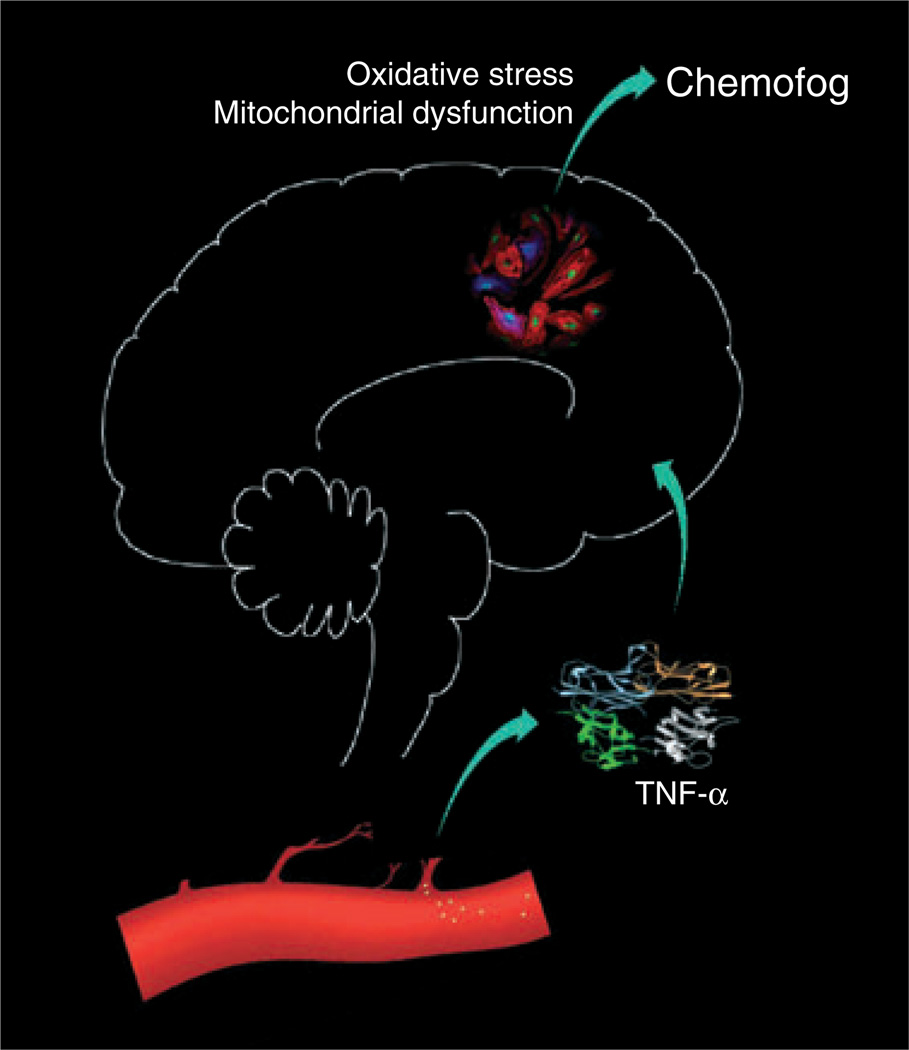
A proposed mechanism for chemotherapy-related cognitive impairment ('chemo-fog')
- PMID: 21545608
- PMCID: PMC3249621
- DOI: 10.1111/j.1365-2710.2010.01188.x
A proposed mechanism for chemotherapy-related cognitive impairment ('chemo-fog')
Abstract
What is known and objective: Chemotherapeutic drugs for cancer treatment are, of necessity, cytotoxic. Unintended damage to normal central nervous system neuronal structure or function might lead to deleterious adverse effects on cognitive function, a mild form of which is reported by some cancer survivors. Understanding the physiologic connection between cancer chemotherapy and the reported cognitive dysfunction, could help inform choice of drugs, treatment regimens and new drug development. Our objective is to comment on a proposed mechanism for 'chemo-fog'.
Comment: An increasing number of patients are surviving cancer and are generating a new and rapidly growing category within the healthcare system. Some of these cancer survivors are reporting that they are experiencing residual and lingering effects from the cancer, or from its treatment, and that they now need care as survivors. This has given rise to the new field of 'survivor care'. Control of chemo-fog is an important aspect and understanding its mechanism, the basis for more rationale therapy. Such insight would also help direct drug-discovery efforts.
What is new and conclusion: New evidence suggests that 'chemo-fog' may be due to excessive cytokine release by the cytotoxic agents. Control of the elevated levels of the blood-brain-barrier-permeable pro-inflammatory cytokines, may help minimize this adverse effect.
© 2010 The Author. JCPT © 2010 Blackwell Publishing Ltd.
Figures
References
-
- Raffa RB, Duong PV, Finney J, et al. Is ‘chemo-fog’/’chemo-brain’ caused by cancer chemotherapy? Journal of Clinical Pharmacy and Therapeutics. 2006;31:129–138. - PubMed
-
- Raffa RB, Tallarida RJ, editors. Chemofog: cancer chemotherapy-related cognitive impairment. Austin: Springer/Landes; 2010. - PubMed
-
- Raffa RB. Is a picture worth a thousand (forgotten) words?: neuroimaging evidence for the cognitive deficits in ‘chemo-fog’/‘chemo-brain’. Journal of Clinical Pharmacy and Therapeutics. 2010;35:1–9. - PubMed
-
- Silberfarb PM, Philibert D, Levine PM. Psychosocial aspects of neoplastic disease: II. Affective and cognitive effects of chemotherapy in cancer patients. American Journal of Psychiatry. 1980;137:597–601. - PubMed
Publication types
MeSH terms
Substances
Grants and funding
LinkOut - more resources
Full Text Sources
