


Hospitalization for infection and risk of acute ischemic stroke: the Cardiovascular Health Study
- PMID: 21546476
- PMCID: PMC3125478
- DOI: 10.1161/STROKEAHA.110.608588
Hospitalization for infection and risk of acute ischemic stroke: the Cardiovascular Health Study
Abstract
Background and purpose: Little is known about the acute precipitants of ischemic stroke, although evidence suggests infections contribute to risk. We hypothesized that acute hospitalization for infection is associated with the short-term risk of stroke.
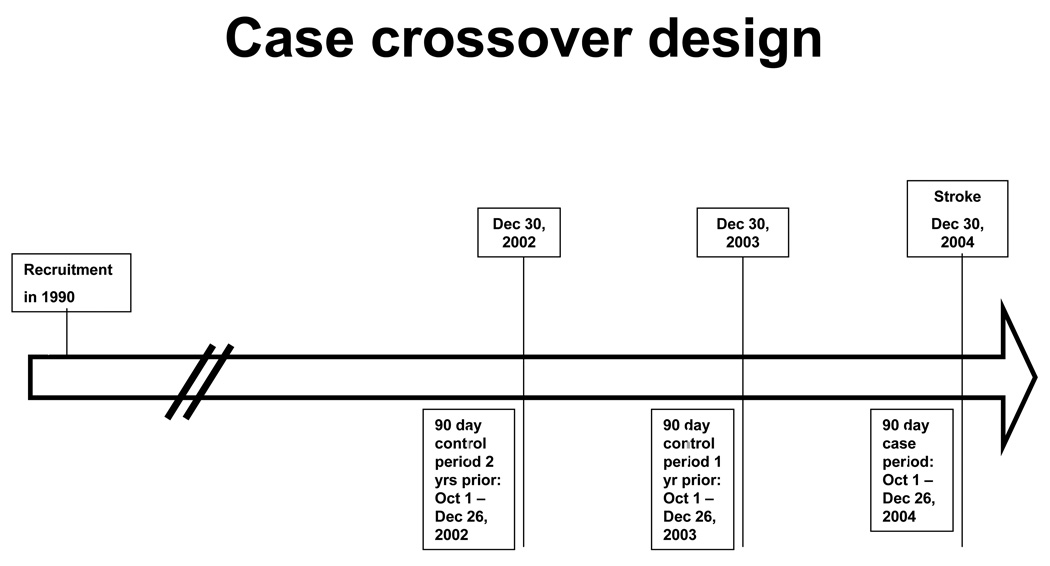
Methods: The case-crossover design was used to compare hospitalization for infection during case periods (90, 30, or 14 days before an incident ischemic stroke) and control periods (equivalent time periods exactly 1 or 2 years before stroke) in the Cardiovascular Health Study, a population-based cohort of 5888 elderly participants from 4 US sites. Odds ratios (ORs) and 95% confidence intervals (95% CIs) were calculated by conditional logistic regression. Confirmatory analyses assessed hazard ratios of stroke from Cox regression models, with hospitalization for infection as a time-varying exposure.
Results: During a median follow-up of 12.2 years, 669 incident ischemic strokes were observed in participants without a baseline history of stroke. Hospitalization for infection was more likely during case than control time periods; for 90 days before stroke, OR=3.4 (95% CI, 1.8 to 6.5). The point estimates of risks were higher when we examined shorter intervals: for 30 days, OR=7.3 (95% CI, 1.9 to 40.9), and for 14 days, OR=8.0 (95% CI, 1.7 to 77.3). In survival analyses, risk of stroke was associated with hospitalization for infection in the preceding 90 days, adjusted hazard ratio=2.4 (95% CI, 1.6 to 3.4).
Conclusions: Hospitalization for infection is associated with a short-term increased risk of stroke, with higher risks observed for shorter intervals preceding stroke.
Figures
References
-
- Maclure M, Mittleman MA. Should we use a case-crossover design. Annu Rev Public Health. 2000;21:193–221. - PubMed
-
- Koton S, Tanne D, Bornstein NM, Green MS. Triggering risk factors for ischemic stroke: a case-crossover study. Neurology. 2004;63:2006–2010. - PubMed
-
- Mittleman MA, Maclure M, Sherwood JB, Mulry RP, Tofler GH, Jacobs SC, Friedman R, Benson H, Muller JE. Triggering of acute myocardial infarction onset by episodes of anger. Determinants of Myocardial Infarction Onset Study Investigators. Circulation. 1995;92:1720–1725. - PubMed
-
- Muller JE, Mittleman MA, Maclure M, Sherwood JB, Tofler GH. Triggering myocardial infarction by sexual activity. Low absolute risk and prevention by regular physical exertion. Determinants of Myocardial Infarction Onset Study Investigators. JAMA. 1996;275:1405–1409. - PubMed
-
- Tofler GH, Muller JE. Triggering of acute cardiovascular disease and potential preventive strategies. Circulation. 2006;114:1863–1872. - PubMed
Publication types
MeSH terms
Grants and funding
- N01 HC085086/HC/NHLBI NIH HHS/United States
- N01 HC075150/HC/NHLBI NIH HHS/United States
- U01-HL080295/HL/NHLBI NIH HHS/United States
- N01 HC015103/HC/NHLBI NIH HHS/United States
- N01-HC-85086/HC/NHLBI NIH HHS/United States
- N01-HC-55222/HC/NHLBI NIH HHS/United States
- N01-HC-85079/HC/NHLBI NIH HHS/United States
- N01 HC045133/HC/NHLBI NIH HHS/United States
- N01 HC035129/HC/NHLBI NIH HHS/United States
- N01 CN015103/CA/NCI NIH HHS/United States
- U01 HL080295/HL/NHLBI NIH HHS/United States
- N01 HC055222/HL/NHLBI NIH HHS/United States
- N01 HC055222/HC/NHLBI NIH HHS/United States
- N01 HC085079/HL/NHLBI NIH HHS/United States
- N01-HC-75150/HC/NHLBI NIH HHS/United States
LinkOut - more resources
Full Text Sources
Medical
