


Inferring epidemiological parameters on the basis of allele frequencies
- PMID: 21546541
- PMCID: PMC3176535
- DOI: 10.1534/genetics.111.126466
Inferring epidemiological parameters on the basis of allele frequencies
Abstract
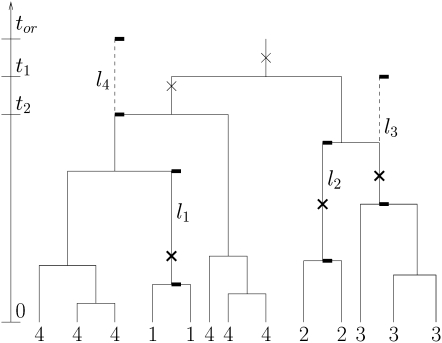
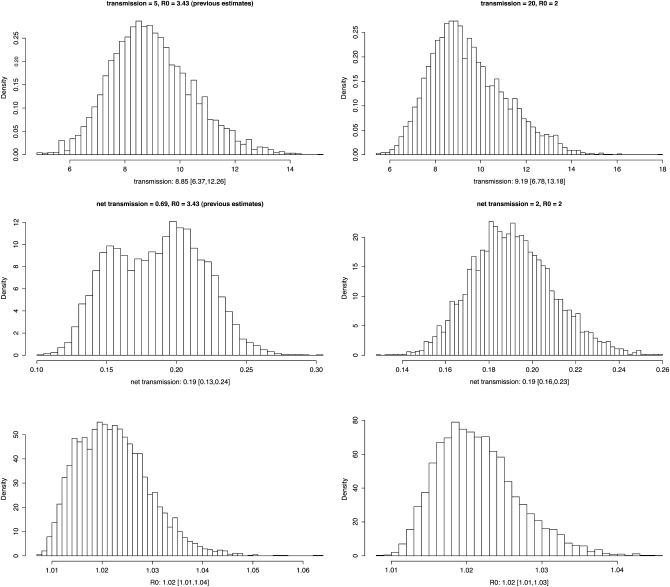
In this article, I develop a methodology for inferring the transmission rate and reproductive value of an epidemic on the basis of genotype data from a sample of infected hosts. The epidemic is modeled by a birth-death process describing the transmission dynamics in combination with an infinite-allele model describing the evolution of alleles. I provide a recursive formulation for the probability of the allele frequencies in a sample of hosts and a Bayesian framework for estimating transmission rates and reproductive values on the basis of observed allele frequencies. Using the Bayesian method, I reanalyze tuberculosis data from the United States. I estimate a net transmission rate of 0.19/year [0.13, 0.24] and a reproductive value of 1.02 [1.01, 1.04]. I demonstrate that the allele frequency probability under the birth-death model does not follow the well-known Ewens' sampling formula that holds under Kingman's coalescent.
Figures
References
-
- Anderson R., May R., 1979. Population biology of infectious diseases: Part I. Nature 280: 361–367 - PubMed
-
- Anderson R., May R., 1992. Infectious Diseases of Humans: Dynamics and Control. Oxford University Press, New York
-
- Ewens W., 1972. The sampling theory of selectively neutral alleles. Theor. Popul. Biol. 3: 87–112 - PubMed
MeSH terms
LinkOut - more resources
Full Text Sources
Medical
