


Absolute strength and loss of strength as predictors of mobility decline in older adults: the InCHIANTI study
- PMID: 21546582
- PMCID: PMC3260485
- DOI: 10.1093/gerona/glr055
Absolute strength and loss of strength as predictors of mobility decline in older adults: the InCHIANTI study
Abstract
Background: Theoretical definitions of sarcopenia traditionally emphasize age-related loss of muscle strength; however, most analyses of the association between strength and mobility examine strength at a single time point. This study sought to identify sex-specific cutpoints for muscle strength and power (at one time point) and 3-year changes in strength and power that would maximize prediction of 3-year mobility decline.
Methods: Longitudinal analysis of 934 adults aged ≥65 years enrolled in the Invecchiare in Chianti study was conducted. Grip strength, knee extension strength, and lower extremity power were measured at baseline and 3 years postenrollment. Mobility function (gait speed and self-reported mobility disability) was measured at 3 and 6 years postenrollment. Classification and regression tree analysis was used to predict mobility decline from Years 3 to 6.
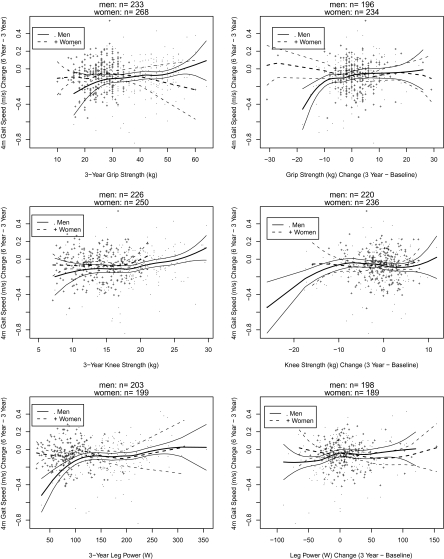
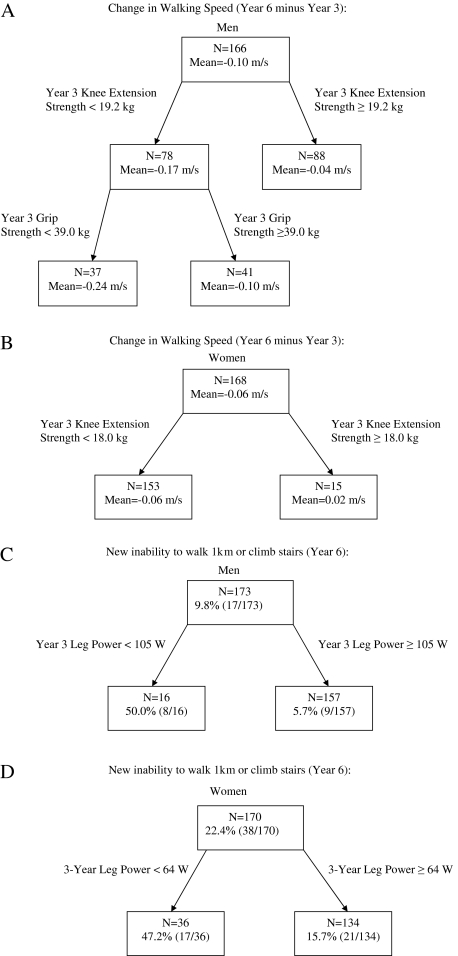
Results: Men with knee extension strength <19.2 kg and grip strength <39.0 kg had clinically meaningful declines in gait speed of .24 m/s. Furthermore, men with power <105 W were nearly nine times more likely to develop incident mobility disability (likelihood ratio = 8.68; 95% confidence interval = 3.91, 19.44). Among women, knee extension strength <18.0 kg was associated with a minimal gait speed decline of 0.06 m/s, and women with leg power <64 W were three times more likely to develop incident mobility disability (likelihood ratio = 3.01; 95% confidence interval = 1.79, 5.08). Three-year changes in strength and power did not predict mobility decline in either sex.
Conclusions: Findings suggest that strength and power measured at one time point are more predictive of mobility decline than 3-year changes and that low strength and power are particularly powerful risk factors in men.
Figures
References
-
- Morley JE, Baumgartner RN, Roubenoff R, Mayer J, Nair KS. Sarcopenia. J Lab Clin Med. 2001;137:231–243. - PubMed
-
- Roubenoff R, Hughes VA. Sarcopenia: current concepts. J Gerontol A Med Sci. 2000;55:M716–M724. - PubMed
-
- Fried LP, Guralnik JM. Disability in older adults: evidence regarding significance, etiology, and risk. J Am Geriatr Soc. 1997;45:92–100. - PubMed
-
- Visser M, Newman AB, Nevitt MC, et al. Reexamining the sarcopenia hypothesis. Muscle mass versus muscle strength. Health, Aging, and Body Composition Study Research Group. Ann N Y Acad Sci. 2000;904:456–461. - PubMed
-
- Clark BC, Manini TM. Sarcopenia =/= dynapenia. J Gerontol A Biol Sci Med Sci. 2008;63:829–834. - PubMed
