. 2011 Jun;90(5):1681-90.
doi: 10.1007/s00253-011-3173-y. Epub 2011 Mar 10.

High-flux isobutanol production using engineered Escherichia coli: a bioreactor study with in situ product removal

Affiliations

High-flux isobutanol production using engineered Escherichia coli: a bioreactor study with in situ product removal

Antonino Baez et al. Appl Microbiol Biotechnol. 2011 Jun.

Abstract

Promising approaches to produce higher alcohols, e.g., isobutanol, using Escherichia coli have been developed with successful results. Here, we translated the isobutanol process from shake flasks to a 1-L bioreactor in order to characterize three E. coli strains. With in situ isobutanol removal from the bioreactor using gas stripping, the engineered E. coli strain (JCL260) produced more than 50 g/L in 72 h. In addition, the isobutanol production by the parental strain (JCL16) and the high isobutanol-tolerant mutant (SA481) were compared with JCL260. Interestingly, we found that the isobutanol-tolerant strain in fact produced worse than either JCL16 or JCL260. This result suggests that in situ product removal can properly overcome isobutanol toxicity in E. coli cultures. The isobutanol productivity was approximately twofold and the titer was 9% higher than n-butanol produced by Clostridium in a similar integrated system.


Figures
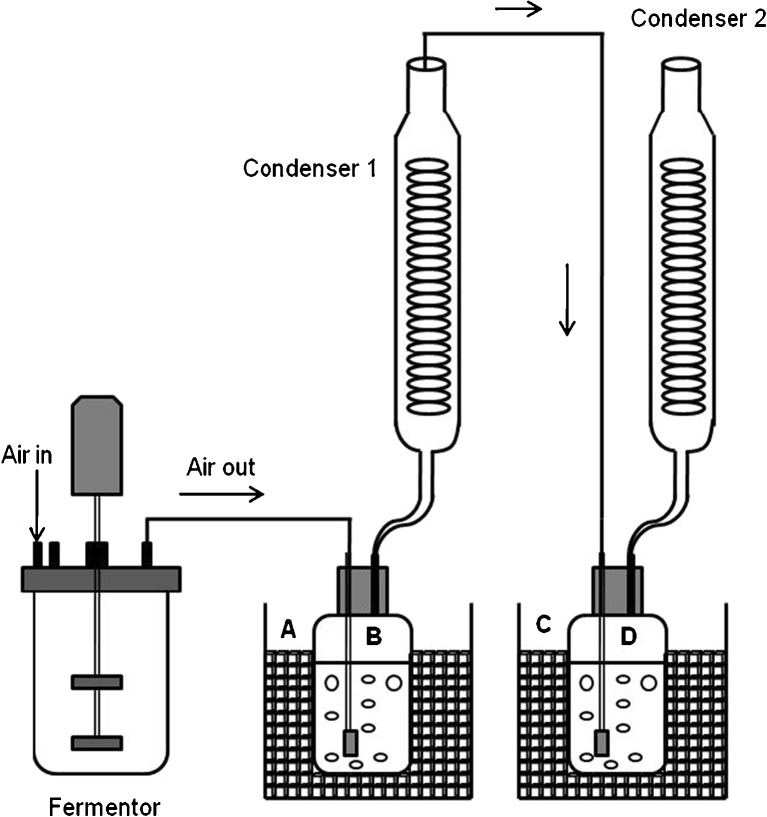
Fig. 1
Fig. 1
Schematic diagram of fermentation/gas stripping process for isobutanol production by E. coli. A and C are ice containers to cool recipients B and D. B and D are receivers containing 0.8 L of water where the evaporated isobutanol was collected
Fig. 2
Fig. 2
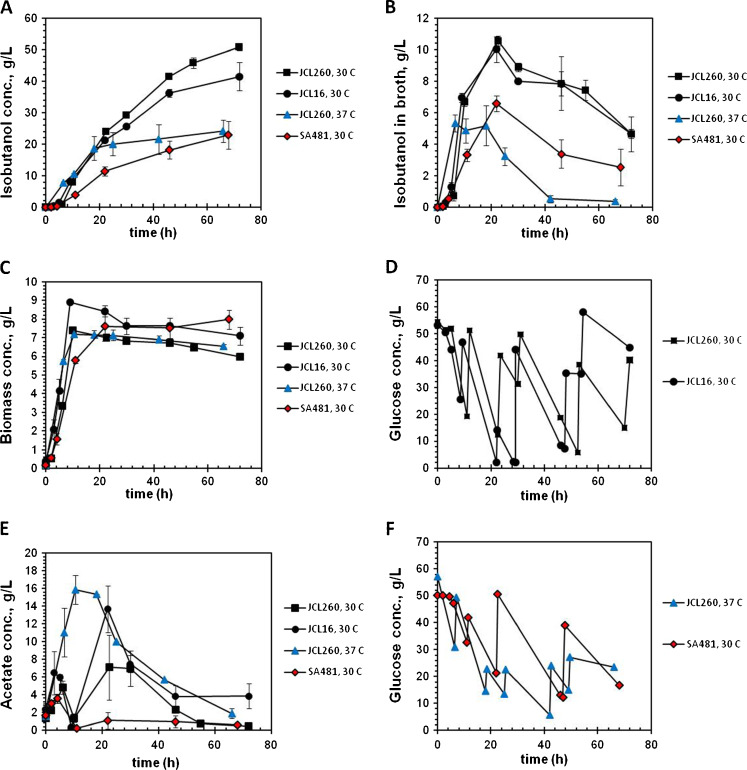
Typical kinetics of isobutanol production by JCL260, JCL16, and SA481 strains harboring pSA65/pSA69. a Total isobutanol production (calculated as sum of isobutanol quantities determined in receivers B, D, and broth culture considering a working volume of 0.35 L). b Isobutanol concentration in fermentation broth. c Cell growth. d, f Glucose consumption. e Acetate production. High isobutanol producer (JCL260) at 30°C (closed squares), parental (JCL16) at 30°C (closed circle), high isobutanol producer (JCL260) at 37°C (closed triangles) and high isobutanol-tolerant strain (closed diamond). Error bars correspond to the difference between duplicate cultures (ac, e). For clarity, one set of data has been plotted in d and f
Fig. 3
Fig. 3
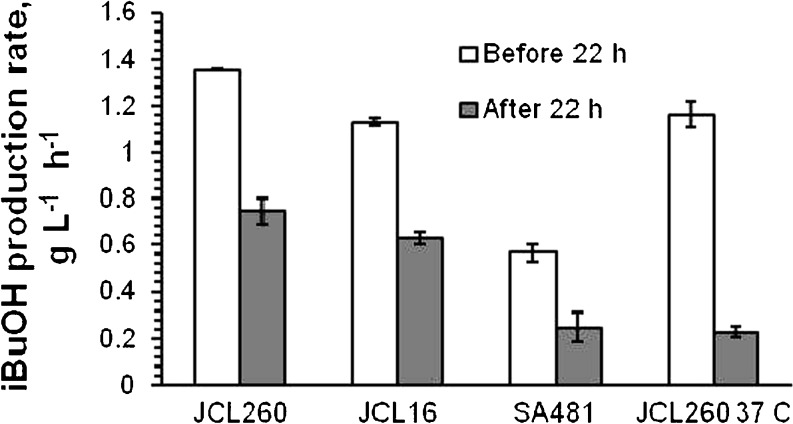
Volumetric isobutanol production rate calculated as slope from time profile of isobutanol production before and after 22 h for all cultures, except for JCL260 at 37°C where it was determined before and after 16 h. Error bars represent the difference between duplicate cultures
Fig. 4
Fig. 4
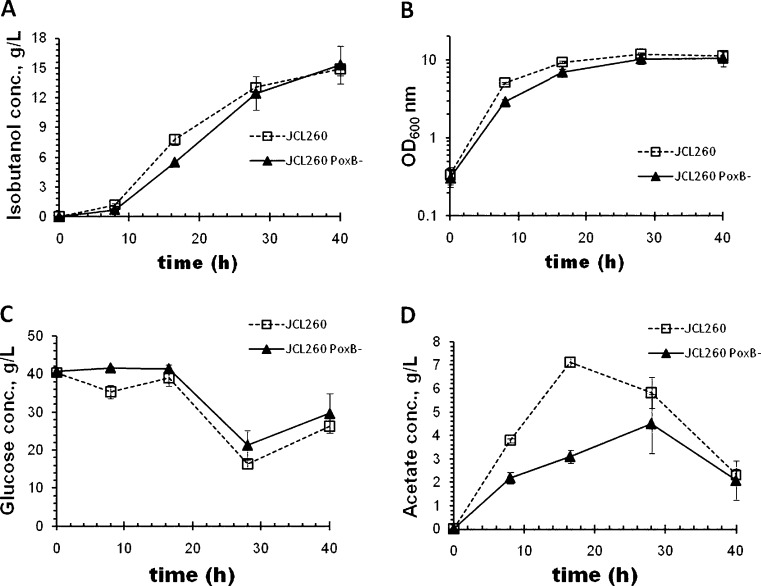
Time profile of acetate production by JCL260 PoxB mutant and high isobutanol producer (JCL260) strains harboring pSA65/pSA69 plasmids cultivated in shake flasks containing 25 mL of medium. Data shown are the results of three independent fermentations
Fig. 5
Fig. 5
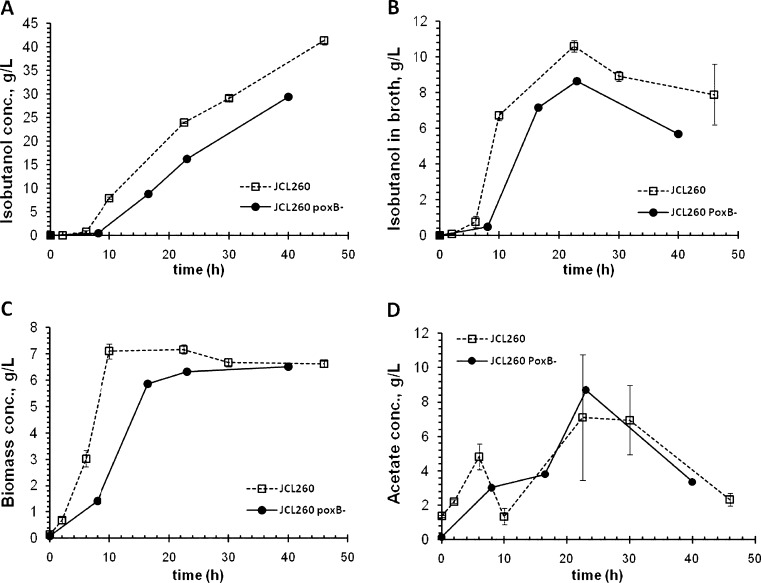
Time profile of acetate production by JCL260 PoxB mutant and high isobutanol producer (JCL260) carrying pSA65/pSA69 in bioreactor cultures. Data shown are duplicated and single fermentation for JCL260 and JCL260 PoxB, respectively
Fig. 6
Fig. 6
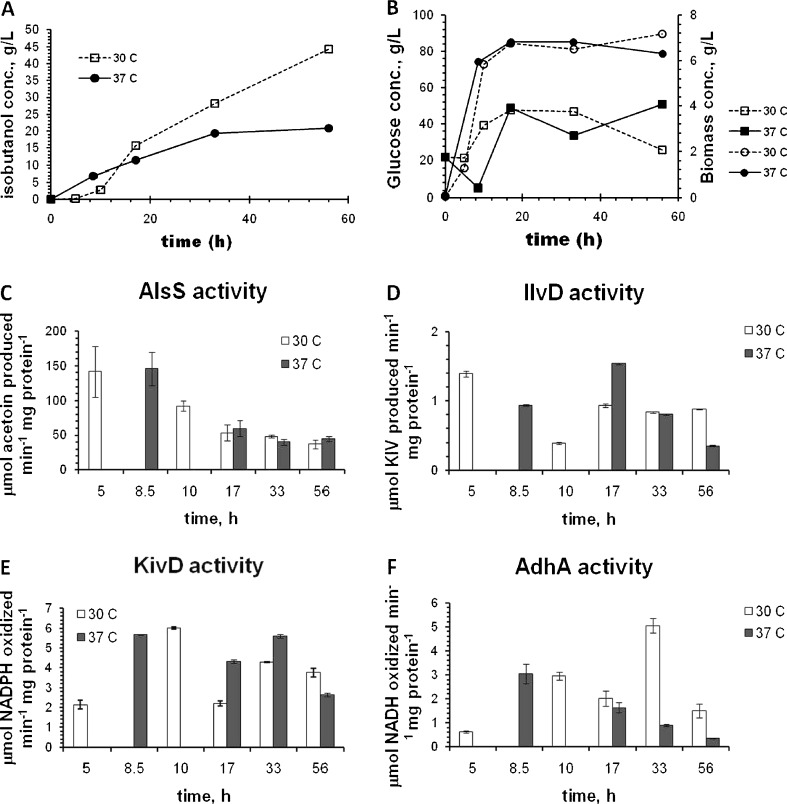
Enzyme activity of isobutanol pathway for JCL260 carrying pSA65/pSA69 plasmids in bioreactor cultures at 30°C (open symbols) and 37°C (closed symbols). a Total isobutanol production calculated as sum of isobutanol concentrations from receivers B, D (Fig. 1), and broth culture considering a working volume of 0.35 L. b Time profile of glucose concentration and cell growth. c Acetolactate synthase (AlsS) activity. d Dihydroxy-acid dehydratase activity. e 2-Ketoisovalerate decarboxylase (KivD) activity. f Alcohol dehydrogenase (AdhA) activity. Error bars indicate the difference between duplicate assays
Fig. 7
Fig. 7
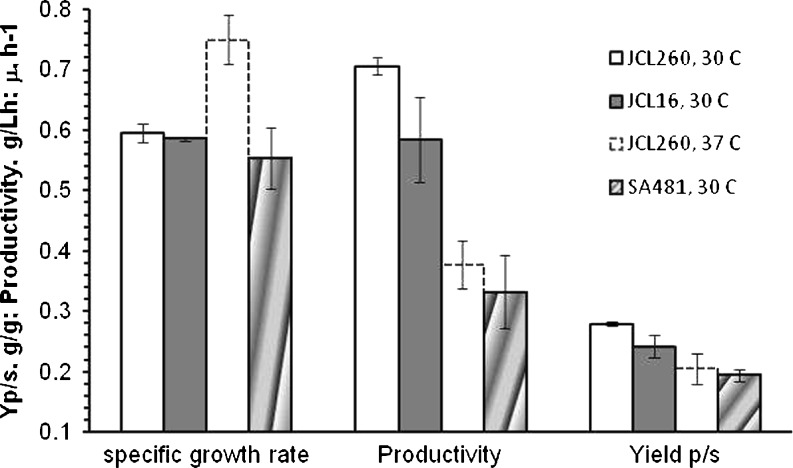
Comparison of specific growth rate (μ, liters per hour), volumetric productivity (grams per liter per hour) and product yield on glucose (Y P/S, gram per gram) of the high isobutanol producer (JCL260), high isobutanol-tolerant (SA481), and parental (JCL16) strains cultured at 30°C and JCL260 at 37°C. The μ was calculated during the exponential growth phase. Error bars indicate the difference between replicate cultures

References

    1. Alper H, Moxley J, Nevoigt E, Fink GR, Stephanopoulos G. Engineering yeast transcription machinery for improved ethanol tolerance and production. Science. 2006;314:1565–1568. - PubMed
    1. Atsumi S, Cann AF, Connor MR, Shen CR, Smith KM, Brynildsen MP, Chou KJ, Hanai T, Liao JC. Metabolic engineering of Escherichia coli for 1-butanol production. Metab Eng. 2008;10:305–311. doi: 10.1016/j.ymben.2007.08.003. - DOI - PubMed
    1. Atsumi S, Hanai T, Liao JC. Non-fermentative pathways for synthesis of branched-chain higher alcohols as biofuels. Nature. 2008;451:86–89. doi: 10.1038/nature06450. - DOI - PubMed
    1. Atsumi S, Higashide W, Liao JC. Direct photosynthetic recycling carbon dioxide to isobutyraldehyde. Nat Biotechnol. 2009;27:1177–1180. doi: 10.1038/nbt.1586. - DOI - PubMed
    1. Atsumi S, Tung-Yun W, Eckl EM, Hawkins SD, Buelter T, Liao JC. Engineering the isobutanol biosynthetic pathway in Escherichia coli by comparison of three aldehyde reductase/alcohol dehydrogenase genes. Appl Microbiol Biotechnol. 2010;85:651–657. doi: 10.1007/s00253-009-2085-6. - DOI - PMC - PubMed

Publication types

MeSH terms