. 2011 May 9:4:12.
doi: 10.1186/1755-8166-4-12.

Clinical implementation of whole-genome array CGH as a first-tier test in 5080 pre and postnatal cases

Affiliations

Clinical implementation of whole-genome array CGH as a first-tier test in 5080 pre and postnatal cases

Sang-Jin Park et al. Mol Cytogenet. .

Abstract

Background: Array comparative genomic hybridization (CGH) is currently the most powerful method for detecting chromosomal alterations in pre and postnatal clinical cases. In this study, we developed a BAC based array CGH analysis platform for detecting whole genome DNA copy number changes including specific micro deletion and duplication chromosomal disorders. Additionally, we report our experience with the clinical implementation of our array CGH analysis platform. Array CGH was performed on 5080 pre and postnatal clinical samples from patients referred with a variety of clinical phenotypes.

Results: A total of 4073 prenatal cases (4033 amniotic fluid and 40 chorionic villi specimens) and 1007 postnatal cases (407 peripheral blood and 600 cord blood) were studied with complete concordance between array CGH, karyotype and fluorescence in situ hybridization results. Among 75 positive prenatal cases with DNA copy number variations, 60 had an aneuploidy, seven had a deletion, and eight had a duplication. Among 39 positive postnatal cases samples, five had an aneuploidy, 23 had a deletion, and 11 had a duplication.

Conclusions: This study demonstrates the utility of using our newly developed whole-genome array CGH as first-tier test in 5080 pre and postnatal cases. Array CGH has increased the ability to detect segmental deletion and duplication in patients with variable clinical features and is becoming a more powerful tool in pre and postnatal diagnostics.


Figures
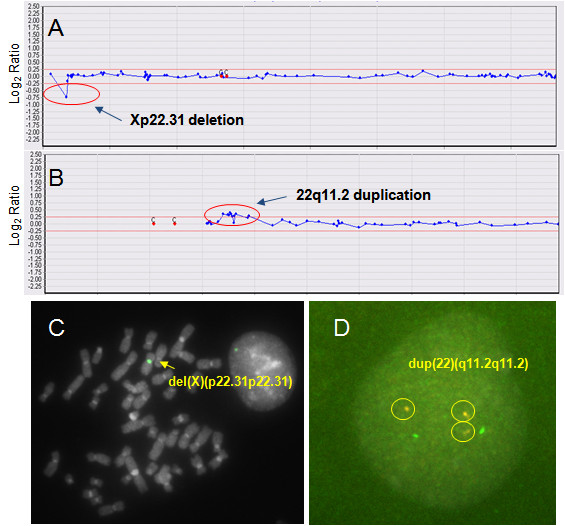
Figure 1
Figure 1
Array CGH with FISH validation data for cases 17 (A, C) and 21 (B, D) (Table 2). (A) The array CGH results for the X chromosome. Arrow indicates deletion of the steroid sulfatase deficiency critical region (Xp22.31) including the STS gene. (B) The array CGH results for chromosome 22. Arrow indicates duplication of the Digeorge syndrome critical region (22q11.2). (C) FISH with a Xp22.31 specific region probe; arrow indicates a deletion of the probe (STS-) in a del(X)(p22.31p22.31) chromosome. (D) FISH with 22q11.2 specific region probe; circles indicate a duplication of the probe (COMTⅹ3) in an interphase cell.
Figure 2
Figure 2
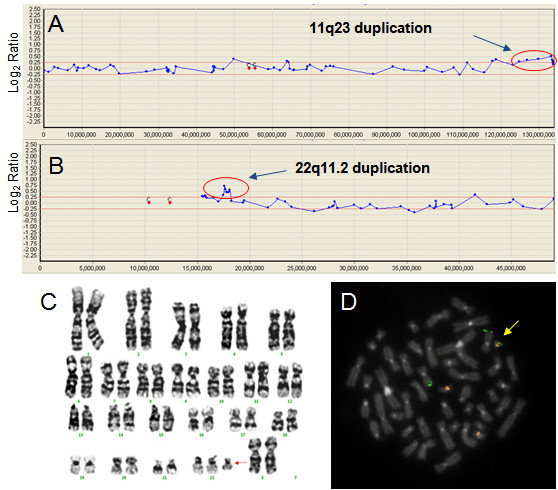
Array CGH with cytogenetics validation data for case 30 (Table 3). (A), (B) The array CGH results for chromosomes 11 and 22. Arrows indicates duplication of 11q23 and 22q11.2. (C) G-banding karyotype result of 47,XX, +der(22)t(11;22)(q23;q11). Arrow indicates the marker chromosome. (D) FISH with 11q23 (green color) and 22q11.2 (yellow color) specific region probes; arrow indicates a +der(22)t(11;22)(q23;q11).
Figure 3
Figure 3
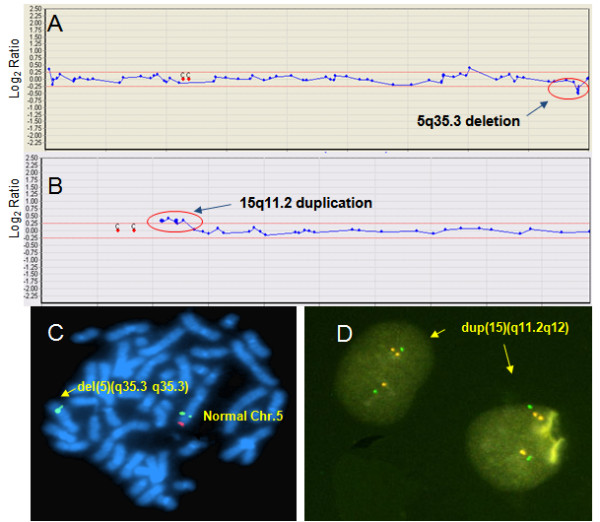
Array CGH with FISH validation data for cases 10 (A, C) and 23 (B, D) (Table 3). (A) The array CGH results for chromosome 5. Arrow indicates deletion of the Sotos syndrome critical region (5q35.3), including the NSD1 gene. (B) The array CGH results for chromosome 15. Arrow indicates duplication of the PWS/AS syndrome critical region (15q11.2). (C) FISH with a 5q35.3 specific region probe; arrow indicates a deletion of the probe (NSD1-) in a del(5)(q35.3q35.3) chromosome. Deletion of the NSD1 gene region (red signal) was observed by FISH analysis, 46, XY, ish del(5)(q35.3q35.3)(D5S404+, NSD1-) (D) FISH with 15q11.2 specific region probe; arrows indicate a duplication of the probe (SNRPNⅹ3) in interphase cells.

References

    1. Park SJ, Jeong SY, Kim HJ. Y chromosome loss and other genomic alterations in hepatocellular carcinoma cell lines analyzed by CGH and CGH array. Cancer Genet Cytogenet. 2006;166:56–64. doi: 10.1016/j.cancergencyto.2005.08.022. - DOI - PubMed
    1. Bejjani BA, Shaffer LG. Clinical utility of contemporary molecular cytogenetics. Annu Rev Genomics Hum Genet. 2008;9:71–86. doi: 10.1146/annurev.genom.9.081307.164207. - DOI - PubMed
    1. Shinawi M, Cheung SW. The array CGH and its clinical applications. Drug Discov Today. 2008;13:760–770. doi: 10.1016/j.drudis.2008.06.007. - DOI - PubMed
    1. Albertson DG, Pinkel D. Genomic microarrays in human genetic disease and cancer. Hum Mol Genet. 2003;12:R145–152. doi: 10.1093/hmg/ddg261. Spec No 2. - DOI - PubMed
    1. Lu X, Shaw CA, Patel A, Li J, Cooper ML, Wells WR, Sullivan CM, Sahoo T, Yatsenko SA, Bacino CA. et al. Clinical implementation of chromosomal microarray analysis: summary of 2513 postnatal cases. PLoS One. 2007;2:e327. doi: 10.1371/journal.pone.0000327. - DOI - PMC - PubMed

LinkOut - more resources