. 2011 May 24;21(10):825-34.
doi: 10.1016/j.cub.2011.04.010. Epub 2011 May 5.

C. elegans Notch signaling regulates adult chemosensory response and larval molting quiescence

Affiliations

C. elegans Notch signaling regulates adult chemosensory response and larval molting quiescence

Komudi Singh et al. Curr Biol. .

Abstract

Background: The conserved DOS-motif proteins OSM-7 and OSM-11 function as coligands with canonical DSL (Delta, Serrate, and LAG-2) ligands to activate C. elegans Notch receptors during development. We report here that Notch ligands, coligands, and the receptors LIN-12 and GLP-1 regulate two C. elegans behaviors: chemosensory avoidance of octanol and quiescence during molting lethargus.

Results: C. elegans lacking osm-7 or osm-11 are defective in their response to octanol. We find that OSM-11 is secreted from hypodermal seam cells into the pseudocoelomic body cavity and acts non-cell autonomously as a diffusible factor. OSM-11 acts with the DSL ligand LAG-2 to activate LIN-12 and GLP-1 Notch receptors in the neurons of adult animals, thereby regulating octanol avoidance response. In adult animals, overexpression of osm-11 and consequent Notch receptor activation induces anachronistic sleep-like quiescence. Perturbation of Notch signaling alters basal activity in adults as well as arousal thresholds and quiescence during molting lethargus. Genetic epistasis studies reveal that Notch signaling regulates quiescence via previously identified circuits and genetic pathways including the egl-4 cGMP-dependent kinase.

Conclusions: Our findings indicate that the conserved Notch pathway modulates behavior in adult C. elegans in response to environmental stress. Additionally, Notch signaling regulates sleep-like quiescence in C. elegans, suggesting that Notch may regulate sleep in other species.


Figures

Figure 1
Figure 1
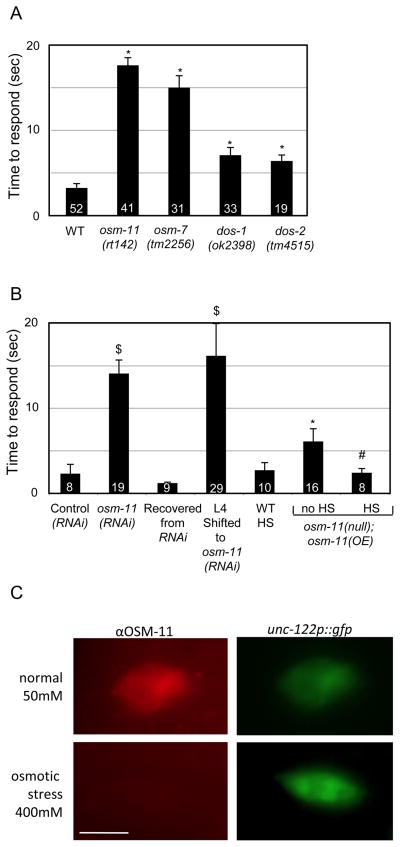
C. elegans DOS-motif proteins are required for response to octanol. (A) Octanol responses of animals carrying the likely null alleles osm-11(rt142), osm-7(tm2256), dos-1(ok2398), and partial loss of function allele dos-2(tm4515). *p<0.0005 vs. wild type (WT). (B) osm-11 function is not required during development for octanol response in adults. $p<10−4 vs. control (RNAi). *p>0.05 vs. wild type, #p>0.05 vs. osm-11(null);osm-11(OE) no HS. (C) OSM-11 protein accumulates in coelomocytes. osm-11p::gfp reporter constructs do not drive GFP expression in coelomocytes [4]. Top left: Representative image of OSM-11 accumulation in a coelomocyte using αOSM-11 antisera [4]. Bottom left: Osmotic stress likely results in diminished OSM-11 secretion by seam cells into pseudocoelom. Top and bottom right: GFP expression (unc-122p:: gfp) in coelomocytes [53]. Scale bar=6 μm. See Supplemental Methods 1 for details.
Figure 2
Figure 2
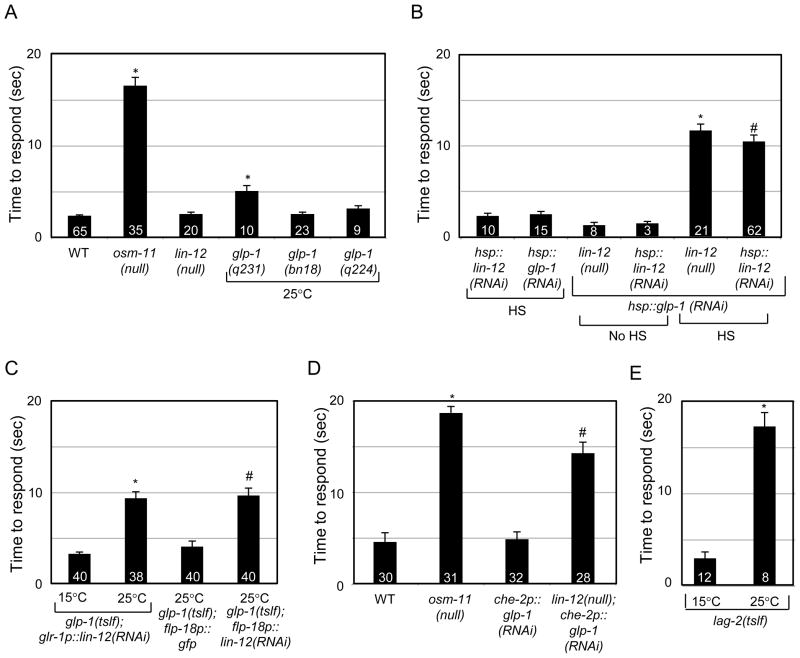
C. elegans Notch receptors and DSL ligand are required for normal octanol response. (A) Decreasing function of either Notch receptor gene alone does not dramatically impair octanol response. *p<10−11 vs. wild type (WT). (B) Knockdown of both Notch receptors impairs octanol response in adult animals #p<0.05 vs. hsp::lin-12(RNAi) HS, *p<0.05 vs. lin-12(null). (C) Notch receptors are required in neurons. lin-12 function is required in a subset of interneurons for normal octanol response. lin-12(RNAi) in glr-1 and flp-18-expressing neurons impairs octanol response. *p<10−11 vs. animals at 15°C. #p<10−4 vs. glp-1(tslf);flp-18p::gfp. (D) glp-1 functions in ciliated sensory neurons to regulate octanol response. glp-1(RNAi) in che-2-expressing ciliated sensory neurons impairs octanol response in lin-12(null) animals. *p<10−12 vs. WT; #p<10−8 vs. che-2p::glp-1(RNAi). (E) lag-2 function is required in adult animals for octanol response. *p<10−7. See Supplemental Methods 2 for details.
Figure 3
Figure 3
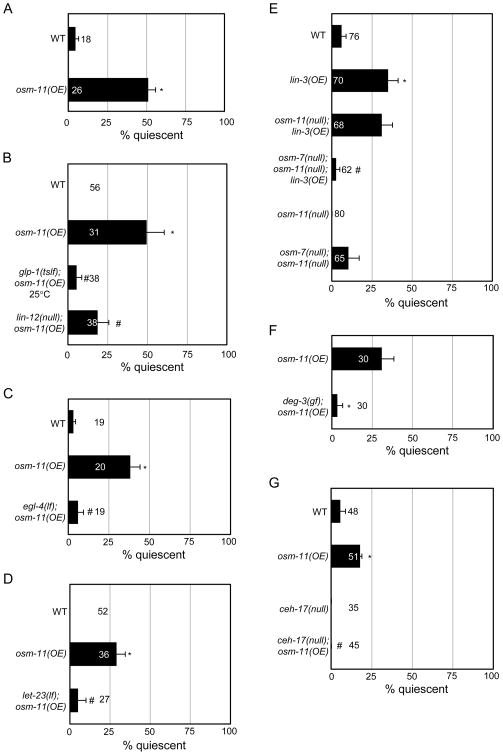
OSM-11 over-expression induces quiescence in adults. In all panels, osm-11 was expressed under the heat shock promoter (hsp::osm-11). (A) OSM-11 over-expression (OE) induces spontaneous, transient and anachronistic quiescence in adult animals. *p<10−5 vs. WT. (B) osm-11(OE)-induced adult quiescence requires Notch receptor function. glp-1(tslf) or lin-12(null) suppress osm-11(OE) induced quiescence. *p<0.05 vs. WT; #p<0.05 vs. osm-11(OE). (C) OSM-11 over-expression induced quiescence is suppressed by egl-4 (lf). *p<0.0001 vs. wild type (WT); #p<0.05 vs. osm-11(OE). (D) Loss of LET-23 EGF receptor function (let-23(lf)) suppresses osm-11(OE)-induced quiescence. *p<0.001 vs. WT; #p<0.05 vs. osm-11(OE). (E) Simultaneous loss of osm-7 and osm-11 suppresses LIN-3 EGF over-expression (lin-3(OE))-induced adult quiescence. *p<0.01 vs. WT; #p<0.05 vs. lin-3(OE). (F) deg-3-induced neurodegeneration suppresses osm-11(OE)-induced quiescence. *p<0.05. As the locomotion of deg-3(u662) animals is severely uncoordinated, pharyngeal pumping was used to assess quiescence. (G) Defective axon outgrowth in ceh-17-expressing neurons suppresses osm-11(OE)-induced quiescence. ceh-17(null) affects processes of ALA and a subset of other neurons. *p<0.05 vs. WT; #p<0.001 vs. osm-11(OE). See Supplemental Methods 3 for details.
Figure 4
Figure 4
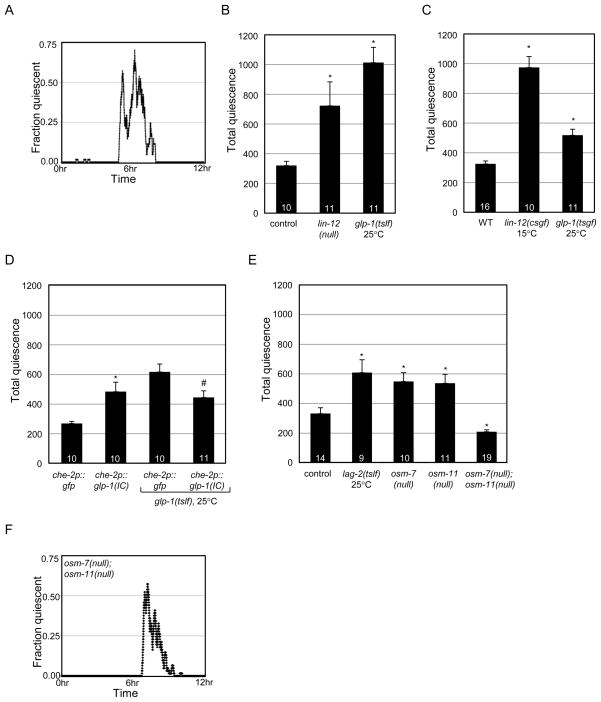
Notch signaling regulates L4-to Adult molting quiescence. (A) Representative fractional quiescence graph. Mid-L4 animals exhibit L4/A molting lethargus quiescence for a few hours before adulthood. (B) Loss of LIN-12 receptor or decreased GLP-1 receptor function increased total L4/A quiescence. *p<0.02 vs. control (mgIs49; see Experimental Procedures for details). (C) Increased LIN-12 or GLP-1 function increased total L4/A molting quiescence. *p<10−4 vs. wild type (WT). (D) Increasing GLP-1 receptor activity in ciliated sensory neurons increased total L4/A quiescence in wild type animals (che-2p::glp-1(IC)). Expression of che-2p::glp-1(IC) transgene restored total quiescence in glp-1(tslf) animals to normal levels. *p<0.003 vs. che-2p::gfp. #p<0.02 vs. glp-1(tslf);che-2p::gfp. (E) Notch ligands/co-ligands regulate total L4/A quiescence. *p<0.002 vs. control (mgIs49; see Experimental Procedures for details). (F) Representative fractional quiescence graph of osm-7(null);osm-11(null) for comparison with (A) is presented. See Supplemental Methods 4 for details.
Figure 5
Figure 5
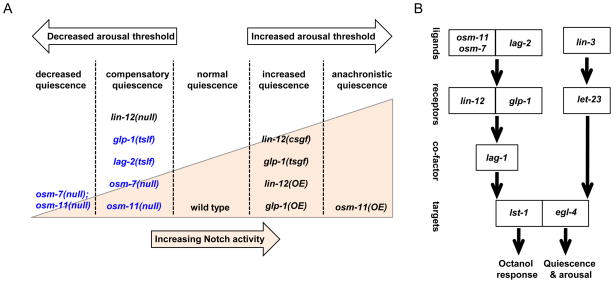
Model for Notch signaling regulating multiple aspects of L4-to-adult molting quiescence. (A) Schematic model summarizing the impact of various Notch pathway genes. Gene name and type of allele is listed; Notch activity increases left to right (illustrated by peach wedge). For each genotype, the impact of altered Notch signaling on total L4-to-adult quiescence is listed above the wedge; OSM-11 co-ligand over-expression also induced anachronistic quiescence in adult animals. Decreased Notch signaling decreased arousal threshold during L4-to-adult molting lethargus while increased Notch signaling increased arousal thresholds (white arrows). Decreased glp-1 Notch receptor function, decreased DSL ligand function or loss of DOS co-ligands increased C. elegans basal locomotion activity (blue text) while loss of lin-12 Notch receptor decreased basal activity. (B) Genetic pathway illustrating relationships between C. elegans genes regulating octanol response and quiescence. egl-4 PKG also contributes, but is not required for octanol response; the role of the EGF pathway in octanol response has not been addressed. Neuronal Notch receptors act redundantly and in different populations of neurons in this behavior: lin-12 in a subset of interneurons and glp-1 in ciliated sensory neurons. Notch receptors may also act elsewhere to regulate quiescence. Activation of either EGF or Notch pathways by ligand over-expression induces anachronistic quiescence and these pathways are both required for normal L4-to-adult molting quiescence. EGF and Notch pathways may act in parallel converging on egl-4 to regulate molting quiescence (illustrated) and/or there may be functional interrelationships between these signaling pathways.

Comment in

References

    1. Fortini ME. Notch signaling: the core pathway and its posttranslational regulation. Developmental Cell. 2009;16:633–647. - PubMed
    1. Sternberg PW. Vulval development. WormBook: the online review of C elegans biology. 2005:1–28. - PMC - PubMed
    1. Kimble J, Crittenden SL. Germline proliferation and its control. WormBook: the online review of C elegans biology. 2005:1–14. - PMC - PubMed
    1. Komatsu H, Chao M, Larkins-Ford J, Corkins M, Somers G, Tucey T, Dionne H, White J, Wani K, Boxem M, et al. OSM-11 facilitates LIN-12 Notch signaling during Caenorhabditis elegans vulval development. Plos Biol. 2008;6:e196. - PMC - PubMed
    1. Frazier HN, Roth MB. Adaptive sugar provisioning controls survival of C. elegans embryos in adverse environments. Current biology: CB. 2009;19:859–863. - PMC - PubMed

Publication types

MeSH terms

LinkOut - more resources