Review
. 2011 Aug;21(4):422-30.
doi: 10.1016/j.gde.2011.03.008.

Nonsense-mediated mRNA decay (NMD) in animal embryogenesis: to die or not to die, that is the question

Affiliations
Review

Nonsense-mediated mRNA decay (NMD) in animal embryogenesis: to die or not to die, that is the question

Jungwook Hwang et al. Curr Opin Genet Dev. 2011 Aug.

Abstract

Nonsense-mediated mRNA decay (NMD) is a well-studied cellular quality-control pathway. It decreases the half-lives of eukaryotic mRNAs that aberrantly contain premature termination codons and additionally regulates an estimated 10-20% of normal transcripts. NMD factors play crucial roles during embryogenesis in many animals. Here, we review data indicating that NMD factors are required for proper embryogenesis by discussing the abnormal developmental phenotypes that result when the abundance of individual NMD factors is either downregulated or completely eliminated. We conclude that while NMD per se affects the embryogenesis of all animals, it is required to avoid embryonic lethality in only some animals. The critical roles of many NMD factors in other metabolic pathways undoubtedly also contribute to embryonic development if not viability.


Figures

Figure 1
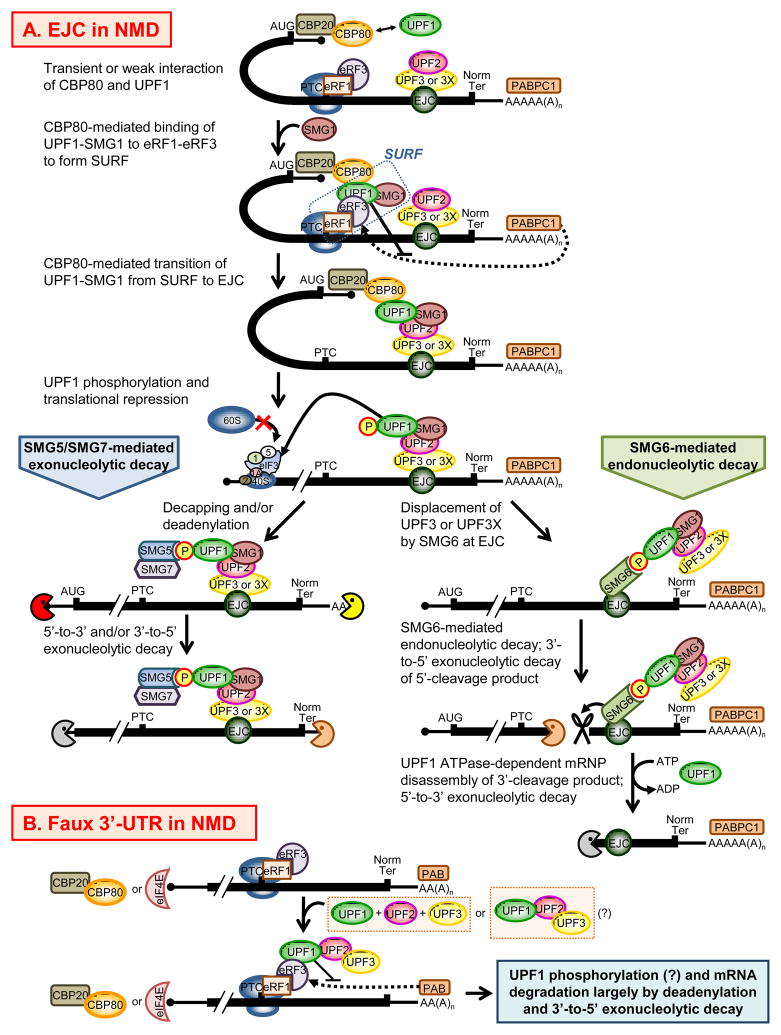
Figure 1. Models for NMD
(A) EJC function in mammalian-cell NMD. NMD is a consequence of PTC recognition during the pioneer-round of translation [18]. This round utilizes newly synthesized mRNA bound by the cap-binding protein heterodimer CBP80-CBP20 and, provided the mRNA derived from splicing, at least one exon-junction complex (EJC) situated ~ 20–24-nucleotides upstream of such a junction. The direct, but weak or transient interaction of CBP80 with the central NMD factor UPF1 promotes at least two steps during NMD [21]. The first step is the joining of UPF1 and its kinase SMG1 to eRF1 and eRF3 at a PTC to form the SURF complex. During NMD, this step is thought to compete effectively with joining of the PABPC1 to eRF3, the latter of which is specified as a dotted line [28]. The second is the joining of UPF1 and SMG1, presumably from SURF, to a downstream EJC, which leads to UPF1 phosphorylation by SMG1 [22]. SMG5 and SMG7 form a complex with phosphorylated UPF1, as does SMG6 [,–79]. It is uncertain if SMG5/SMG7 and SMG6 bind multiple phosphates on the same UPF1 molecule or, as shown, different phosphorylated UPF1 molecules. In favor of the first possibility, SMG6 co-immunoprecipitates with SMG5 and SMG7 in an RNase A-resistant manner [77]. Since SMG7-mediated mRNA decay occurs independently of SMG6 [79], it is plausible that SMG5/SMG7-mediated NMD leads to deadenylation and/or decapping followed, respectively, by exosome-mediated 3′-to-5′ and XRN1-mediated 5′-to-3′ exonucleolytic activities (reviewed in [–82]). An alternative or additional mRNA degradation pathway involves SMG6, whose binding to hyperphosphorylated UPF1 competes with UPF3X and may replace the interaction of UPF3X with Y14-MAGOH EJC constituents [77]. The endonuclease activity of SMG6 cleaves the NMD substrate into 5′- and 3′-cleavage products. Activation of the RNA-dependent ATPase activity of UPF1 subsequently results in the XRN1-mediated 5′-to-3′ decay of the 3′ fragment, which presumably depends on UPF1 helicase activity [8]. PAPBC1, poly(A) binding protein C1. (B) Faux 3′-UTR function in S. cerevisiae NMD, where CBP80 and CBP20 are alternatively referred to as, respectively, CBC1 and CBC2. When a ribosome reaches a PTC that is situated abnormally upstream of the mRNA poly(A) tail, UPF1 can effectively compete with PAB for association with eRF3 so as to trigger NMD [28,44]. How and when the other UPF proteins associate with an NMD target and contribute to NMD remains uncertain, as does whether UPF1 undergoes phosphorylation during NMD. CBC, cap-binding complex constituent.

References

    1. Bhuvanagiri M, Schlitter AM, Hentze MW, Kulozik AE. NMD: RNA biology meets human genetic medicine. Biochem J. 2010;430:365–377. - PubMed
    1. Nicholson P, Mühlemann O. Cutting the nonsense: the degradation of PTC-containing mRNAs. Biochem Soc Trans. 2010;38:1615–1620. - PubMed
    1. Jaillon O, Bouhouche K, Gout JF, Aury JM, Noel B, Saudemont B, Nowacki M, Serrano V, Porcel BM, Segurens B, et al. Translational control of intron splicing in eukaryotes. Nature. 2008;451:359–362. - PubMed
    1. Sayani S, Janis M, Lee CY, Toesca I, Chanfreau GF. Widespread impact of nonsense-mediated mRNA decay on the yeast intronome. Mol Cell. 2008;31:360–370. - PMC - PubMed
    1. Mitrovich QM, Anderson P. mRNA surveillance of expressed pseudogenes in C. elegans. Curr Biol. 2005;15:963–967. - PubMed

Publication types