. 2011 Jul;10(7):945-55.
doi: 10.1128/EC.00013-11. Epub 2011 May 6.

SclR, a basic helix-loop-helix transcription factor, regulates hyphal morphology and promotes sclerotial formation in Aspergillus oryzae

Affiliations

SclR, a basic helix-loop-helix transcription factor, regulates hyphal morphology and promotes sclerotial formation in Aspergillus oryzae

Feng Jie Jin et al. Eukaryot Cell. 2011 Jul.

Abstract

Most known basic-region helix-loop-helix (bHLH) proteins belong to a superfamily of transcription factors often involved in the control of growth and differentiation. Therefore, inappropriate expression of genes encoding bHLH proteins is frequently associated with developmental dysfunction. In our previously reported study, a novel bHLH protein-encoding gene (AO090011000215) of Aspergillus oryzae was identified. The gene-disrupted strain was found to produce dense conidia, but sparse sclerotia, relative to the parent strain. Here, to further analyze its function, we generated an overexpressing strain using the A. oryzae amyB gene promoter. Genetic overexpression led to a large number of initial hyphal aggregations and then the formation of mature sclerotia; it was therefore designated sclR (sclerotium regulator). At the same time, the sclR-overexpressing strain also displayed both delayed and decreased conidiation. Scanning electron microscopy indicated that the aerial hyphae of the sclR-overexpressing strain were extremely branched and intertwined with each other. In the generation of the SclR-enhanced green fluorescent protein (EGFP) expression strain, the SclR-EGFP protein fusion was conditionally detected in the nuclei. In addition, the loss of sclR function led to rapid protein degradation and cell lysis in dextrin-polypeptone-yeast extract liquid medium. Taken together, these observations indicate that SclR plays an important role in hyphal morphology, asexual conidiospore formation, and the promotion of sclerotial production, even retaining normal cell function, at least in submerged liquid culture.


Figures
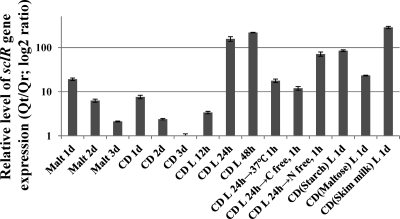
Fig. 1.
Fig. 1.
Pattern of sclR gene expression. The relative levels of expression of sclR message were determined by qRT-PCR. The relative amounts of sclR message (target) were determined from the ratio of the target to the reference gene after amplification (Qt/Qr). TEF1 was used as an endogenous reference gene. Malt, malt agar medium; CD, CD agar medium; CD L, CD liquid medium; CD(Starch) L, CD liquid medium contained 3% soluble starch instead of glucose; CD(Maltose) L, CD liquid medium contained 3% maltose instead of glucose; CD(Skim milk) L, CD liquid medium contained 0.2% skim milk instead of NaNO3. The expression value of sclR gene at CD 3d point was used as the baseline.
Fig. 2.
Fig. 2.
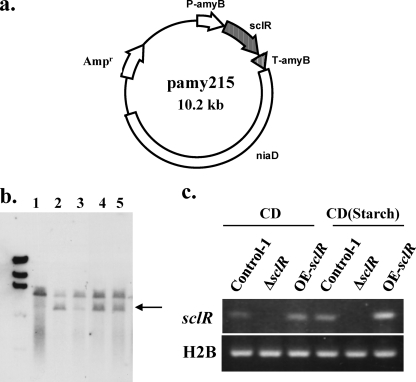
Construction of the sclR overexpression strain. (a) Construction of the plasmid for sclR overexpression. The construction of the plasmid is described in detail in Materials and Methods. The full-length sclR ORF is inserted into the terminus of the amyB promoter. (b) Confirmation of sclR overexpression strain by Southern blot analysis. Genomic DNAs were digested with EcoRI and hybridized with the probe (sclR ORF). The expected DNA sizes are shown by the arrow. Lane 1, parent strain; lanes 2 to 5, transformants with pamy215. (c) Confirmation of sclR overexpression by semiquantitative RT-PCR analysis. Total RNA was isolated from the strains cultured on CD or starch-containing CD media for 2 days. Negative-control PCR analysis using each mRNA as a template showed no amplified fragments (data not shown).
Fig. 3.
Fig. 3.
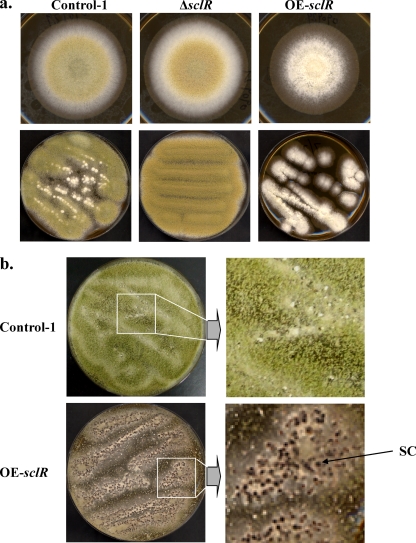
Growth phenotype of the sclR-overexpressing strain and the sclR-disrupted strain. (a) Comparison of growth phenotypes. The Control-1 strain, sclR-disrupted strain (ΔsclR), and sclR-overexpressing strain (OE-sclR) were cultivated on malt agar medium at 30°C using spot and streak culture. (b) sclR overexpression promotes sclerotial production. The OE-sclR strain and the Control-1 strain were cultured on malt agar medium at 30°C for 9 days. The magnification of the panels on the right hand site is the same. SC, sclerotium.
Fig. 4.
Fig. 4.
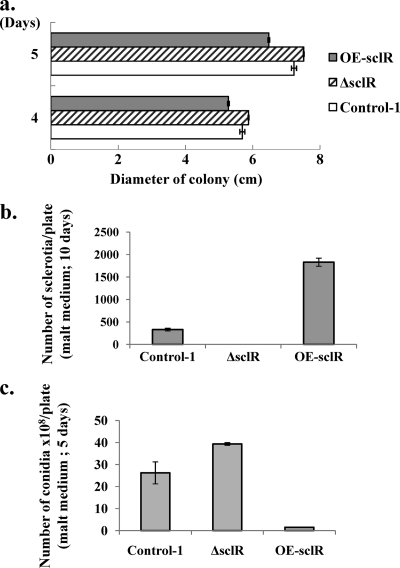
Comparison of growth of the sclR-overexpressing strain, the sclR-disrupted strain, and the control strain. The OE-sclR strain, the ΔsclR strain, and the Control-1 strain were spot cultured on malt agar medium at 30°C for several days. The colony diameter (a), sclerotial number (b), and conidial number (c) were measured and compared. Each experiment was performed in duplicate.
Fig. 5.
Fig. 5.
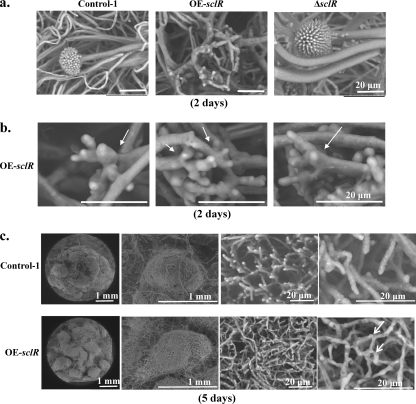
Electron microscopy. (a) Observation of hyphal morphology. The Control-1 strain, the OE-sclR strain, and the ΔsclR strain were cultivated on malt agar medium at 30°C for 2 days. Scale bar, 20 μm. (b) Further observation of superhyphal branching of the sclR-overexpressing strain. The sclR overexpression strain that was cultivated on malt agar medium for 2 days was further magnified and observed by SEM. The white arrows indicate the hyphal branching sites at the apex. (c) Comparison of sclerotial structure between the OE-sclR strain and the Control-1 strain. The control strain and OE-sclR strain were cultivated on malt agar medium at 30°C for 5 days. Hard white sclerotial structures were observed and compared. The arrows indicate the hyphal fusions and interconnections.
Fig. 6.
Fig. 6.
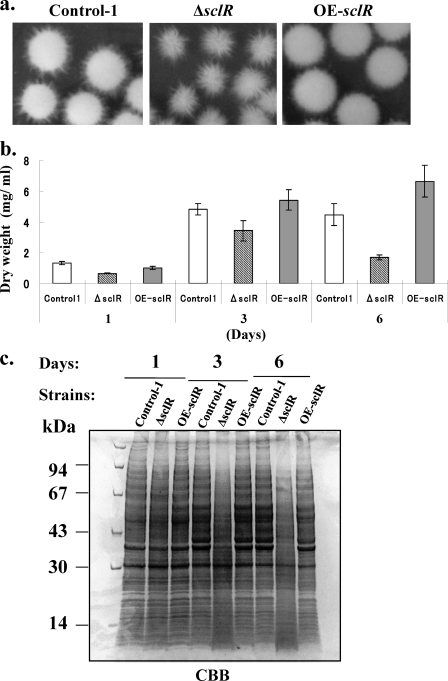
Growth phenotype of the sclR-overexpressing strain and the sclR-disrupted strain in DPY liquid medium. (a) Growth phenotype of the OE-sclR strain and the ΔsclR strain. Each strain was cultivated in DPY liquid medium at 30°C for 3 days. (b) Biomass comparison. A total of 106 conidia of each strain were cultivated in 40 ml of DPY liquid medium for 1, 3, and 6 days. Mycelia were collected by filtering through Miracloth, and then lyophilization was performed. The dry weight of each strain was determined. (c) Protein production pattern in DPY liquid medium. A total of 106 conidia of each strain were cultivated in 40 ml of DPY liquid medium for 1, 3, and 6 days. The protein was extracted from the mycelia, and SDS-PAGE was performed with a 10 to 20% polyacrylamide gel. Then, 10 μl/well (24 μg) of each sample was loaded. The polyacrylamide gel was further stained with quick-CBB.
Fig. 7.
Fig. 7.
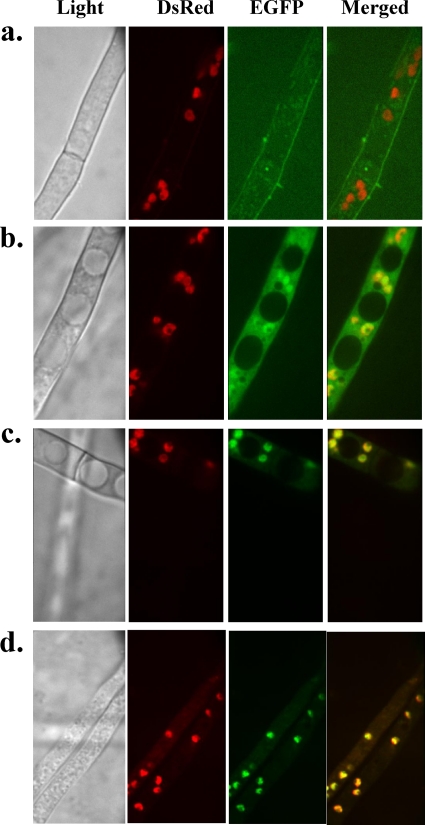
Localization of SclR-EGFP fusion protein. SclR-EGFP strains were cultured in DPY liquid medium at 30°C for several days. Light and fluorescence microscopic observations were performed. The fluorescence of the Control-2 strain (a), the SclR-EGFP strain on day 3 after inoculation (b) and (c), and the SclR-EGFP expression strain on day 4 after inoculation (d) was observed with GFP, DsRed, and DualView filters.
Fig. 8.
Fig. 8.
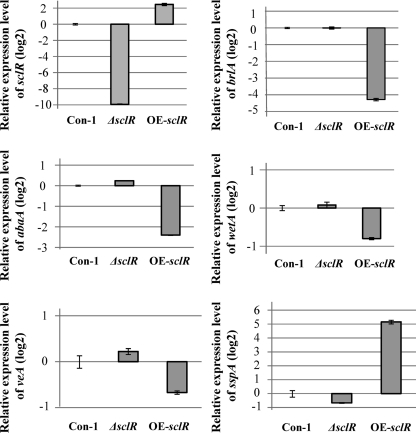
qRT-PCR analysis. The relative expression levels of genes involved in sexual/asexual development and sclerotial formation were examined and compared by using qRT-PCR. The expression levels of all genes were normalized to the expression level of the endogenous control gene TEF1. The expression value of each gene in the Control-1 strain was used as the baseline. Con-1, Control-1 strain. Each experiment was performed in duplicate.

References

    1. Atchley W. R., Fitch W. M. 1997. A natural classification of the basic helix-loop-helix class of transcription factors. Proc. Natl. Acad. Sci. U. S. A. 94:5172–5176 - PMC - PubMed
    1. Atchley W. R., Terhalle W., Dress A. 1999. Positional dependence, cliques, and predictive motifs in the bHLH protein domain. J. Mol. Evol. 48:501–516 - PubMed
    1. Atchley W. R., Wollenberg K. R., Fitch W. M., Terhalle W., Dress A. W. 2000. Correlations among amino acid sites in bHLH protein domains: an information theoretic analysis. Mol. Biol. Evol. 17:164–178 - PubMed
    1. Calvo A. M., Bok J., Brooks W., Keller N. P. 2004. veA is required for toxin and sclerotial production in Aspergillus parasiticus. Appl. Environ. Microbiol. 70:4733–4739 - PMC - PubMed
    1. Caruso M. L., Litzka O., Martic G., Lottspeich F., Brakhage A. A. 2002. Novel basic-region helix-loop-helix transcription factor (AnBH1) of Aspergillus nidulans counteracts the CCAAT-binding complex AnCF in the promoter of a penicillin biosynthesis gene. J. Mol. Biol. 323:425–439 - PubMed

Publication types

MeSH terms

LinkOut - more resources