


Modulation of human beta-defensin-1 (hBD-1) in plasmacytoid dendritic cells (PDC), monocytes, and epithelial cells by influenza virus, Herpes simplex virus, and Sendai virus and its possible role in innate immunity
- PMID: 21551252
- PMCID: PMC3133436
- DOI: 10.1189/jlb.0209079
Modulation of human beta-defensin-1 (hBD-1) in plasmacytoid dendritic cells (PDC), monocytes, and epithelial cells by influenza virus, Herpes simplex virus, and Sendai virus and its possible role in innate immunity
Abstract
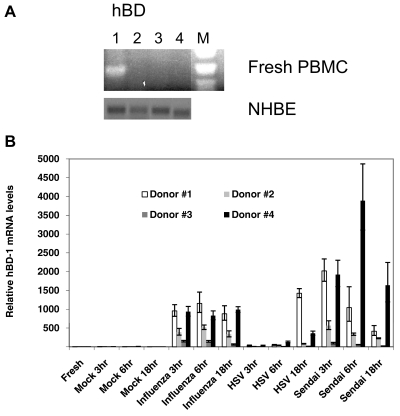
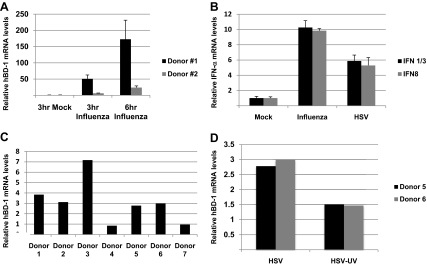
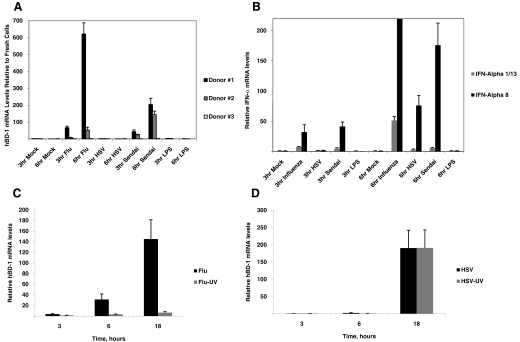
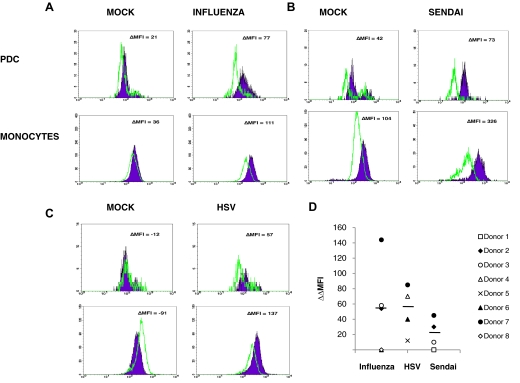
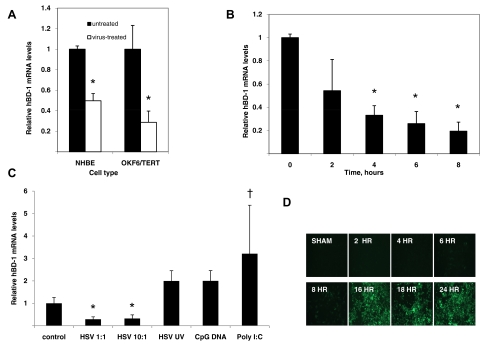
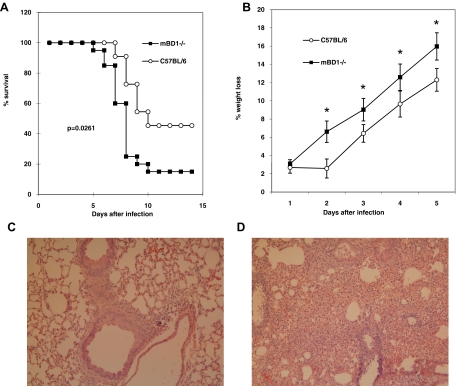
hBD comprise a family of antimicrobial peptides that plays a role in bridging the innate and adaptive immune responses to infection. The expression of hBD-2 increases upon stimulation of numerous cell types with LPS and proinflammatory cytokines. In contrast, hBD-1 remains constitutively expressed in most cells in spite of cytokine or LPS stimulation; however, its presence in human PDC suggests it plays a role in viral host defense. To examine this, we characterized the expression of hBD-1 in innate immune cells in response to viral challenge. PDC and monocytes increased production of hBD-1 peptide and mRNA as early as 2 h following infection of purified cells and PBMCs with PR8, HSV-1, and Sendai virus. However, treatment of primary NHBE cells with influenza resulted in a 50% decrease in hBD-1 mRNA levels, as measured by qRT-PCR at 3 h following infection. A similar inhibition occurred with HSV-1 challenge of human gingival epithelial cells. Studies with HSV-1 showed that replication occurred in epithelial cells but not in PDC. Together, these results suggest that hBD-1 may play a role in preventing viral replication in immune cells. To test this, we infected C57BL/6 WT mice and mBD-1((-/-)) mice with mouse-adapted HK18 (300 PFU/mouse). mBD-1((-/-)) mice lost weight earlier and died sooner than WT mice (P=0.0276), suggesting that BD-1 plays a role in early innate immune responses against influenza in vivo. However, lung virus titers were equal between the two mouse strains. Histopathology showed a greater inflammatory influx in the lungs of mBD-1((-/-)) mice at Day 3 postinfection compared with WT C57BL/6 mice. The results suggest that BD-1 protects mice from influenza pathogenesis with a mechanism other than inhibition of viral replication.
Figures
References
-
- Diamond G., Bevins C. L. (1998) β-Defensins: endogenous antibiotics of the innate host defense response. Clin. Immunol. Immunopathol. 88, 221–225 - PubMed
-
- Lehrer R. I., Ganz T. (2002) Defensins of vertebrate animals. Curr. Opin. Immunol. 14, 96–102 - PubMed
-
- Martin E., Ganz T., Lehrer R. I. (1995) Defensins and other endogenous peptide antibiotics of vertebrates. J. Leukoc. Biol. 58, 128–136 - PubMed
-
- Kao C. Y., Chen Y., Zhao Y. H., Wu R. (2003) ORFeome-based search of airway epithelial cell-specific novel human β-defensin genes. Am. J. Respir. Cell Mol. Biol. 29, 71–80 - PubMed
-
- Rodríguez-Jiménez F. J., Krause A., Schulz S., Forssmann W. G., Conejo-Garcia J. R., Schreeb R., Motzkus D. (2003) Distribution of new human β-defensin genes clustered on chromosome 20 in functionally different segments of epididymis. Genomics 81, 175–183 - PubMed
Publication types
MeSH terms
Substances
Grants and funding
LinkOut - more resources
Full Text Sources
Molecular Biology Databases
Research Materials
