


Blood loss control with two doses of tranexamic Acid in a multimodal protocol for total knee arthroplasty
- PMID: 21552468
- PMCID: PMC3087309
- DOI: 10.2174/1874325001105010044
Blood loss control with two doses of tranexamic Acid in a multimodal protocol for total knee arthroplasty
Abstract
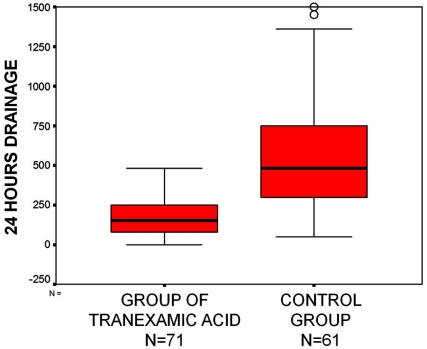
Average blood loss after total knee arthroplasty (TKA) usually ranges from 1500 to 1900 cc, including both the postoperative drain and hidden blood loss. This represents about 46% of TKA patients requiring postoperative blood transfusion. Not only the risks of disease transmission but also those of ABO incompatibility, infection due to immunosupression, increased procedure costs, and increased length of hospital stay, are potential problems that foster blood saving strategies. In this study, 71 unilateral TKAs using a multimodal protocol to decrease blood loss were compared to 61 historical cases. Patients in both groups underwent cemented TKA with the same system, surgical technique, and multimodal protocol (MIS approach, plug in the femoral canal, tourniquet removal after wound closure and compressive bandage, analgesic periarticular infiltration with vasoconstrictor, postoperative drain at atmospheric pressure, opened 2 hours after the end of the surgical procedure and removed after 24 hours). The study series incorporated intravenous tranexamic acid (TXA) infusion in 2 doses of 10-15 mg/kg, 15 minutes before tourniquet release and 3 hours later. Results showed no transfusion requirements in the TXA series (0%), with 23/61 (37.7%) transfusions in the control, with an average cost decrease of 240 euros per patient. Visible bleeding in 24h significantly decreased from 553.36 cc (range 50-1500) to 169.72 cc (range 10-480) in the TXA series. As a conclusion, implementing a TXA-based multimodal protocol produced significant decrease in the transfusion rate, visible blood loss, and cost per patient, thus proving effectiveness and efficiency in the surgical management of TKA.
Keywords: Blood saving surgery; TKA; effectiveness.; tranexamic acid; transfusion rate.
Figures
References
-
- Sehat KR, Evans RL, Newman JH. Hidden blood loss following hip and knee arthroplasty. Correct management of blood loss should take hidden loss into account. J Bone Joint Surg Br. 2004;86(4 ):561–5. - PubMed
-
- Woolson ST, Wall WW. Autologous blood transfusion after total knee arthroplasty: a randomized, prospective study comparing predonated and postoperative salvage blood. J Arthroplasty. 2003;18(3 ):243–9. - PubMed
-
- Cid J, Lozano M. Tranexamic acid reduces allogeneic red cell transfusions in patients undergoing total knee arthroplasty: results of a meta-analysis of randomized controlled trials. Transfusion. 2005;45(8 ):1302–7. - PubMed
-
- Benoni G, Fredin H. Fibrinolytic inhibition with tranexamic acid reduces blood loss and blood transfusion after knee arthroplasty: a prospective, randomised, double-blind study of 86 patients. J Bone Joint Surg Br. 1996;78(3 ):434–40. - PubMed
-
- Hiippala ST, Strid LJ, Wennerstrand MI, et al. Tranexamic acid radically decreases blood loss and transfusions associated with total knee arthroplasty. Anesth Analg. 1997;84(4 ):839–44. - PubMed
LinkOut - more resources
Full Text Sources
Medical
Research Materials