


Cardiovascular responses to passive static flexibility exercises are influenced by the stretched muscle mass and the Valsalva maneuver
- PMID: 21552673
- PMCID: PMC3072008
- DOI: 10.1590/s1807-59322011000300017
Cardiovascular responses to passive static flexibility exercises are influenced by the stretched muscle mass and the Valsalva maneuver
Abstract
Background: The respiratory pattern is often modified or even blocked during flexibility exercises, but little is known about the cardiovascular response to concomitant stretching and the Valsalva maneuver (VM) in healthy subjects.
Objectives: This study evaluated the heart rate (HR), systolic blood pressure (SBP), and rate-pressure product (RPP) during and after large and small muscle group flexibility exercises performed simultaneously with the VM.
Methods: Asymptomatic volunteers (N = 22) with the following characteristics were recruited: age, 22 ± 3 years; weight, 73 ± 6 kg; height, 175 ± 5 cm; HR at rest, 66 ± 9 BPM; and SBP at rest, 113 ± 10 mmHg. They performed two exercises: four sets of passive static stretching for 30 s of the dorsi-flexion (DF) of the gastrocnemius and the hip flexion (HF) of the ischio-tibialis. The exercises were performed with (V+) or without (V-) the VM in a counterbalanced order. The SBP and HR were measured, and the RPP was calculated before the exercise session, at the end of each set, and during a 30-min post-exercise recovery period.
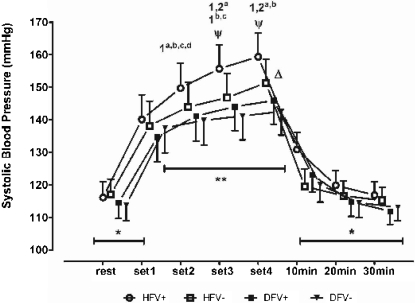
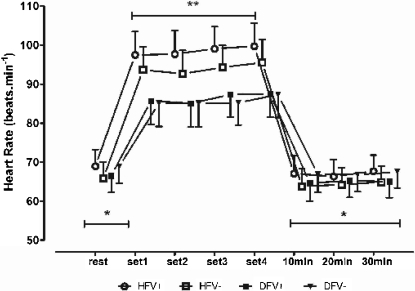
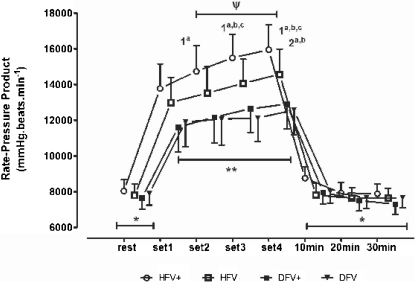
Results: The within-group comparisons showed that only the SBP and RPP increased throughout the sets (p < 0.05), but no post-exercise hypotension was detected. The between-group comparisons showed that greater SBP increases were related to the VM and to a larger stretched muscle mass. Differences for a given set were identified for the HR (the HFV+ and HFV- values were higher than the DFV+ and DFV- values by approximately 12 BPM), SBP (the HFV+ value was higher than the DFV+ and DFV- values by approximately 12 to 15 mmHg), and RPP (the HFV+ value was higher than the HFV- value by approximately 2000 mmHGxBPM, and the HFV+ value was higher than the DFV+ and DFV- values by approximately 4000 mmHGxBPM).
Conclusion: Both the stretched muscle mass and the VM influence acute cardiovascular responses to multiple-set passive stretching exercise sessions.
Figures
References
-
- Rassier DE, Macintosh BR, Herzog W. Length dependence of active force production in skeletal muscle. J Appl Physiol. 1999;86:1445–57. - PubMed
-
- Drew RC, Bell MP, White MJ. Modulation of spontaneous baroreflex control of heart rate and indexes of vagal tone by passive calf muscle stretch during graded metaboreflex activation in humans. J Appl Physiol. 2008;104:716–23. 10.1152/japplphysiol.00956.2007 - DOI - PubMed
-
- Fisher JP, Bell MP, White MJ. Cardiovascular responses to human calf muscle stretch during varying levels of muscle metaboreflex activation. Exp Physiol. 2005;90:773–81. 10.1113/expphysiol.2005.030577 - DOI - PubMed
-
- Gladwell VF, Fletcher J, Patel N, Elvidge LJ, Lloyd D, Chowdhary S, et al. The influence of small fibre muscle mechanoreceptors on the cardiac vagus in humans. J Physiol. 2005;567:713–21. 10.1113/jphysiol.2005.089243 - DOI - PMC - PubMed
-
- Fisher WJ, White MJ. Training-induced adaptations in the central command and peripheral reflex componts of the pressor response to isometric exercise of the human tríceps surae. J Physiol. 1999;520:621–8. 10.1111/j.1469-7793.1999.00621.x - DOI - PMC - PubMed
Publication types
MeSH terms
LinkOut - more resources
Full Text Sources
Medical
Research Materials
Miscellaneous
