


Angiogenesis in the progression of cutaneous squamous cell carcinoma: an immunohistochemical study of endothelial markers
- PMID: 21552674
- PMCID: PMC3072009
- DOI: 10.1590/s1807-59322011000300018
Angiogenesis in the progression of cutaneous squamous cell carcinoma: an immunohistochemical study of endothelial markers
Abstract
Objective: To demonstrate the role of angiogenesis in the progression of cutaneous squamous cell carcinoma.
Introduction: Angiogenesis is a pivotal phenomenon in carcinogenesis. Its time course in cutaneous squamous cell carcinoma has not yet been fully established.
Methods: We studied the vascular bed in 29 solar keratoses, 30 superficially invasive squamous cell carcinomas and 30 invasive squamous cell carcinomas. The Chalkley method was used to quantify the microvascular area by comparing panendothelial (CD34) with neoangiogenesis (CD105) immunohistochemical markers. The vascular bed from non-neoplastic adjacent skin was evaluated in 8 solar keratoses, 10 superficially invasive squamous cell carcinomas and 10 invasive squamous cell carcinomas.
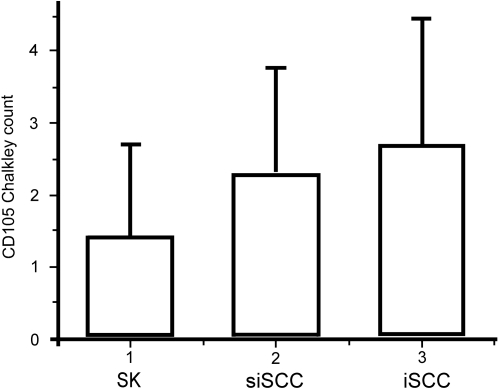
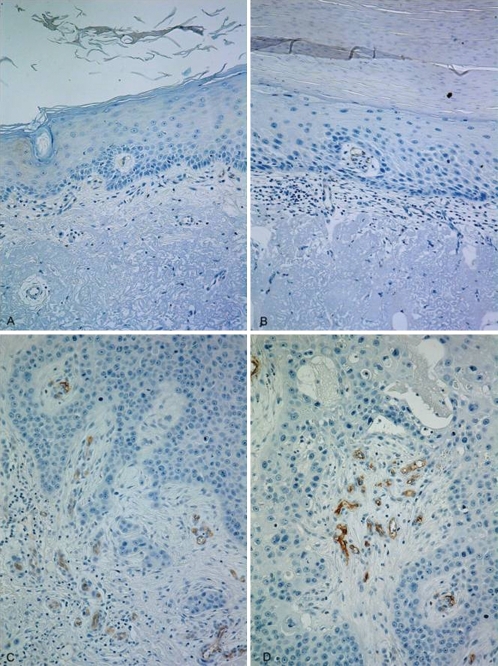
Results: The microvascular area in CD105-stained specimens significantly increased in parallel with cutaneous squamous cell carcinoma progression. However, no differences between groups were found in CD34 sections. Solar keratosis, superficially invasive squamous cell carcinoma and invasive squamous cell carcinoma samples showed significant increases in microvascular area for both CD34- and CD105-stained specimens compared with the respective adjacent skin.
Discussion: The angiogenic switch occurs early in the development of cutaneous squamous cell carcinoma, and the rate of neovascularization is parallel to tumor progression. In contrast to panendothelial markers, CD105 use allows a dynamic evaluation of tumor angiogenesis.
Conclusion: This study demonstrated the dependence of skin carcinogenesis on angiogenesis.
Figures
References
Publication types
MeSH terms
Substances
LinkOut - more resources
Full Text Sources
Medical
