


Age as an independent risk factor for intensive care unit admission or death due to 2009 pandemic influenza A (H1N1) virus infection
- PMID: 21553663
- PMCID: PMC3072856
- DOI: 10.1177/003335491112600308
Age as an independent risk factor for intensive care unit admission or death due to 2009 pandemic influenza A (H1N1) virus infection
Erratum in
- Public Health Rep. 2011 Sep-Oct;126(5):624
Abstract
Objective: This study evaluated risk factors for intensive care unit (ICU) admission or death among people hospitalized with 2009 pandemic influenza A (pH1N1) virus infection.
Methods: We based analyses on data collected in Washington State from April 27 to September 18, 2009, on deceased or hospitalized people with laboratory-confirmed pH1N1 infection reported by health-care providers and hospitals as part of enhanced public health surveillance. We used bivariate analyses and multivariable logistic regression to identify risk factors associated with ICU admission or death due to pH1N1.
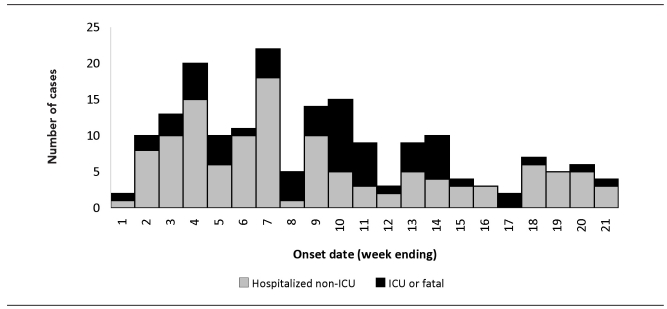
Results: We identified 123 patients admitted to the hospital but not an ICU and 61 patients who were admitted to an ICU or died. Independent of high-risk medical conditions, both older age and delayed time to hospital admission were identified as risk factors for ICU admission or death due to pH1N1. Specifically, the odds of ICU admission or death were 4.44 times greater among adults aged 18-49 years (95% confidence interval [CI] 1.97, 10.02) and 5.93 times greater among adults aged 50-64 years (95% CI 2.24, 15.65) compared with pediatric patients < 18 years of age. Likewise, hospitalized cases admitted more than two days after illness onset had 2.17 times higher odds of ICU admission or death than those admitted within two days of illness onset (95% CI 1.10, 4.25).
Conclusion: Although certain medical conditions clearly influence the need for hospitalization among people infected with pH1N1 virus, older age and delayed time to admission each played an independent role in the progression to ICU admission or death among hospitalized patients.
Figures
References
-
- Swine influenza A (H1N1) infection in two children—Southern California March–April 2009. MMWR Morb Mortal Wkly Rep. 2009;58(15):400–2. - PubMed
-
- Centers for Disease Control and Prevention (US). 2008–2009 influenza season week 34 ending August 29, 2009. [cited 2010 Jun 18]. Available from: URL: http://www.cdc.gov/flu/weekly/weeklyarchives2008-2009/weekly34.htm.
-
- Fiore AE, Shay DK, Broder K, Iskander JK, Uyeki TM, Mootrey G, et al. Prevention and control of seasonal influenza with vaccines: recommendations of the Advisory Committee on Immunization Practices (ACIP), 2009. MMWR Recomm Rep. 2009;58(RR08):1–52. - PubMed
-
- Neuzil KM, Wright PF, Mitchel EF, Jr, Griffin MR. The burden of influenza illness in children with asthma and other chronic medical conditions. J Pediatr. 2000;137:856–64. - PubMed
-
- Barker WH, Mullooly JP. Impact of epidemic type A influenza in a defined adult population. Am J Epidemiol. 1980;112:798–811. - PubMed
Publication types
MeSH terms
Grants and funding
LinkOut - more resources
Full Text Sources
Medical
Miscellaneous
