


Hurricane Katrina: addictive behavior trends and predictors
- PMID: 21553669
- PMCID: PMC3072862
- DOI: 10.1177/003335491112600314
Hurricane Katrina: addictive behavior trends and predictors
Abstract
Objectives: Post-disaster trends in alcohol consumption and cigarette smoking, as well as their predictors, were identified. Methods. Data from cross-sectional and panel surveys of African American adults in New Orleans, Louisiana, were used from before (2004: n = 1,867; 2005: n = 879) and after (2006a: n = 500; 2006b: n = 500) Hurricane Katrina.
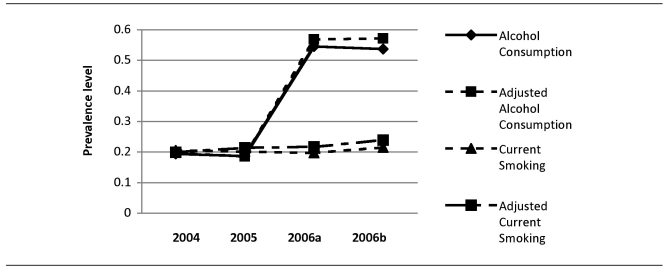
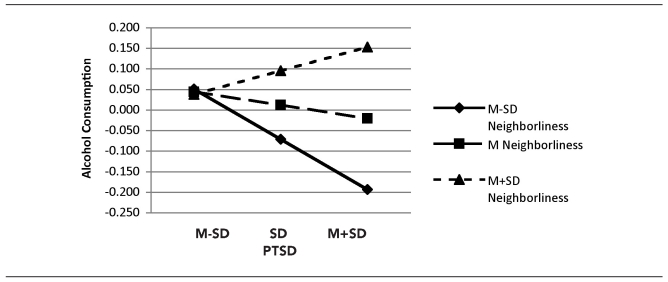
Results: Alcohol consumption increased significantly from pre- to post-Hurricane Katrina, while cigarette smoking remained constant. In 2006, posttraumatic stress disorder (PTSD) was associated with cigarette smoking, whereas "news attention" and "provided social support" were inversely associated with cigarette smoking. "News attention" was also inversely associated with cigarette smoking frequency, while "neighborliness" was associated with alcohol consumption. In addition, the effects of PTSD on alcohol consumption were moderated by "neighborliness."
Conclusions: In the wake of Hurricane Katrina, there were complex predictive processes of addictive behaviors involving PTSD, news information, and social capital-related measures.
Figures
References
-
- Khantzian EJ. The self-medication hypothesis of addictive disorders: focus on heroin and cocaine dependence. Am J Psychiatry. 1985;142:1259–64. - PubMed
-
- McFarlane AC. Epidemiological evidence about the relationship between PTSD and alcohol abuse: the nature of the association. Addict Behav. 1998;23:813–25. - PubMed
-
- Joseph S, Yule W, Williams R, Hodgkinson P. Increased substance use in survivors of the Herald of Free Enterprise disaster. Br J Med Psychol. 1993;66(Pt 2):185–91. - PubMed
-
- Smith DW, Christiansen EH, Vincent R, Hann NE. Population effects of the bombing of Oklahoma City. J Okla State Med Assoc. 1999;92:193–8. - PubMed
Publication types
MeSH terms
LinkOut - more resources
Full Text Sources
Medical
