Walk on the bright side: physical activity and affect in major depressive disorder
- PMID: 21553939
- PMCID: PMC3982878
- DOI: 10.1037/a0023533
Walk on the bright side: physical activity and affect in major depressive disorder
Abstract
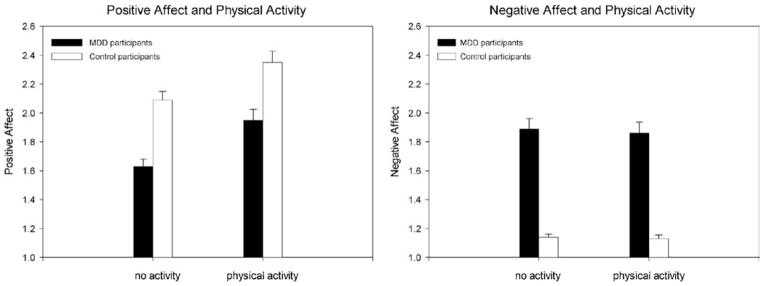
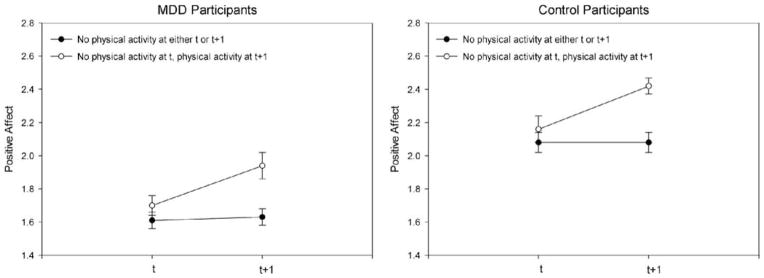
Although prescribed exercise has been found to improve affect and reduce levels of depression, we do not know how self-initiated everyday physical activity influences levels of positive affect (PA) and negative affect (NA) in depressed persons. Fifty-three individuals diagnosed with Major Depressive Disorder (MDD) and 53 never-depressed controls participated in a seven-day experience sampling study. Participants were prompted randomly eight times per day and answered questions about their physical activity and affective state. Over the week, the two groups of participants did not differ in average level of physical activity. As expected, participants with MDD reported lower average PA and higher average NA than did never-depressed controls. Both participants with MDD and controls reported higher levels of PA at prompts after physical activity than at prompts after inactive periods; moreover, for both groups of participants, PA increased from a prompt after an inactive period to a subsequent prompt at which activity was reported. Depressed participants in particular showed a dose-response effect of physical activity on affect: longer duration and/or higher intensity of physical activity increased their PA significantly more than did short duration and/or lower intensity physical activity. Physical activity did not influence NA in either group. In contrast to previous treatment studies that examined the effects of prescribed structured exercise, this investigation showed that self-initiated physical activity influences PA. These findings also underscore the importance of distinguishing between PA and NA to gain a more comprehensive understanding of the effects of physical activity on affect in MDD.
Figures
References
-
- Arent SM, Landers DM, Etnier JL. The effects of exercise on mood in older adults: A meta-analytic review. Journal of Aging and Physical Activity. 2000;8:407–430.
-
- Bahrke MS, Morgan WP. Anxiety reduction following exercise and meditation. Cognitive Therapy and Research. 1978;2:323–333. doi: 10.1007/BF01172650. - DOI
-
- Barrett DJ, Feldman Barrett L. The Experience Sampling Program (ESP) 2000 Available at: http://www.experience-sampling.org/
Publication types
MeSH terms
Grants and funding
LinkOut - more resources
Full Text Sources
Medical
Research Materials