


Inhibiting myosin-ATPase reveals a dynamic range of mitochondrial respiratory control in skeletal muscle
- PMID: 21554250
- PMCID: PMC3863643
- DOI: 10.1042/BJ20110366
Inhibiting myosin-ATPase reveals a dynamic range of mitochondrial respiratory control in skeletal muscle
Abstract
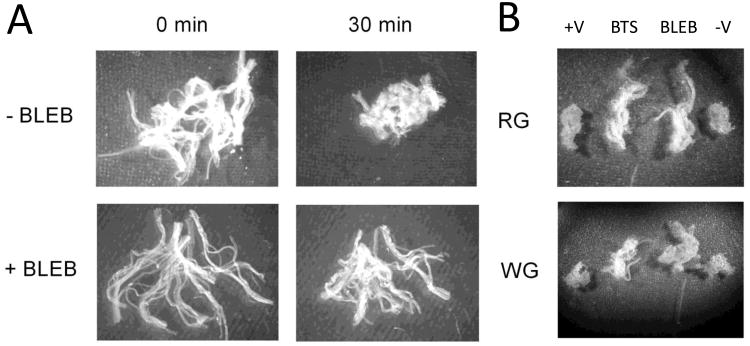
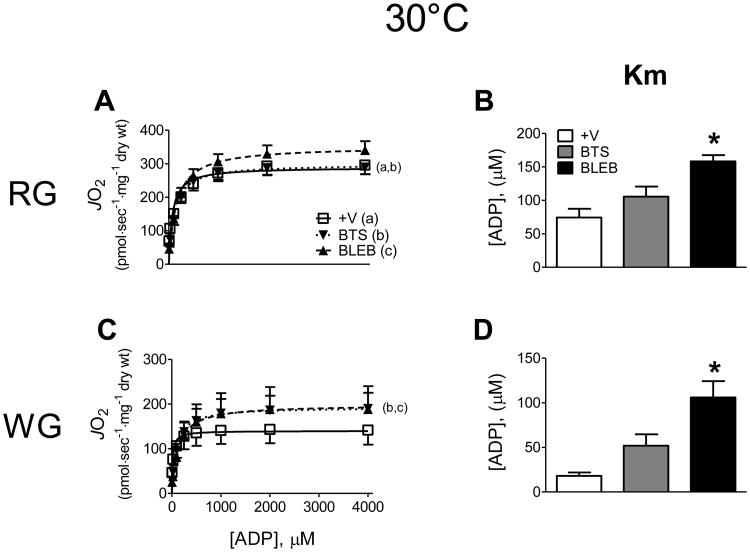
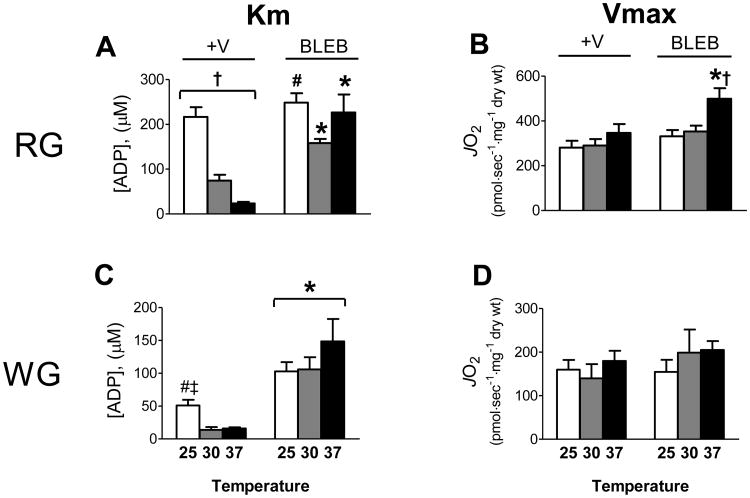
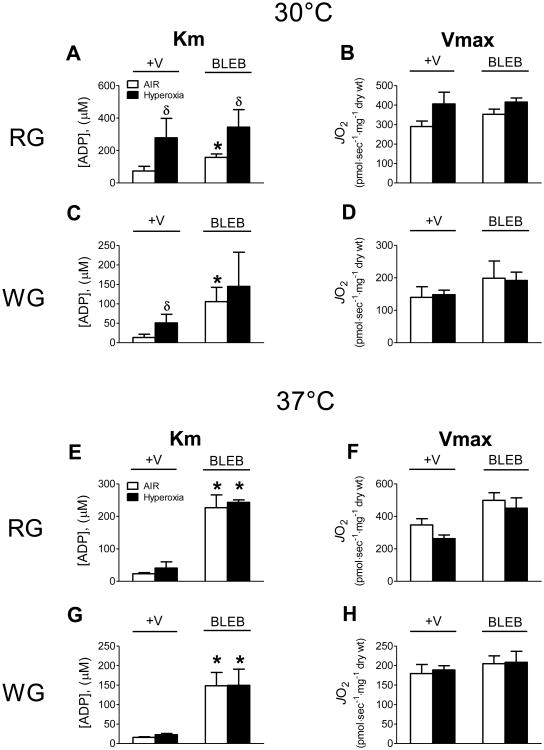
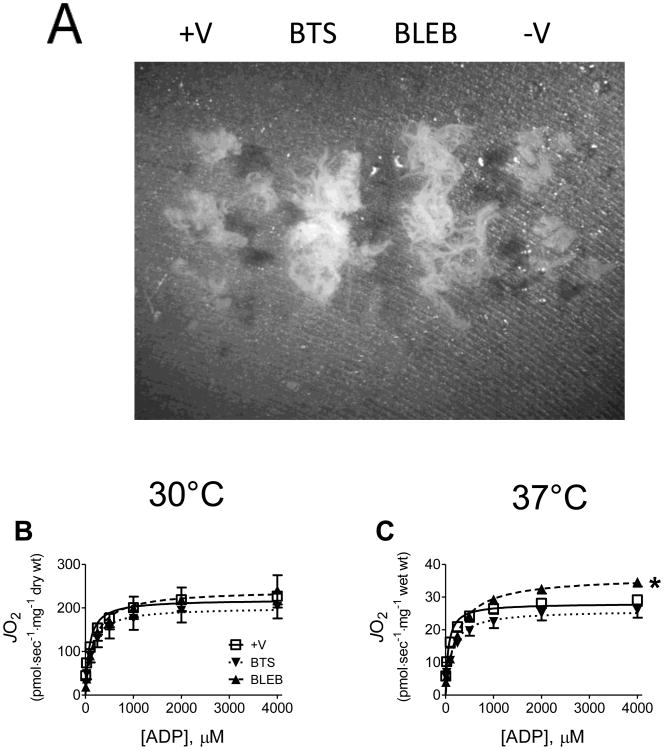
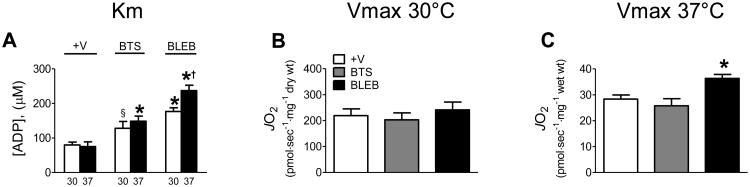
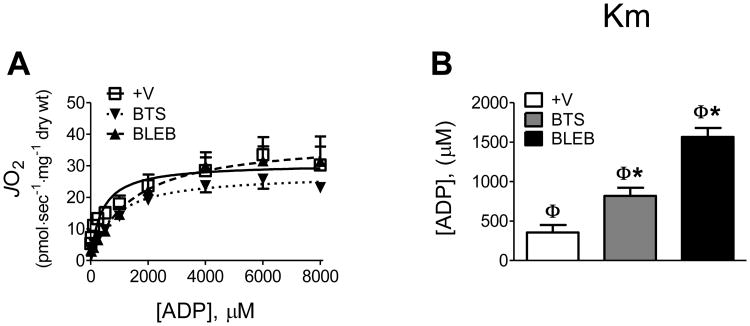
Assessment of mitochondrial ADP-stimulated respiratory kinetics in PmFBs (permeabilized fibre bundles) is increasingly used in clinical diagnostic and basic research settings. However, estimates of the Km for ADP vary considerably (~20-300 μM) and tend to overestimate respiration at rest. Noting that PmFBs spontaneously contract during respiration experiments, we systematically determined the impact of contraction, temperature and oxygenation on ADP-stimulated respiratory kinetics. BLEB (blebbistatin), a myosin II ATPase inhibitor, blocked contraction under all conditions and yielded high Km values for ADP of >~250 and ~80 μM in red and white rat PmFBs respectively. In the absence of BLEB, PmFBs contracted and the Km for ADP decreased ~2-10-fold in a temperature-dependent manner. PmFBs were sensitive to hyperoxia (increased Km) in the absence of BLEB (contracted) at 30 °C but not 37 °C. In PmFBs from humans, contraction elicited high sensitivity to ADP (Km<100 μM), whereas blocking contraction (+BLEB) and including a phosphocreatine/creatine ratio of 2:1 to mimic the resting energetic state yielded a Km for ADP of ~1560 μM, consistent with estimates of in vivo resting respiratory rates of <1% maximum. These results demonstrate that the sensitivity of muscle to ADP varies over a wide range in relation to contractile state and cellular energy charge, providing evidence that enzymatic coupling of energy transfer within skeletal muscle becomes more efficient in the working state.
Figures
References
-
- Sperl W, Skladal D, Gnaiger E, Wyss M, Mayr U, Hager J, Gellerich FN. High resolution respirometry of permeabilized skeletal muscle fibers in the diagnosis of neuromuscular disorders. Mol Cell Biochem. 1997;174:71–78. - PubMed
-
- N'Guessan B, Zoll J, Ribera F, Ponsot E, Lampert E, Ventura-Clapier R, Veksler V, Mettauer B. Evaluation of quantitative and qualitative aspects of mitochondrial function in human skeletal and cardiac muscles. Mol Cell Biochem. 2004;256-257:267–280. - PubMed
-
- Chance B, Williams GR. Respiratory enzymes in oxidative phosphorylation. I. Kinetics of oxygen utilization. J Biol Chem. 1955;217:383–393. - PubMed
-
- Saks VA, Kuznetsov AV, Khuchua ZA, Vasilyeva EV, Belikova JO, Kesvatera T, Tiivel T. Control of cellular respiration in vivo by mitochondrial outer membrane and by creatine kinase. A new speculative hypothesis: possible involvement of mitochondrial-cytoskeleton interactions. J Mol Cell Cardiol. 1995;27:625–645. - PubMed
-
- Tonkonogi M, Sahlin K. Rate of oxidative phosphorylation in isolated mitochondria from human skeletal muscle: effect of training status. Acta Physiol Scand. 1997;161:345–353. - PubMed
Publication types
MeSH terms
Substances
Grants and funding
LinkOut - more resources
Full Text Sources
