. 2011 May 9:4:70.
doi: 10.1186/1756-3305-4-70.

The distribution of potential West Nile virus vectors, Culex pipiens pipiens and Culex pipiens quinquefasciatus (Diptera: Culicidae), in Mexico City

Affiliations

The distribution of potential West Nile virus vectors, Culex pipiens pipiens and Culex pipiens quinquefasciatus (Diptera: Culicidae), in Mexico City

Alvaro Diaz-Badillo et al. Parasit Vectors. .

Abstract

Background: Culex spp. mosquitoes are considered to be the most important vectors of West Nile virus (WNV) detected in at least 34 species of mosquitoes in the United States. In North America, Culex pipiens pipiens, Culex pipiens quinquefasciatus, and Culex tarsalis are all competent vectors of WNV, which is considered to be enzootic in the United States and has also been detected in equines and birds in many states of Mexico and in humans in Nuevo Leon. There is potential for WNV to be introduced into Mexico City by various means including infected mosquitoes on airplanes, migrating birds, ground transportation and infected humans. Little is known of the geographic distribution of Culex pipiens complex mosquitoes and hybrids in Mexico City. Culex pipiens pipiens preferentially feed on avian hosts; Culex pipiens quinquefasciatus have historically been considered to prefer mammalian hosts; and hybrids of these two species could theoretically serve as bridge vectors to transmit WNV from avian hosts to humans and other mammalian hosts. In order to address the potential of WNV being introduced into Mexico City, we have determined the identity and spatial distribution of Culex pipiens complex mosquitoes and their hybrids.

Results: Mosquito larvae collected from 103 sites throughout Mexico City during 2004-2005 were identified as Culex, Culiseta or Ochlerotatus by morphological analysis. Within the genus Culex, specimens were further identified as Culex tarsalis or as belonging to the Culex pipiens complex. Members of the Culex pipiens complex were separated by measuring the ratio of the dorsal and ventral arms (DV/D ratio) of the male genitalia and also by using diagnostic primers designed for the Ace.2 gene. Culex pipiens quinquefasciatus was the most abundant form collected.

Conclusions: Important WNV vectors species, Cx. p. pipiens, Cx. p. quinquefasciatus and Cx. tarsalis, are all present in Mexico City. Hybrids of Cx. p. pipiens and Cx. p. quinquefasciatus were also collected and identified. The presence and abundance of these WNV competent vectors is a cause for concern. Understanding the distribution of these vectors can help improve viral surveillance activities and mosquito control efforts in Mexico City.


Figures
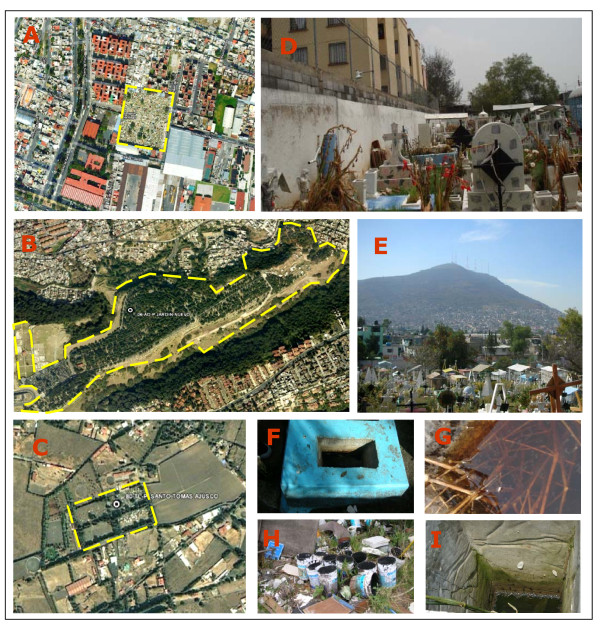
Figure 1
Figure 1
Landscape and habitats of mosquito larval collection sites. (A) Urban area, representative urban area in cemeteries of Mexico City characterized by high human population density, public transportation and communication containing a small amount of green areas. (B) Suburban, this area is constituted for a balance between buildings and green areas with sufficient public transportation and communication but where the people are not dedicated to agricultural activities. (C) Rural, this representative area is characterized by low density human population, with little public transportation and communication and extensive green and agricultural areas. (D-I) Display all varieties of natural and man-made containers representative of the mosquito larval habitats in the collection sites at the cemeteries.
Figure 2
Figure 2
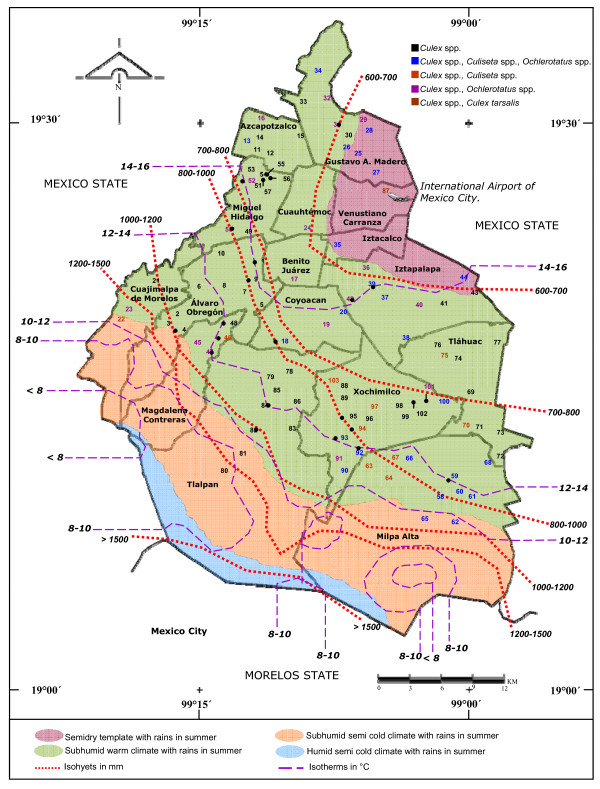
Location of mosquito sampling sites and species detected in Mexico City for 2004. The map of Mexico City displays the distribution of the mosquito species identified in the collection sites with some climatic and geographic features including humidity, isohyets, isotherms and surrounding states. Numbers in black indicate morphological identification of Culex spp.; in blue Culex spp., Culiseta and Ochlerotatus; in red Culex spp. and Culiseta; in purple Culex spp. and Ochlerotatus; and in brown Culex spp. and Cx. tarsalis.
Figure 3
Figure 3
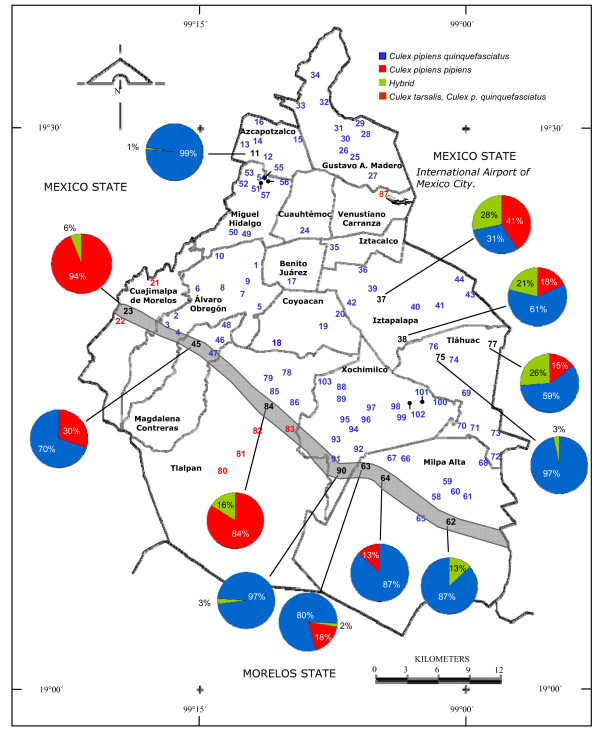
Culex pipiens complex distribution in Mexico City. Map of Cx. p. quinquefasciatus, Cx. p. pipiens and hybrid distribution in all collection sites according to nucleotide differences in the Ace.2 gene. Pie chart graphs (numbers in black) indicate the distributional frequency of identified lineages. The sizes of the pie chart's segments are proportional to the number of mosquitoes identified as Cx. p. quinquefasciatus (blue), Cx. p. pipiens (red) or hybrid (green). The numbers in blue indicate the sites where Cx. p. quinquefasciatus was exclusively identified, red where Cx. p. pipiens was recognized and in black where hybrids were localized according to chart graphs. In addition the number in brown indicates the site where Cx. p. quinquefasciatus and Cx. tarsalis was observed. The grey line approximates the probable hypothetical introgression area. The numbers correspond to the collection sites displayed in the Additional File 1.
Figure 4
Figure 4
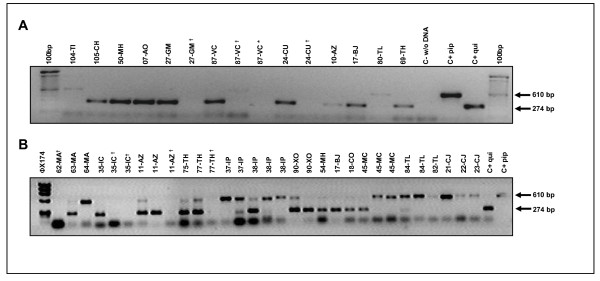
PCR amplification of the Ace.2 gene. Larvae collected at various cemeteries in Mexico City were reared to mosquito adults and then identified by PCR amplification of the Ace.2 gene [30]. The Cx. p. pipiens specific band of 610 bp and Cx. p. quinquefasciatus specific band of 274 bp and the expected bands of 610 and 274 bp for hybrids (panel B) are displayed in the agarose gels. *Cx. tarsalis identified by morphological analysis did not produce a PCR amplicon. Culex spp. mosquitoes that were not identified as pertaining to the Cx. pipiens complex or hybrids by morphological analysis or by the Ace.2 gene assay.

References

    1. Viral hemorrhagic fevers. http://www.cdc.gov/ncidod/dvrd/spb/mnpages/dispages/vhf.htm
    1. Arboviral encephalitides. http://www.cdc.gov/ncidod/dvbid/Arbor/index.htm
    1. Van den Hurk AF, Ritchie SA, Mackenzie JS. Ecology and geographical expansion of Japanese encephalitis virus. Annual Review of Entomology. 2009;54:17–35. doi: 10.1146/annurev.ento.54.110807.090510. - DOI - PubMed
    1. West Nile virus. http://www.cdc.gov/ncidod/dvbid/westnile/index.htm
    1. Blitvich B. Transmission dynamics and changing epidemiology of West Nile virus. Anim Hlth Res Rev. 2008;9:71–86. doi: 10.1017/S1466252307001430. - DOI - PubMed

Substances

LinkOut - more resources