


Interviewer versus self-administered health-related quality of life questionnaires - does it matter?
- PMID: 21554737
- PMCID: PMC3100232
- DOI: 10.1186/1477-7525-9-30
Interviewer versus self-administered health-related quality of life questionnaires - does it matter?
Abstract
Background: Patient-reported outcomes are measured in many epidemiologic studies using self- or interviewer-administered questionnaires. While in some studies differences between these administration formats were observed, other studies did not show statistically significant differences important to patients. Since the evidence about the effect of administration format is inconsistent and mainly available from cross-sectional studies our aim was to assess the effects of different administration formats on repeated measurements of patient-reported outcomes in participants with AIDS enrolled in the Longitudinal Study of Ocular Complications of AIDS.
Methods: We included participants enrolled in the Longitudinal Study of Ocular Complications in AIDS (LSOCA) who completed the Medical Outcome Study [MOS] -HIV questionnaire, the EuroQol, the Feeling Thermometer and the Visual Function Questionnaire (VFQ) 25 every six months thereafter using self- or interviewer-administration. A large print questionnaire was available for participants with visual impairment. Considering all measurements over time and adjusting for patient and study site characteristics we used linear models to compare HRQL scores (all scores from 0-100) between administration formats. We defined adjusted differences of ≥0.2 standard deviations [SD]) to be quantitatively meaningful.
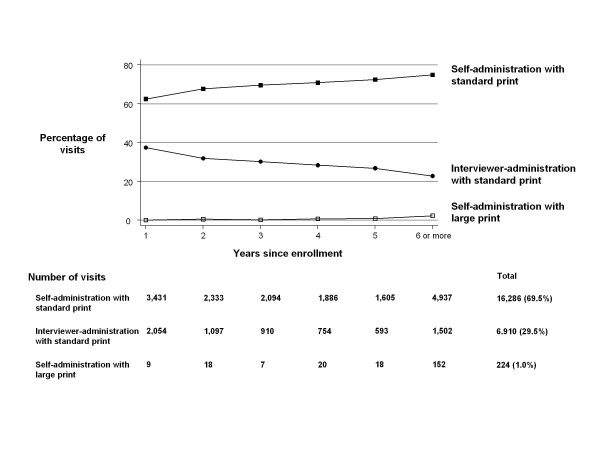
Results: We included 2,261 participants (80.6% males) with a median of 43.1 years of age at enrollment who provided data on 23,420 study visits. The self-administered MOS-HIV, Feeling Thermometer and EuroQol were used in 70% of all visits and the VFQ-25 in 80%. For eight domains of the MOS-HIV differences between the interviewer- and self- administered format were < 0.1 SD. Differences in scores were highest for the social and role function domains but the adjusted differences were still < 0.2 SD. There was no quantitatively meaningful difference between administration formats for EuroQol, Feeling Thermometer and VFQ-25 domain scores. For ocular pain (VFQ-25), we found a statistically significant difference of 3.5 (95% CI 0.2, 6.8), which did, however, not exceed 0.2 SD. For all instruments scores were similar for the large and standard print formats with all adjusted differences < 0.2 SD.
Conclusions: Our large study provides evidence that administration formats do not have a meaningful effect on repeated measurements of patient-reported outcomes. As a consequence, longitudinal studies may not need to consider the effect of different administration formats in their analyses.
Figures
References
-
- Puhan MA, Gaspoz JM, Bridevaux PO, Schindler C, Ackermann-Liebrich U, Rochat T, Gerbase MW. Comparing a disease-specific and a generic health-related quality of life instrument in subjects with asthma from the general population. Health Qual Life Outcomes. 2008;6:15. doi: 10.1186/1477-7525-6-15. - DOI - PMC - PubMed
-
- Spilker B. Quality of Life and Pharmacoeconomics in Clinical Trials. 2. Philadelphia: Lippincott Williams & Wilkins; 1996.
Publication types
MeSH terms
Grants and funding
- 5MO1 RR 00047/RR/NCRR NIH HHS/United States
- U01 AI 27660/AI/NIAID NIH HHS/United States
- U01 AI 27674/AI/NIAID NIH HHS/United States
- U01 AI 25858/AI/NIAID NIH HHS/United States
- 5MO1 RR 00865/RR/NCRR NIH HHS/United States
- U10 EY008057/EY/NEI NIH HHS/United States
- U10 EY 08057/EY/NEI NIH HHS/United States
- M01 RR00096/RR/NCRR NIH HHS/United States
- 5M01 RR00046/RR/NCRR NIH HHS/United States
- U01 AI 25903/AI/NIAID NIH HHS/United States
- 5MO1 RR 00043/RR/NCRR NIH HHS/United States
- U10 EY 08052/EY/NEI NIH HHS/United States
- 5MO1 RR 05280/RR/NCRR NIH HHS/United States
- U01 AI 276670/AI/NIAID NIH HHS/United States
- MO1 RR 00052/RR/NCRR NIH HHS/United States
- 5MO1 RR 00188/RR/NCRR NIH HHS/United States
- U10 EY 08067/EY/NEI NIH HHS/United States
- U01 AI 32783/AI/NIAID NIH HHS/United States
- 5MO1 RR 05096/RR/NCRR NIH HHS/United States
- U01 AI 27663/AI/NIAID NIH HHS/United States
LinkOut - more resources
Full Text Sources
Medical
Research Materials
