


doi: 10.1016/j.mimet.2011.04.014.
Epub 2011 Apr 29.
Efficient implementation of RNA interference in the pathogenic yeast Cryptococcus neoformans
Affiliations
- PMID: 21554906
- PMCID: PMC3163904
- DOI: 10.1016/j.mimet.2011.04.014
Item in Clipboard
Efficient implementation of RNA interference in the pathogenic yeast Cryptococcus neoformans
J Microbiol Methods.
2011 Aug.
Abstract
An improved method has been developed for RNA interference in Cryptococcus neoformans, using opposing promoters to facilitate cloning and RNA interference targeting URA5 to allow selection of cells in which silencing is most effective. These advances significantly reduce the variability of silencing and the effort required for interference plasmid construction.
Copyright © 2011 Elsevier B.V. All rights reserved.
Figures
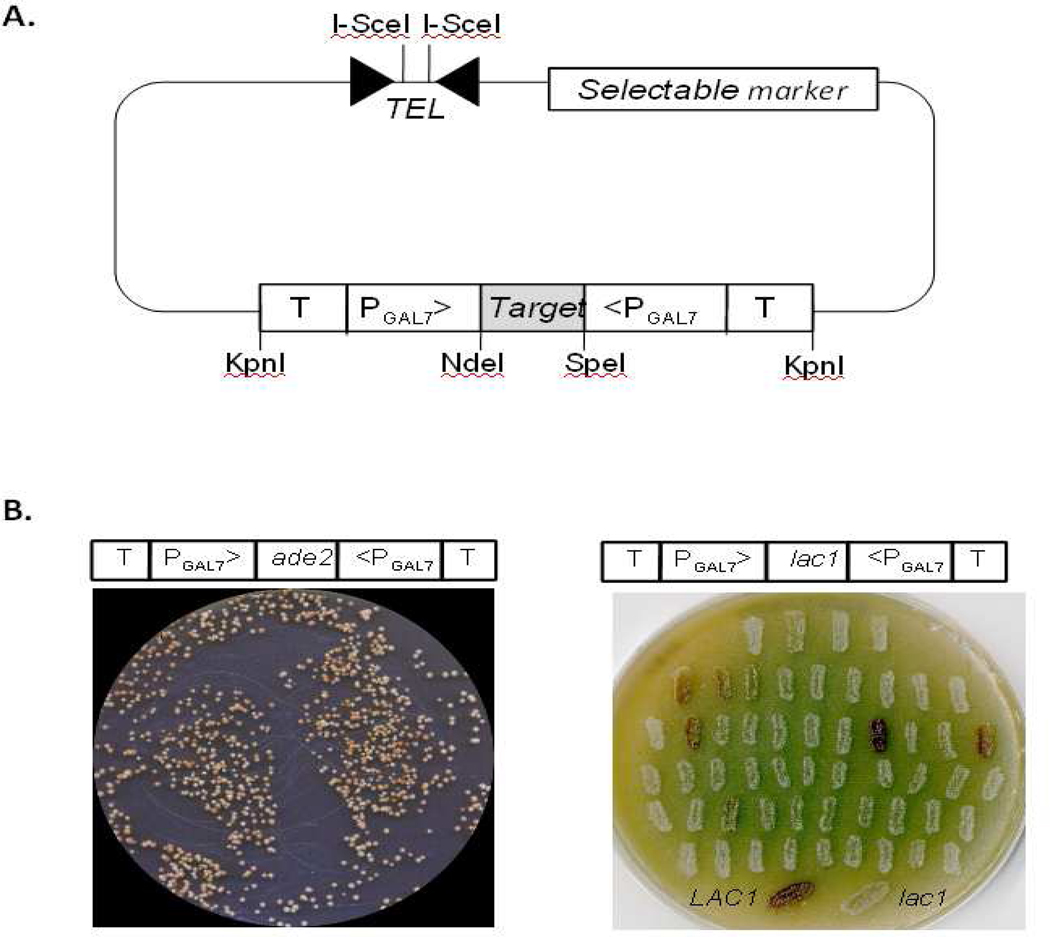
Opposing promoter constructs mediate RNAi. A. Schematic view of an RNAi plasmid with major elements shown; see text for details. TEL, telomeres; T, terminator; P, promoter; Target, sequence to be silenced. Restriction sites are indicated by vertical lines labeled with the abbreviated enzyme name. B. An opposing PGAL7 construct mediates silencing of ADE2 and LAC1. Left, A ura5 mutant (JEC43) was transformed with plasmid pIBB1, shown schematically, and grown on galactose medium lacking uracil (-ura/gal) for 2 days at 30°C. Right, a parallel study with plasmid pIBB29, showing a master plate with a random selection of transformants streaked onto niger seed agar with galactose (NSA/gal) and grown for 2 days at 30 °C. Controls streaked at the bottom of the plate are a wild-type strain that melanizes and appears brown (LAC1), and a deletion strain that does not melanize and therefore remains white (lac1).
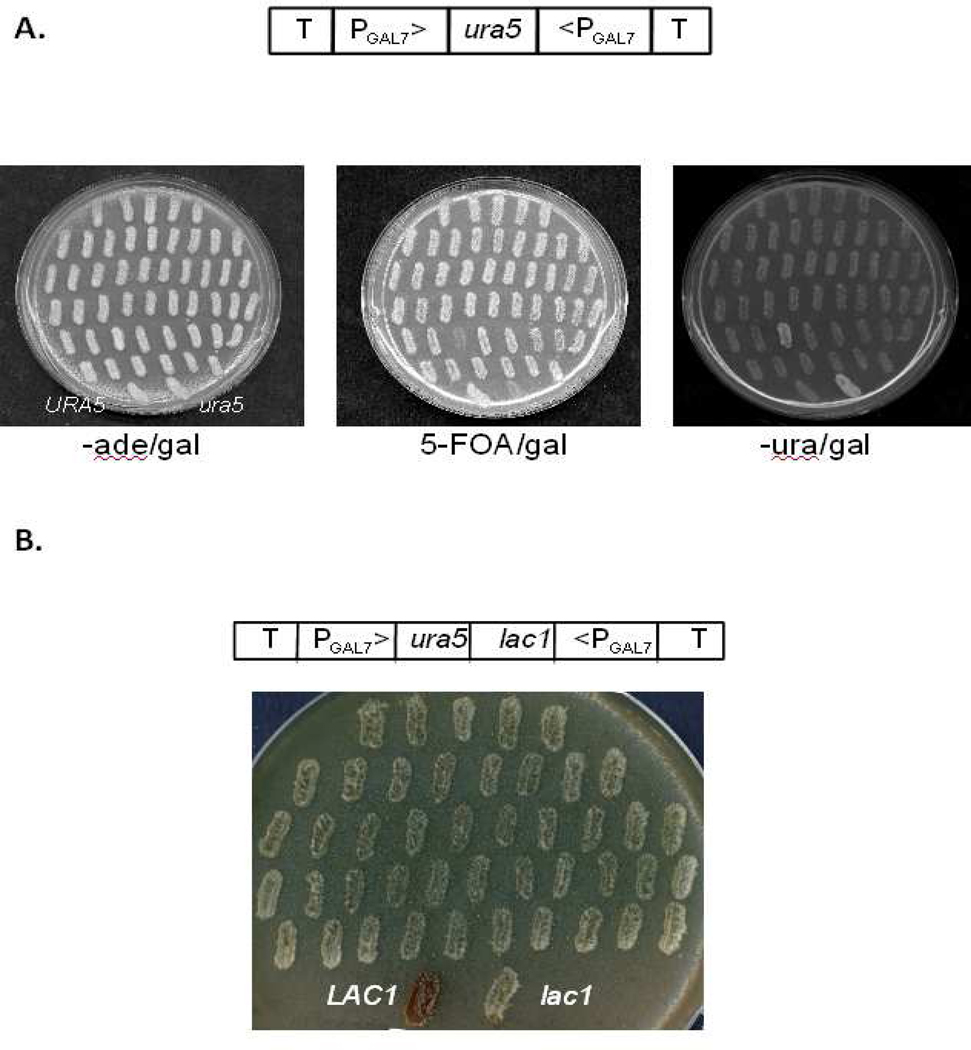
Silencing URA5 allows 5-FOA selection of cells actively performing RNAi. A. Cells transformed with plasmid pIBB32 containing the RNAi cassette cartooned above were recovered and treated as described in the text before plating to medium with galactose but lacking adenine (left) and replica-plating to galactose media with 5-FOA (middle) or without uracil (right). Cells undergoing effective RNAi grow on 5-FOA and not on medium lacking uracil; this plate was chosen to show the single transformant (of over 100) that did not demonstrate this phenotype. The bottom two streaks on each plate are control strains with normal (left) or mutant (right) URA5 genes as indicated in the left panel. B. JEC50 cells were transformed with pIBB69 targeting LAC1 as cartooned above, pretreated with 5-FOA, and selected on –ade/gal medium as for the study in Fig. 2A. Transformants were restreaked on NSA/gal and grown for 2 days at 30°C, demonstrating effective silencing by white color matching that of control lac1 cells (bottom right of the plate). In contrast, the wild-type LAC1 strain is dark brown (bottom left).
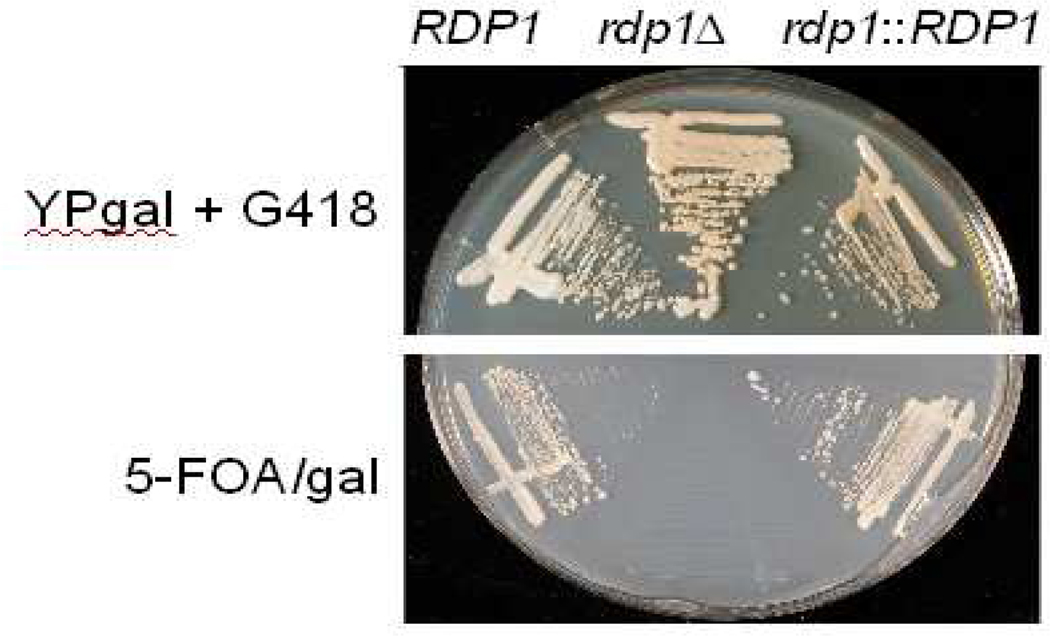
Deletion of RDP1 abolishes RNAi silencing. Wild-type RDP1, rdp1Δ, and rdp1::RDP1 complemented strains were electroporated with pIBB103 and transformants were grown on either complete media containing galactose and G418 (YPgal + G418) or 5-FOA/gal media at 30°C for 2 days.
References
-
- Boeke JD, Trueheart J, Natsoulis G, Fink GR. 5-Fluoroorotic acid as a selective agent in yeast molecular genetics. Methods Enzymol. 1987;154:164–175. - PubMed
-
- Cox GM, Rude TH, Dykstra CC, Perfect JR. The actin gene from Cryptococcus neoformans: structure and phylogenetic analysis. J Med. Vet. Mycol. 1995;33:261–266. - PubMed
Publication types
MeSH terms
Substances
Associated data
- Actions
Grants and funding
LinkOut - more resources
Full Text Sources
Other Literature Sources
