. 2011 Jul;79(7):2755-63.
doi: 10.1128/IAI.01375-10. Epub 2011 May 9.

Immune response of chicken gut to natural colonization by gut microflora and to Salmonella enterica serovar enteritidis infection

Affiliations

Immune response of chicken gut to natural colonization by gut microflora and to Salmonella enterica serovar enteritidis infection

Magdalena Crhanova et al. Infect Immun. 2011 Jul.

Abstract

In commercial poultry production, there is a lack of natural flora providers since chickens are hatched in the clean environment of a hatchery. Events occurring soon after hatching are therefore of particular importance, and that is why we were interested in the development of the gut microbial community, the immune response to natural microbial colonization, and the response to Salmonella enterica serovar Enteritidis infection as a function of chicken age. The complexity of chicken gut microbiota gradually increased from day 1 to day 19 of life and consisted of Proteobacteria and Firmicutes. For the first 3 days of life, chicken cecum was protected by increased expression of chicken β-defensins (i.e., gallinacins 1, 2, 4, and 6), expression of which dropped from day 4 of life. On the other hand, a transient increase in interleukin-8 (IL-8) and IL-17 expression could be observed in chicken cecum on day 4 of life, indicating physiological inflammation and maturation of the gut immune system. In agreement, the response of chickens infected with S. Enteritidis on days 1, 4, and 16 of life shifted from Th1 (characterized mainly by induction of gamma interferon [IFN-γ] and inducible nitric oxide synthase [iNOS]), observed in younger chickens, to Th17, observed in 16-day-old chickens (characterized mainly by IL-17 induction). Active modification of chicken gut microbiota in the future may accelerate or potentiate the maturation of the gut immune system and increase its resistance to infection with different pathogens.


Figures

Fig. 1.
Fig. 1.
Cecal microflora development in chickens. (A) T-RFLP analysis; (B) number of T-RFLP peaks. Solid symbols, total number of unique peaks identified in three different birds at each time point; open symbols, average number of peaks ± standard deviation (SD) per individual bird. (C) Ratio of the total number of peaks to an average number of peaks.
Fig. 2.
Fig. 2.
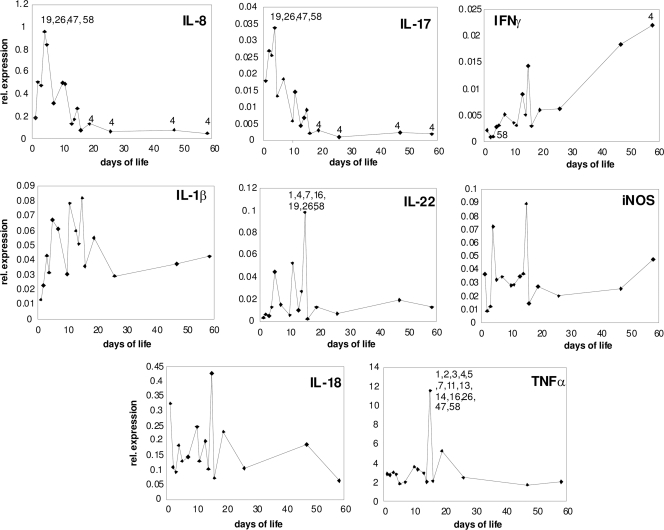
Cytokine gene expression in the cecum of noninfected chickens. For days 1, 19, 26, 47, and 58, each dot is a mean value of relative (rel.) expression from six chicks. For days 2, 3, 5, 10, 11, 13, 14, 15, and 16, each dot is a mean value from three chicks. For days 4 and 7, each dot represents a mean value from nine chicks. Numbers in the individual panels indicate significant differences in cytokine expression between particular days of life by one-way ANOVA at P < 0.05.
Fig. 3.
Fig. 3.
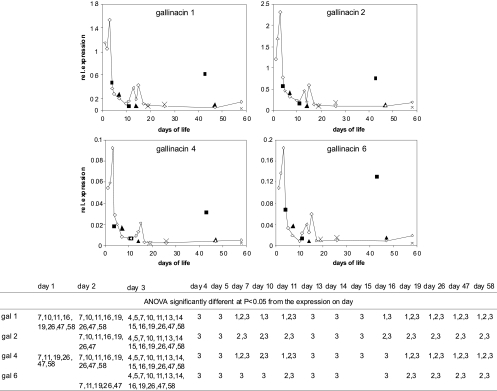
Chicken β-defensin gene expression in noninfected chickens (open diamonds) and chickens infected with S. Enteritidis at 1 day old (solid squares), 4 days old (solid triangles), and 16 days old (crosses) and sacrificed 3, 10, and 42 days postinfection. rel., relative. The table under the figure indicates significantly different levels of expression of individual gallinacins (gal 1, 2, 4, or 6) versus those of noninfected chickens at different days of life.
Fig. 4.
Fig. 4.
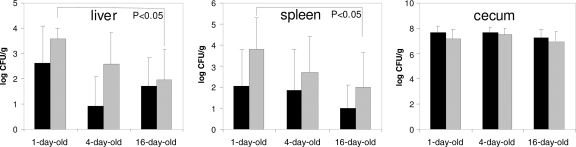
S. Enteritidis counts in liver, spleen, and cecum. Black columns represent average S. Enteritidis counts in organs from chickens 3 days postinfection. Gray columns represent average S. Enteritidis counts in organs from chickens 10 days postinfection. S. Enteritidis counts from spleen, liver, and cecum of infected chickens 42 days postinfection were all negative and therefore are not shown.
Fig. 5.
Fig. 5.
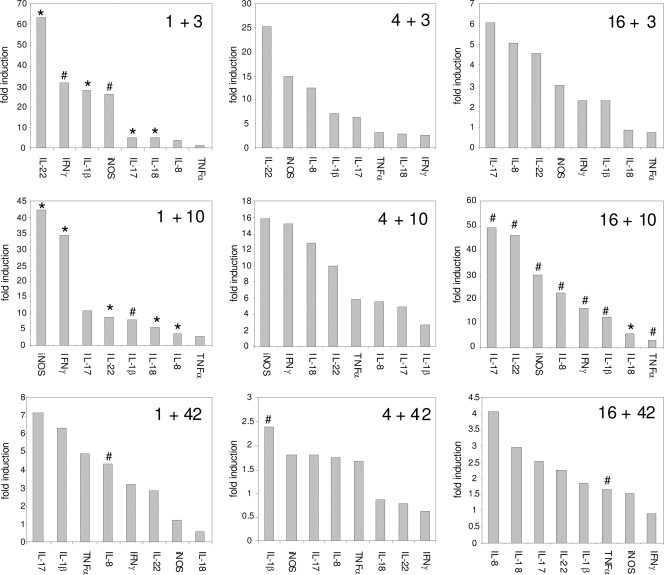
Relative increase in fold inductions of selected cytokines after infection with S. Enteritidis. The following format was used: “1 + 3” represents infection of 1-day-old chickens and determination of cytokine gene expression 3 days postinfection. *, value by t test significantly different from that for noninfected controls at P < 0.01; #, value by t test significantly different at P < 0.05.
Fig. 6.
Fig. 6.
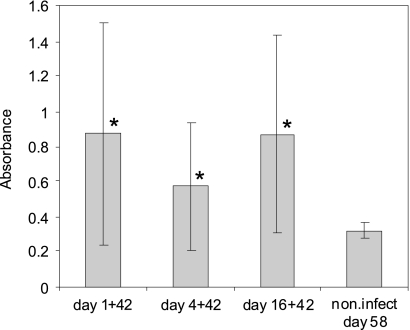
Salmonella LPS ELISA 42 days postinfection of 1-, 4-, and 16-day-old chickens, with 58-day-old noninfected (non.infect) chickens used as a control. The following format was used: “1 + 42“ represents infection of 1-day-old chickens and detection of serum antibodies 42 days later. *, value by t test significantly different from noninfected controls at P < 0.05.

References

    1. Amit-Romach E., Sklan D., Uni Z. 2004. Microflora ecology of the chicken intestine using 16S ribosomal DNA primers. Poult. Sci. 83:1093–1098 - PubMed
    1. Bar-Shira E., Friedman A. 2006. Development and adaptations of innate immunity in the gastrointestinal tract of the newly hatched chick. Dev. Comp. Immunol. 30:930–941 - PubMed
    1. Bar-Shira E., Sklan D., Friedman A. 2003. Establishment of immune competence in the avian GALT during the immediate post-hatch period. Dev. Comp. Immunol. 27:147–157 - PubMed
    1. Berndt A., et al. 2007. Chicken cecum immune response to Salmonella enterica serovars of different levels of invasiveness. Infect. Immun. 75:5993–6007 - PMC - PubMed
    1. Curtis M. M., Way S. S. 2009. Interleukin-17 in host defence against bacterial, mycobacterial and fungal pathogens. Immunology 126:177–185 - PMC - PubMed

Publication types

MeSH terms

LinkOut - more resources